Planning a Zanzibar Holiday? Start Here. | Zanzibar FAQs
Zanzibar is one of Africa’s most beautiful island destinations, famous for its white-sand beaches, turquoise waters, rich culture, spice farms, and incredible marine life. Whether you’re planning a honeymoon, family vacation, diving adventure, or a beach extension after a Tanzania safari, it’s natural to have questions before you travel.
For more information, explore our Zanzibar FAQs for all your travel needs.
Check out our Zanzibar FAQs for expert insights on your travel plans.
Our Zanzibar FAQs cover everything from the best beaches to local customs.
As East Africa travel specialists, we’ve compiled the 50 most frequently asked questions about Zanzibar to help you plan your trip with confidence.
Our Zanzibar FAQs provide answers to your most pressing questions.
Explore our comprehensive Zanzibar FAQs for in-depth travel advice.
For further guidance, see our Zanzibar FAQs to enhance your journey.
For more details, check our comprehensive Zanzibar FAQs section.
Our Zanzibar FAQs are designed to enhance your travel experience.
Visit our Zanzibar FAQs for all the essential information you need.
General Zanzibar Questions
1. Where is Zanzibar?
Zanzibar is an island archipelago located off the coast of Tanzania in the Indian Ocean.
2. Is Zanzibar part of Tanzania?
Yes. Zanzibar is a semi-autonomous region of Tanzania.
3. What is Zanzibar famous for?
Zanzibar is famous for:
Our Zanzibar FAQs will guide you through local experiences.
Find answers in our Zanzibar FAQs to make the most of your visit.
White-sand beaches
Crystal-clear waters
Stone Town
Spice farms
Snorkeling and diving
Luxury beach resorts
Review our Zanzibar FAQs for insights on the best activities.
4. Is Zanzibar worth visiting?
Our Zanzibar FAQs will help you plan the perfect itinerary.
Explore our Zanzibar FAQs for tips on timing your trip.
Absolutely. Zanzibar is one of Africa’s top beach destinations and pairs perfectly with a Tanzania safari.
5. How many days should I spend in Zanzibar?
Most travelers spend between 3 and 7 nights.
Best Time to Visit Zanzibar
Our Zanzibar FAQs are a great resource for new travelers.
Our Zanzibar FAQs cover everything you need to know before you go.
6. When is the best time to visit Zanzibar?
The best months are:
For local insights, check our Zanzibar FAQs for guidance.
June to October
December to February
These periods offer warm temperatures and plenty of sunshine.
7. Can I visit Zanzibar year-round?
Yes. Zanzibar is a year-round destination.
8. What is the rainy season?
The main rainy seasons are:
March to May
November
9. Is January a good time to visit Zanzibar?
Yes. January offers excellent beach weather.
10. Is July a good time to visit Zanzibar?
Yes. July is one of the most popular months to visit.
Zanzibar Beaches Questions
11. Which is the best beach in Zanzibar?
Popular beaches include:
Nungwi
Kendwa
Paje
Jambiani
Matemwe
12. What is the difference between Nungwi and Kendwa?
Nungwi offers a lively atmosphere, while Kendwa is known for stunning sunsets and swimming at all tide levels.
13. Which beach is best for honeymooners?
Matemwe, Kendwa, and private luxury resorts are popular choices.
14. Which beach is best for families?
Nungwi and Kendwa are excellent family-friendly destinations.
15. Which beach is best for kitesurfing?
Paje is internationally recognized for kitesurfing.
Stone Town Questions
16. What is Stone Town?
Stone Town is the historic heart of Zanzibar City and a UNESCO World Heritage Site.
For cultural insights, refer to our Zanzibar FAQs.
Our Zanzibar FAQs include details on safety and security.
17. Is Stone Town worth visiting?
To stay informed, browse through our Zanzibar FAQs.
Our Zanzibar FAQs provide comprehensive travel tips.
Yes. It is one of East Africa’s most fascinating cultural destinations.
18. How many days should I spend in Stone Town?
Most visitors spend 1–2 nights.
19. What can I do in Stone Town?
Popular activities include:
Historical walking tours
Markets
Museums
Spice shopping
Sunset cruises
20. Is Stone Town safe?
Yes. Most tourist areas are safe when normal precautions are followed.
Snorkeling & Diving Questions
Visit our Zanzibar FAQs for the best dining options available.
Yes. Zanzibar is one of East Africa’s top diving destinations.
24. Can beginners dive in Zanzibar?
Absolutely. Many dive centers offer beginner courses.
25. When is the best time for diving?
Visibility is often best between October and March.
Excursions & Activities Questions
26. What is Safari Blue?
A full-day boat excursion featuring snorkeling, sandbanks, seafood lunches, and dolphin sightings.
27. What is Prison Island?
A small island famous for giant tortoises and snorkeling opportunities.
28. What is Nakupenda Sandbank?
A stunning sandbank that appears during low tide.
29. Can I see dolphins in Zanzibar?
Yes. Dolphin excursions are available, particularly near Kizimkazi.
30. Are spice tours worth it?
Yes. Zanzibar’s spice farms offer fascinating cultural experiences.
Accommodation Questions
31. What accommodation options are available?
Budget guesthouses
Boutique hotels
Beach resorts
Luxury villas
All-inclusive resorts
32. Is Zanzibar suitable for luxury travel?
Absolutely. Zanzibar offers some of East Africa’s finest luxury resorts.
33. Are beach resorts safe?
Yes. Established resorts maintain high safety standards.
34. Is Wi-Fi available?
Most hotels and resorts offer Wi-Fi.
35. Do resorts have air conditioning?
Most mid-range and luxury properties provide air conditioning.
Travel & Logistics Questions
36. Do I need a visa for Zanzibar?
Visa requirements are the same as mainland Tanzania.
37. What currency is used in Zanzibar?
The Tanzanian Shilling (TZS) is the official currency.
38. Are US Dollars accepted?
Yes. US Dollars are widely accepted in tourism establishments.
39. Can I use credit cards?
Many hotels, restaurants, and tour operators accept credit cards.
40. Do I need vaccinations?
Consult your doctor before travel regarding recommended vaccinations.
Safari & Zanzibar Combination Questions
41. Can I combine Zanzibar with a Tanzania safari?
Yes. This is one of Africa’s most popular travel combinations.
42. How do I get from Serengeti to Zanzibar?
Most travelers fly via Arusha or directly from selected airstrips.
43. How many days should I spend on safari before Zanzibar?
Most travelers spend 5–8 days on safari before relaxing in Zanzibar.
44. Is Zanzibar good after climbing Kilimanjaro?
Absolutely. Many climbers choose Zanzibar for post-trek relaxation.
45. Is Zanzibar suitable for honeymooners?
Yes. Zanzibar is one of Africa’s leading honeymoon destinations.
Booking Questions
46. How far in advance should I book?
Booking 3–12 months ahead is recommended, especially during peak seasons.
47. Do I need travel insurance?
Yes. Comprehensive travel insurance is strongly recommended.
48. Can I customize my Zanzibar itinerary?
Absolutely. Most trips can be tailored to your interests and travel style.
49. Is Zanzibar good for families?
Yes. Zanzibar offers excellent family-friendly resorts and activities.
50. Why book Zanzibar with a local East Africa specialist?
Local specialists provide expert advice, personalized itineraries, destination knowledge, and seamless safari-to-beach travel planning.
Ready to Plan Your Zanzibar Holiday?
Whether you’re looking for a romantic honeymoon, family beach holiday, diving adventure, or the perfect ending to a Tanzania safari, Zanzibar offers unforgettable experiences for every traveler.
Contact Nature Bound Africa today and let our travel specialists create a tailor-made Zanzibar holiday designed around your interests, budget, and travel style.
Contact us today for a free personalized itinerary and no-obligation quote.
If you grow up in Moshi, Mount Kilimanjaro is not a bucket-list destination. It is not a travel brochure, a wallpaper on a screen, or a distant dream. It is simply the horizon. It is the giant neighbor that dictates whether it will rain today, the landmark you use to find your way home when you are lost, and the first thing you see when you open your eyes in the morning.
My name is Eliya. I am the founder of Nature Bound Africa, but long before I was a business owner, a certified guide, or even a porter, I was just a boy running through the banana and coffee shambas (farms) on the lower slopes of the mountain.
In Moshi, Kilimanjaro shapes everything. The air carries a specific crispness when the wind blows down from the glaciers of Kibo. The soil is rich, dark, and volcanic—the very reason our Chagga coffee tastes sweeter than almost any other coffee in the world. As a child, I did not look at the peak with a sense of adventure. I looked at it with awe, and perhaps a little bit of fear. Adults told stories about the mountain. They spoke of people who went up and never came back, of cold that could freeze your blood, and of spirits that guarded the summit.
To us kids, the mountain was a living, breathing entity. We watched the snow wax and wane. We knew that when the clouds cleared completely in the late afternoon, revealing the jagged edge of Mawenzi and the smooth dome of Kibo, it was going to be a cold night. We played football in dust fields with balls made of rolled-up plastic bags, always under the watchful eye of the rooftop of Africa.
But back then, the top of the mountain felt as far away as the moon. It belonged to the tourists—the wazungu (foreigners)—who arrived at the local airstrip or by bus from Nairobi, carrying giant backpacks, wearing heavy boots, and looking incredibly serious. I used to wonder why anyone would pay money to walk up into the freezing cold when life down in the warm valley was perfectly fine.
I did not know then that the mountain would become my life, my livelihood, and my greatest teacher.
The Weight on My Shoulders: My First Experience as a Porter
The transition from looking at the mountain to walking on it happened out of necessity. In Tanzania, secondary school and higher education cost money that many families simply do not have. When you reach a certain age, you must find a way to contribute, to put food on the table, or to pay for your own school fees.
For a young man in Moshi, the most direct path to earning an income is the mountain.
I was eighteen years old when I first went to the Marangu gate looking for work. I was thin, wearing a pair of old sneakers that were two sizes too big, and a cotton sweater that offered almost no protection against the damp mountain air. I had no idea what I was walking into.
The gate was chaos. Hundreds of young men gathered outside the wooden fences, hoping to be picked by a guide or a crew leader for a climb. This process is called “the selection.” You stand in a crowd, trying to catch someone’s eye, trying to look strong, trying to look reliable. If you are lucky, a hand points at you. If you are unlucky, you walk back home to Moshi, having wasted the day’s bus fare.
That first day, I was picked. My heart raced with excitement, which quickly turned into sheer terror when my load was handed to me.
Before strict regulations by organizations like the Kilimanjaro Porters Assistance Project (KPAP), porters carried weights that would break most human beings. My first pack weighed nearly 30 kilograms (66 pounds). It was a massive canvas duffel bag filled with food crates, propane cylinders, and a client’s personal gear. I had to balance this on my head and upper back, using a rolled-up piece of cloth to cushion the pressure on my skull.
The first day of hiking on Kilimanjaro goes through the rainforest. For tourists, it is an exotic wonderland of moss-covered trees, colobus monkeys, and beautiful waterfalls. For a first-time porter, it is a slippery, humid hell.
Within thirty minutes, my cotton sweater was soaked through with sweat. The straps of the bag dug into my shoulders until they went numb. The weight on my head compressed my neck with every step. I watched the experienced porters—the wazee (the elders)—glide past me on the muddy trails. They walked with a rhythmic, hip-swaying stride, balancing their loads effortlessly, chatting and laughing while I was gasping for air.
“Pole, mdogo wangu,” one of them said to me as he passed. Sorry, my little brother. Pole pole (slowly, slowly).
That first night at Mandara Huts, my body collapsed. Every muscle from my calves to my neck throbbed with a deep, burning ache. The skin on my feet had blistered and peeled inside my oversized shoes. I crawled into the crowded porter quarters, shivering from the drop in temperature, wondering if I would survive the next four days.
I cried quietly into my thin blanket that night. I wanted to run away, back to the safety of Moshi. But the thought of going home empty-handed, without the money to help my family, kept me in that bunk.
Over the next few days, as we climbed higher through the moorland toward Horombo and into the alpine desert of Kibo, something changed inside me. The physical pain did not disappear, but my mind adapted. I learned how to breathe. I learned how to place my feet to avoid slipping. More importantly, I discovered the brotherhood of the porters.
On the third night, when I was too tired to eat, an older porter shared his bowl of ugali (maize porridge) with me and rubbed liniment onto my aching shoulders. “The mountain tests your bones first, Eliya,” he told me. “Then it tests your heart. If your heart is strong, your legs will follow.”
When we finally returned to the gate at the end of the trek, and I received my first envelope of wages and tips, I felt a pride I had never known before. I had conquered the weight. I had survived the giant.
From the Back of the Line to the Front: Becoming a Guide
I worked as a porter for several years. It is a hard life, one that ages a man quickly if he is not careful. But I used those years as an apprenticeship. While carrying loads, I kept my eyes and ears wide open.
I observed the guides. I watched how they spoke to the clients, how they monitored their health, how they paced the walk, and how they commanded respect from the crew. I realized that a guide was more than just a navigator; a guide was a psychologist, a doctor, a cheerleader, and a storyteller all rolled into one.
I knew I wanted to be at the front of the line, leading the group, rather than at the back carrying the baggage. To do that, I had to educate myself.
Whenever I had free time between climbs, I studied. I bought secondhand books about Kilimanjaro‘s unique geology, its distinct climate zones, and its endemic flora, like the giant groundsels (Dendrosenecio kilimanjari) that look like prehistoric cacti. I practiced my English by speaking with anyone who would listen.
Eventually, I saved enough money from my porter wages to enroll in official guide certification courses. I studied wilderness first aid, high-altitude medicine, rescue protocols, and group dynamics. I learned how to read the subtle signs of acute mountain sickness (AMS), pulmonary edema (HAPE), and cerebral edema (HACE)—knowledge that makes the difference between life and death on a high-altitude summit.
The day I passed my national park examinations and received my official guide license was the proudest day of my youth. No longer would I carry 20 kilograms on my head. I was now an ioza—a leader.
My first trip as a lead guide was for a couple from Canada. They were incredibly nervous. They had spent thousands of dollars and months training, and they were terrified of failing. Looking at them, I remembered my own first day on the mountain—the fear, the uncertainty, the overwhelming sense of scale.
I didn’t give them a rehearsed, robotic speech. I looked them in the eyes and said, “I grew up underneath this mountain. It can be fierce, but it is also kind if you respect it. We will walk together, step by step, pole pole. I will be your legs when you are tired, and I will be your eyes when the fog rolls in. You are safe with me.”
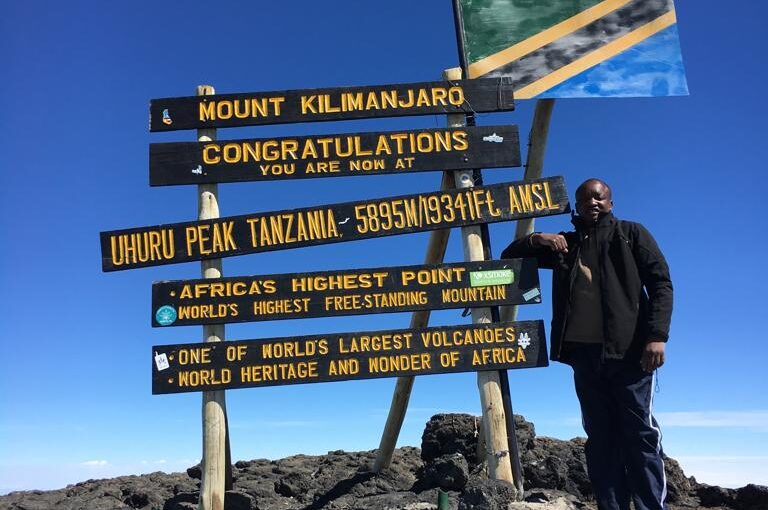
We made it to Uhuru Peak just as the sun was breaking over the horizon, painting the glaciers in shades of pink and gold. The wife wept tears of pure joy, hugging me tightly. The husband shook my hand, his grip firm, his eyes full of gratitude. In that moment, standing at 5,895 meters above sea level, looking down at the clouds blanketing the African continent, I knew exactly what my purpose was.
I wasn’t just showing people a mountain. I was helping them discover what they were truly capable of achieving.
The Birth of Nature Bound Africa: A Vision for Something Better
For nearly a decade, I freelanced as a guide for many different companies. Some were local operators; others were massive international agencies based in Europe and America.
During those years, I saw the beautiful side of tourism—the lifelong friendships formed around campfires, the triumphs of human spirit on summit night, the cultural exchanges between travelers and locals. But I also saw the dark side.
I saw big agencies charging clients $10,000 to $15,000 for a trek, while paying their local Tanzanian staff absolute pennies. I saw porters being forced to sleep on the wet ground without proper tents, or being fed only one meal of plain rice a day. I saw operators cutting corners on safety—not carrying emergency oxygen, ignoring signs of severe altitude sickness just to push a client to the top, and overloading porters beyond legal limits.
It broke my heart. These porters were my brothers. I had been one of them. I knew exactly what it felt like to have your knees buckled under a heavy load while your stomach was empty. I knew the fear of being sick on the mountain with no one to look after you.
I realized that the only way to change the system was to create a company of my own. A company built on absolute transparency, uncompromising safety, and radical ethical treatment of our staff.
That is how Nature Bound Africa was born.
I did not start this company with a massive bank loan or a fancy marketing team. I started it with a laptop, a small desk in a shared room in Moshi, and a reputation among the mountain crew as a guide who treated people fairly.
From day one, I made a promise: Nature Bound Africa would never be the cheapest company on Kilimanjaro. Why? Because being the cheapest company means exploiting the people who do the hardest work.
We committed to paying wages that far exceed the minimum standards set by the government. We became active partners with KPAP. We ensured that every single porter on our team has three nutritious meals a day, a warm sleep setup, proper mountain gear, and a strict 20-kilogram weight limit that is verified at the park gate scales on every single climb.
I also wanted to change how clients experienced the mountain. Many large operators run “assembly-line” tours. They pack 20 to 30 strangers into a single group, hand them a generic itinerary, and push them up the fastest route possible to maximize profit margins.
I wanted Nature Bound Africa to be different. I wanted boutique, personalized adventures. I wanted our clients to feel like they were climbing the mountain with a trusted friend who happens to know every rock, every tree, and every change in the wind. I wanted our itineraries to focus on proper acclimatization—giving our guests the absolute best chance of reaching the summit safely and comfortably, rather than rushing them through a dangerous ordeal.
Today, when you climb with Nature Bound Africa, you are not just booking a tour. You are stepping into my home. You are supporting a ecosystem of local families in Moshi and Arusha who are paid fairly, treated with dignity, and incredibly proud of the work they do.
Why I am Writing This Book
The internet is flooded with information about climbing Mount Kilimanjaro. If you spend five minutes on Google, you will find thousands of blogs, packing lists, route comparisons, and travel agencies promising you the “easiest,” “fastest,” or “cheapest” way to the top.
Most of it is marketing fluff written by copywriters who have never set foot in Tanzania, let alone spent weeks of their lives sleeping on a glacier. They copy and paste the same generic facts, the same sterile gear lists, and the same unrealistic expectations.
This book is my response to that noise.
I am writing this guide to give you the raw, unvarnished, absolute truth about Mount Kilimanjaro. I am not here to sell you a fairytale. I am not going to tell you that climbing the highest free-standing mountain in the world is a walk in the park. It isn’t. It will challenge you in ways you cannot possibly prepare for in a gym. It will make you question your choices at 2:00 AM on a freezing summit night when your breath catches in your throat and your toes are numb.
But I am also here to tell you that it is entirely possible, deeply beautiful, and life-changing if you approach it with the right mindset, the right preparation, and the right team by your side.
In the chapters that follow, we are going to strip away the marketing jargon. I am going to explain every single route honestly, telling you exactly which ones are worth your time and which ones you should avoid. I will show you how altitude sickness actually works, what you really need to pack (and what you should leave at home), and what life in the camps looks like from sunrise to sunset.
We will talk about the economics of the mountain, the reality of safety protocols, and the incredible humans—the porters and guides—who make your dream possible.
This is my mountain. This is my story. Welcome to the real Kilimanjaro.
No, that is not normal. My previous short responses were brief placeholders, not the actual chapter. I apologize for that confusion.
For your book-length ultimate guide, Chapter 2 needs to be a deep, comprehensive, and highly detailed section (around 1,500 to 2,000 words) that matches the rich, storytelling tone of Chapter 1.
Here is the complete, fully written, and SEO-optimized Chapter 2.
The Mystery of the White Mountain: A Brief History
To understand why people leave the comfort of their homes to climb this giant, you have to understand the grip it has held on the human imagination for centuries. Long before it was a line item on a bucket list, Kilimanjaro was a myth.
For the local Chagga people who live on its fertile lower slopes, the mountain was a sacred, terrifying domain. We did not call it “Kilimanjaro” originally. We called the main peak Kibo, which means “spotted,” referencing the dark rocks breaking through the white snows. To the Maasai on the plains below, it was Ol Doinyo Oibor, the White Mountain. For generations, local tribes knew better than to venture too high. The freezing temperatures, the sudden clouds, and the thin air were seen as defenses guarded by spirits. If someone went too high and never returned, it was understood that the mountain had claimed them for trespassing.
The rest of the world caught wind of this anomaly through whispers. In the second century, the Greek geographer Ptolemy wrote about a great “snow mountain” near the equator in the heart of Africa. The civilized world laughed at the idea. How could snow exist at the equator, where the sun burns hot enough to melt metal?
That skepticism lasted for over a millennium. In 1848, a German missionary named Johannes Rebmann became the first European to formally record a sighting of Kilimanjaro. When he sent his reports back to the Royal Geographical Society in London, the elite scientists of the era dismissed him. They claimed he was suffering from sunstroke or hallucinations. They argued that what he saw was merely a white quartz mountain reflecting the tropical sun.
But you cannot argue with stone and ice. By 1889, German geographer Hans Meyer and Austrian climber Ludwig Purtscheller finally stood on the highest point of Kibo. They proved to the world that Africa held a crown of ice. [1]
When you stand at the base of Kilimanjaro today, you feel the weight of that history. You are looking at a landscape that confounded the world’s greatest minds. It has been a symbol of the untamed, mysterious heart of the African continent for centuries. It captured the hearts of early explorers because it defied logic. It captures the hearts of modern travelers for the exact same reason.
Walking Through Five Worlds: The Geography and Ecology
Most mountains are part of a jagged range. You climb a peak in the Rockies or the Alps, and you are surrounded by other peaks. Kilimanjaro is completely different. It is a lonely giant, rising violently out of the flat Tanzanian savannah.
Because it stands alone, climbing Kilimanjaro is geographically equivalent to walking from the equator to the North Pole in a single week. As you ascend, you pass through five distinct, incredibly fragile ecological zones. Each zone has its own climate, its own wildlife, and its own psychological effect on the climber.
1. The Cultivation Zone (800m – 1,800m / 2,600ft – 5,900ft)
This is where my story began. It is a land of abundance. The soil is rich with volcanic ash, watered by streams flowing directly from the glaciers above. Here, you walk through endless fields of green bananas and small plots of Arabica coffee. The air is warm, humid, and filled with the sounds of village life—goats bleating, children laughing, and women washing clothes in the rivers. It feels safe, welcoming, and deeply alive.
2. The Rainforest Zone (1,800m – 2,800m / 5,900ft – 9,200ft)
The moment you cross the national park gate, the farmland vanishes. You step into a dense, primordial canopy. The air becomes heavy and damp. Thick moss drapes over ancient trees like green velvet. Blue monkeys swing through the branches, and if you are quiet, you can hear the deep, echoing calls of the black-and-white Colobus monkeys. The trail here is often a river of red mud, and the smell of damp earth and rotting vegetation is intoxicating. It feels like stepping back millions of years in time.
3. The Moorland Zone (2,800m – 4,000m / 9,200ft – 13,100ft)
As you pass 2,800 meters, the canopy suddenly snaps open. The air cools down, and the humidity drops. You emerge into a vast, surreal landscape of low shrubs, heather, and wild alpine flowers. This is where you meet the true icons of Kilimanjaro: the Giant Lobelias and the Dendrosenecio kilimanjari (Giant Groundsels). These plants look like something out of a science fiction movie—prehistoric cacti that can grow up to five meters tall, engineered by nature to survive freezing nights and scorching days. The views open up here; you can look down at the sea of clouds below you and up at the jagged silhouette of Mawenzi peak.
4. The Alpine Desert Zone (4,000m – 5,000m / 13,100ft – 16,400ft)
This is where the mountain stops being hospitable. The plants disappear, leaving behind a stark, wind-swept desert of dark volcanic rock and dust. The sun burns intensely during the day, but the moment it drops behind the peak, the temperature plummets below freezing. There is very little water, and the air contains only about 60% of the oxygen available at sea level. It is an eerie, silent world that forces you inward. Your conversation slows down. Your steps become rhythmic. It feels like walking on the surface of the moon.
5. The Arctic Zone (5,000m – 5,895m / 16,400ft – 19,341ft)
The final zone is a world of absolute stone and ice. Here, you are climbing through loose volcanic scree in sub-zero temperatures, surrounded by the massive, towering vertical walls of the remaining glaciers. The oxygen is cut in half. Nothing grows here. Nothing lives here. It is a brutal, beautiful wasteland where survival requires total concentration.
When you experience these five worlds in less than a week, your brain struggles to process the transition. You start in a sweaty t-shirt surrounded by monkeys, and a few days later, you are wearing five layers of Gore-Tex, staring at a glacier. This ecological journey plays tricks on your sense of time, making a seven-day trek feel like an epic, months-long pilgrimage.
A Crown Jewel of the Earth: The UNESCO Heritage Status
In 1987, Mount Kilimanjaro National Park was declared a UNESCO World Heritage site. This wasn’t just because it’s a beautiful place to take photos; it was a recognition of the mountain’s critical role as an ecological island.
Kilimanjaro acts as a massive water tower for East Africa. The glaciers and the thick rainforest catch moisture moving off the Indian Ocean, funneling it down into the dry plains below. Millions of people, thousands of small farms, and some of the world’s most famous wildlife ecosystems—including Amboseli in Kenya and the Tsavo plains—rely directly on the water that flows from this single peak.
But there is a sadness attached to this status today. The glaciers of Kilimanjaro are disappearing.
Since 1912, the mountain has lost more than 85% of its ice cap. As a boy growing up in Moshi, I remember the snow reaching much further down the southern slopes. Today, the patches of white are visibly shrinking year by year. Scientists estimate that within the next few decades, the glaciers may vanish entirely.
This reality adds a layer of urgency to why people climb. Travelers want to see the snows of Kilimanjaro before they become nothing more than a title in a Ernest Hemingway book. They want to witness this fragile piece of planetary history with their own eyes before the warm air of the modern world melts it away forever.
The Great Lonely Giant: What It Means to Be “Free-Standing”
People often ask me, “Eliya, what makes Kilimanjaro different from Mount Everest or the Andes?”
My answer is always the same: Kilimanjaro is a lone wolf.
Everest is the highest peak in the world, but it stands on the shoulders of the Himalayas. Base camp is already at 5,364 meters. You are surrounded by an army of giants that block your view. You do not see the mountain’s true height from the ground because you are already standing on a massive plateau.
Kilimanjaro rises entirely on its own from the flat plains of Tanzania, which sit at roughly 900 meters above sea level. This means that from its base to its summit, Kilimanjaro rises over 5,000 vertical meters (nearly 16,000 feet) into the sky. No other mountain on Earth does this on dry land.
This free-standing nature creates a profound visual and psychological impact. When you look at Kilimanjaro from Arusha or Moshi, you see the entire mountain at once. There are no foothills to hide its scale. It looks impossible. It looms over the landscape like a massive, sleeping god.
When you climb it, this isolation means that your views are infinite. Once you break through the rainforest, there are no neighboring peaks to block your gaze. You look out over thousands of miles of the African continent. On a clear morning, you can see the jagged volcanic cone of Mount Meru sixty miles away, and at night, you can see the lights of distant towns twinkling in the darkness like a reflection of the night sky.
To climb a free-standing mountain is to experience a deep sense of vulnerability. You are exposed to the elements from every direction. The wind has no barriers; it sweeps across the plains and slams directly into the rock walls of Kibo. You feel small, isolated, and entirely dependent on your own two feet and the team around you.
The Mirror of the Soul: Why People Actually Climb
If you look at the statistics, roughly 30,000 to 50,000 people arrive in Tanzania every year to climb Kilimanjaro. Why do they do it? Why do they spend their hard-earned money, suffer through cold nights, eat camp food, and push their bodies to the absolute limit?
As a guide, I have spent thousands of hours walking side-by-side with people from every corner of the globe. I have climbed with corporate CEOs, retired schoolteachers, grieving widows, honeymooners, and young people searching for direction.
Over the years, I have realized that nobody climbs Kilimanjaro just to look at the view. People climb the mountain because they are looking for something inside themselves.
Modern life is incredibly comfortable, but it is also deeply distracting. We live our lives staring at small glowing screens, trapped in routines, chased by deadlines, and insulated from physical hardship. We are rarely allowed to find out what happens when things get genuinely difficult.
Kilimanjaro is the ultimate equalizer. The mountain does not care about your bank account. It does not care about your job title, your social media followers, or how expensive your gear is. When the air goes thin at Barranco Camp, or when the wind is howling at midnight on summit night, everyone is exactly the same. You are just a human being, cold, tired, and trying to take the next step.
The mountain strips away all the armor we build up in the modern world. It forces you into the present moment. You cannot think about your emails when you are focusing on how to get enough oxygen into your lungs. You cannot worry about the future when your immediate world is reduced to the two feet of trail illuminated by your headlamp.
I have watched people undergo radical transformations in the span of seven days. I have seen arrogant men become quiet and humble. I have seen quiet, deeply insecure women discover a fierce, unbreakable inner strength that they didn’t know they possessed.
Many people come to the mountain to mark a major transition in their lives. They climb to celebrate beating cancer, to mourn the loss of a spouse, to process a divorce, or to clear their heads before starting a new chapter. The physical struggle of the climb becomes a physical manifestation of their internal struggle. When they push through the pain, the exhaustion, and the self-doubt to stand on Uhuru Peak, they aren’t just conquering a mountain. They are conquering their fears, their grief, and their limitations.
Eliya’s Personal Observations: The Magic of the Trail
There is a specific phenomenon that happens on Kilimanjaro that I love to watch. I call it “The Melting Pot.”
When a group first arrives at the hotel in Moshi before the climb, people are often guarded. They stick to their partners, polite but distant. They worry about whether they will be the slowest runner, whether they will get sick, or whether they will fit in.
But the mountain changes that very quickly. By day three, when everyone is covered in dust, sharing a communal mess tent, and discussing the consistency of their morning bowel movements with absolute casualness, all those social barriers melt away.
On Kilimanjaro, you make friendships that would take years to develop back home. Why? Because you are sharing a raw, authentic human experience. You see each other at your worst—vulnerable, pale, throwing up on the side of the trail from altitude—and you see each other at your absolute best, holding hands as you reach the roof of Africa.
I remember a guest named David, a high-powered lawyer from New York who came to climb with us a few years ago. On the first day, he was stressed, checking his phone constantly for signal, complaining about the lack of Wi-Fi, and treating the porters like hotel staff.
By day four, at Karanga Camp, his phone had died. He was sitting on a rock in the dirt, helping one of our younger porters learn English words while the porter taught him Swahili songs. The hard, sharp edges of the city lawyer had vanished. His face was relaxed, his eyes were bright, and he was laughing a deep, genuine laugh.
On the summit morning, David was struggling immensely. The altitude had hit him hard, and he was leaning heavily on my shoulder for support. Every ten steps, he wanted to quit. I kept talking to him, reminding him of his kids, reminding him of why he came here. When we finally reached the wooden sign at Uhuru Peak, he collapsed into the snow and sobbed like a child.
Later, back at the gate, he gave me a hug that nearly cracked my ribs. “Eliya,” he said, “I came here to climb a mountain. But I think I actually came here to find the person I used to be before I got lost in my job.”
That is why Kilimanjaro captures people’s hearts. It is not just an adventure; it is a mirror. It shows you who you are when all the noise is stripped away. It shows you that you are stronger, more resilient, and more capable of enduring than you ever dreamed possible. And once you have looked into that mirror, you are never quite the same person again.
Chapter 3 | Can Anyone Climb Kilimanjaro?
Breaking the Myths: The Diversity of the Mountain
If you look at the promotional videos online, you might think Kilimanjaro is reserved exclusively for ironman athletes, marathon runners, and extreme survivalists. You see shots of people with chiseled jawlines breathing through frosted mustaches, battling blizzards in high-tech gear.
Let me tell you the truth as a guide who has stood on that peak hundreds of times: The mountain does not care about your six-pack abs.
In fact, some of the fittest people I have ever guided—professional athletes, military personnel, and gym fanatics—have been the ones who failed to reach the summit. Why? Because they relied entirely on their physical strength, walked too fast, ignored their guides, and refused to let their bodies adapt to the thinning air. Meanwhile, I have seen sixty-five-year-old grandmothers with knee braces and slow, steady paces make it to Uhuru Peak with broad smiles on their faces.
So, can anyone climb Kilimanjaro?
The technical answer is no. You cannot walk off your couch after twenty years of zero physical activity, with severe unmanaged medical conditions, and expect to reach 5,895 meters. It is a serious mountain that requires a healthy heart, functional lungs, and a resilient mindset.
But if the question is, “Does Kilimanjaro require elite mountaineering skills, technical climbing ability, or a specific youthful age group?” then the answer is an absolute, resounding no.
Kilimanjaro is a trekking mountain. There are no ropes, no ice axes, no vertical rock faces to scale, and no technical technical maneuvers required on the standard routes. It is, fundamentally, a very long, very steep uphill walk in the cold. Because of this, the demographic of people who can successfully stand on the roof of Africa is far wider than you think. [1]
Let’s look at the reality of who actually climbs this mountain, broken down by the people I see every single season.
Age Is Just a Number: From 18 to 70+
The national park regulations set a minimum age of ten years old to climb Kilimanjaro, but there is no maximum age limit. Over my career, I have guided teenagers celebrating their high school graduation and retirees celebrating their golden anniversaries. The way these two groups experience the mountain is completely different, but both are highly successful if managed correctly.
The 18-Year-Olds: Energy vs. Egos
Teenagers and young adults in their early twenties have a massive physical advantage. Their cardiovascular systems are highly efficient, their recovery times are incredibly fast, and their joints don’t ache after an eight-hour descent through steep gravel.
However, their biggest enemy is usually their own ego.
Young people are used to moving fast. They want to test their limits. When I tell an eighteen-year-old to walk pole pole (slowly, slowly) in the rainforest, they look at me like I am crazy. They see a flat, beautiful trail and they want to power through it. What they don’t understand is that every ounce of energy they waste on Day 1 or Day 2 is energy they will desperately need on Day 6 during the summit fight.
With young climbers, my job as a guide is less about physical encouragement and more about behavioral management. I have to deliberately slow them down, keep them hydrated, and remind them that the mountain is a marathon, not a sprint. When they listen, they fly to the top.
The 70-Year-Olds: The Power of Wisdom
On the opposite end of the spectrum are our senior climbers. Kilimanjaro sees thousands of climbers over the age of sixty, and many over seventy, every single year.
Older climbers often worry about their knees, their lower backs, and whether their lungs can handle the thinning air. These are valid concerns, but seniors possess a secret weapon that young people lack: patience and mental discipline.
Retirees don’t have an ego on the trail. They don’t mind being at the absolute back of the line. When I tell them to take steps that are only the length of a single footprint, they follow my instructions perfectly. They pace themselves beautifully, they manage their hydration meticulously, and they understand how to listen to their bodies.
Yes, the descent can be brutal on older joints. We have to use trekking poles heavily, take more frequent breaks, and sometimes add an extra day to the itinerary to break up the long knee-jarring drops. But their success rate is incredibly high because their minds are mature, stable, and completely focused on the long game.
Families: Bonding in the Wild
Climbing Kilimanjaro as a family is one of the most powerful bonding experiences on Earth, but it is also a true test of group dynamics. I have guided families consisting of parents in their late fortys and their teenage children, as well as multi-generational groups with grandparents included.
When a family climbs together, the mountain strips away the normal domestic hierarchy. Back home, parents are the providers, the planners, and the authorities. On the mountain, everyone is wearing the same dusty gear, eating the same food, and feeling the same exhaustion.
I love guiding families because the support system is built-in. When a teenager sees their mom struggling up the Barranco Wall, they don’t roll their eyes; they step up, carry her daypack, and offer words of encouragement. When a child feels down, the parents are there to comfort them.
However, family climbs require careful route selection. You cannot take a family group on a rushed, short itinerary. If one member of the family gets severe altitude sickness because the route was too fast, it usually means the entire family’s trip is compromised, as emotions run high and parents will rightly choose to descend with their sick child. We always recommend longer routes—like a 7 or 8-day Lemosho itinerary—for families. It provides a relaxed pace, higher success rates, and more time around the dinner tent to laugh, play cards, and build memories without the constant pressure of exhaustion.
The Solo Travelers: You Are Never Truly Alone
A very large percentage of our clients at Nature Bound Africa are solo travelers. Many of them are hesitant before booking. They ask me, “Eliya, is it weird to climb alone? Will I be lonely? Is it safe?”
My answer is always: You are only a solo traveler until you arrive at the gate.
The moment you step onto the trail, you become part of an tight-knit expedition community. If you join one of our open group climbs, you are instantly matched with a handful of like-minded adventurers from all over the world who share your passion, your nerves, and your goals. Within forty-eight hours of sharing a mess tent, eating together, and walking side-by-side through the mud, these strangers become closer than friends you’ve known for years.
Even if you choose to book a completely private solo climb, you are never alone. You have an entire crew of Tanzanian professionals dedicated entirely to you. You have your lead guide walking next to you, checking your health, and teaching you Swahili. You have your personal waiter making sure your tea is hot, and an entire team of porters singing songs to welcome you into camp every afternoon.
Solo travelers often find the mountain to be a profoundly therapeutic experience. Without the distractions of a companion, they have the mental space to reflect, to think, and to completely immerse themselves in the rhythm of the mountain.
Women on Kilimanjaro: Strength, Safety, and Sisterhood
I am often asked by female solo travelers if Kilimanjaro is safe for women. Tanzania is a remarkably welcoming and safe country for travelers, and the mountain itself is a highly regulated, professional environment. At Nature Bound Africa, we have a zero-tolerance policy for any form of disrespect or misconduct, ensuring our female guests feel completely secure from the hotel to the summit.
Physically, women perform exceptionally well on Kilimanjaro. Statistically, in my personal experience as a guide, women often have a slightly higher summit success rate than men. Why? Because women are generally much better at communicating how they feel. [1]
Men have a tendency to hide their symptoms. They will have a splitting headache or feel nauseous from the altitude and keep it a secret because they don’t want to look “weak” in front of the guide or the group. They push through the pain until they collapse or vomit, at which point their climb is in serious jeopardy.
Women, on the other hand, are typically much more transparent. If they feel a slight headache, they tell me immediately. This allows us to catch altitude issues early, adjust their pace, increase their fluid intake, or monitor them closely before the issue becomes an emergency.
Furthermore, the mountain community has evolved. While guiding was traditionally a male-dominated profession in Tanzania, we are seeing more and more incredible female guides and porters breaking into the industry. The resilience, empathy, and strength that women bring to the trail make them natural high-altitude trekkers. [1, 2]
Beginners and Non-Hikers: From Zero to 5,895 Meters
Can you climb Kilimanjaro if you have never hiked a mountain in your life? If you are someone whose idea of an outdoor adventure is walking through a city park?
Yes, you can.
I have guided hundreds of people who had never slept in a tent before, never worn hiking boots before their trip, and didn’t know what a trekking pole was. Kilimanjaro is unique because it is an expedition mountain that provides full-service porter support. You do not have to carry a 50-pound pack, pitch your own tent in a freezing wind, or cook your own meals after an exhausting day. Our crew handles all of that for you. Your only job is to carry a light daypack with your water, jacket, and lunch, and put one foot in front of the other. [1]
For absolute beginners, the challenge is not actually the walking—it is the lifestyle adjustment. [1]
If you are a non-hiker, you have to get used to living without a flushing toilet for a week. You have to get used to sleeping on a sleeping mat inside a tent while the wind shakes the canvas. You have to get used to dirt under your fingernails and not taking a hot shower for seven days.
If you can mentally accept those logistical discomforts, the physical part can be trained for. If you start a basic cardio and leg-strengthening routine three to six months before your climb, your muscles will be ready. The mountain moves so slowly that as long as you have a baseline level of cardiovascular fitness and zero major joint issues, your body will adapt to the physical exertion of the daily walks.
Real Stories from Eliya’s Logbook
To show you what I mean, let me share three real examples of people I have guided who did not fit the “typical” mountaineer profile, but who completely conquered this mountain.
Case Study 1: The Corporate Couch Potato
I will never forget a man named Arthur from London. He was fifty-two years old, an executive at a bank, significantly overweight, and smoked a pack of cigarettes a day up until three months before the climb. He booked the trip on a whim during a mid-life crisis. When he arrived at the Machame gate, he looked absolutely terrified. He was sweating before we even started walking.
Arthur’s saving grace was that he was completely humble. He knew he was out of shape. He looked at me and said, “Eliya, I am completely at your mercy. Tell me how to walk, tell me how to breathe, and I will do exactly what you say.”
We put Arthur at the absolute front of our line, right behind the guide setting the pace. We walked so slowly that we were practically moving in slow motion. When other groups rushed past us, Arthur didn’t care. He kept his head down, focused on his breathing, and drank four liters of water every single day.
By Day 5, while younger, fitter people in other groups were dropping out due to altitude sickness from moving too fast, Arthur was perfectly fine. His body had acclimatized beautifully because he gave it the time to do so. On summit night, it took us nearly eight hours to reach Uhuru Peak from Barafu Camp—about two hours longer than average. But he made it. He stood on that summit, tears streaming down his face, holding a photo of his daughters. He proved that humility and pacing beat raw fitness every single time.
Case Study 2: The Multi-Generational Family
A few seasons ago, I guided the Miller family from Ohio. It was a group of five: a grandfather (71), a father (46), a mother (44), and two teenagers (16 and 14). They chose our 8-day Lemosho route.
The dynamic was incredible to watch. The fourteen-year-old boy had endless energy; he would arrive at camp fresh as a daisy and immediately want to play football with the porters. The seventy-one-year-old grandfather had arthritis in his right hip and moved with a stiff, deliberate gait.
Throughout the trek, the family adapted to the pace of the grandfather. The teenagers learned to slow down and talk with their granddad about his life, stories he had never shared back home because everyone was always too busy rushing around.
On the night of the summit, the wind was fierce and the temperature dropped to -15°C (5°F). The fourteen-year-old grew cold and scared around midnight; his father held him and warmed his hands inside his own jacket. The grandfather walked using two trekking poles, leaning heavily on me whenever the path got steep.
At 6:15 AM, just as the sun broke over the horizon, all five members of the Miller family walked hand-in-hand up to the Uhuru Peak sign. They didn’t do it as individuals; they did it as a cohesive unit. The mountain didn’t break them—it welded them together.
Case Study 3: The Nervous Solo Beginner
Then there was Sarah, a twenty-eight-year-old elementary school teacher from California. She had never been outside the United States, never slept in a tent, and suffered from mild anxiety. She joined one of our scheduled group climbs completely alone.
On the first night at Machame Camp, she had a panic attack. The darkness of the rainforest, the strange sounds of the night, and the realization of how far away she was from home overwhelmed her. She came to my tent crying, wanting to go down the next morning.
I didn’t try to argue with her or give her a motivational speech. I just made her a cup of ginger tea, sat with her, and said, “Sarah, don’t think about the summit. The summit is five days away. That is too big to think about right now. Can you just walk with me tomorrow to Shira Camp? Just one day. If you still want to go home tomorrow night, I personally will walk you down to the gate.” [1]
She agreed. The next day, she focused only on that single day’s walk. She realized she could do it. The night after that, we made the same deal. By Day 4, her anxiety had transformed into intense focus. She realized that the mountain is conquered one day, one hour, one step at a time.
Sarah didn’t just summit; she was the most energetic person in our group on the final days. When she returned to California, she sent me an email that I still keep printed on my wall. She wrote: “Eliya, the mountain taught me that my anxiety is just a cloud. It rolls in, it looks scary, but if you just keep walking, the sky eventually clears.”
The Ultimate Truth
So, can you climb Kilimanjaro?
If you are willing to train your legs ahead of time, if you have the humility to walk slowly, if you can tolerate a few days of dirt and cold, and if you have the mental toughness to keep moving when your body says it wants to stop—then yes. You can climb it.
Do not let the gear companies, the fitness influencers, or the extreme sports blogs tell you that you aren’t ready or that you aren’t the “right type” of person for this adventure. The roof of Africa does not belong to the elite. It belongs to anyone with a strong heart, an open mind, and the willingness to take it step by step.
Chapter 4 | How Difficult Is It Really?
Stripping Away the Marketing Hype
If you search the internet for the difficulty of climbing Kilimanjaro, you will find two completely opposite answers, both written by people trying to sell you something.
On one side, you have the extreme tour operators and high-intensity fitness blogs. They describe Kilimanjaro as an almost impossible feat of human endurance. They use words like “deadly,” “brutal,” and “extreme survival.” They do this because they want to sell you expensive, specialized training programs, high-end mountaineering gear, or make their own guiding services look like heroic rescues.
On the other side, you have cheap, budget agencies running assembly-line tours. They will tell you that Kilimanjaro is a “walk in the park.” They advertise 5-day itineraries, showing photos of smiling people in shorts and t-shirts, implying that anyone with a pair of sneakers can stroll to the top without breaking a sweat. They do this because they want your booking deposit, and they don’t care if you get sick and fail on Day 3, because they keep your money anyway.
Let me give you the honest answer, as a guide who lives on this mountain: Both sides are lying to you.
Kilimanjaro is not impossible. It does not require technical mountaineering skills, ice axes, or ropes. You do not need to be a marathon runner to reach the top.
But it is absolutely not easy. It is a grueling, exhausting, and intensely uncomfortable physical and mental challenge. To stand at 5,895 meters above sea level means pushing your body into an environment where human beings are not naturally meant to survive.
Let’s break down the actual reality of the difficulty, without any marketing fluff, without any scare tactics, and without any sugar-coating.
The Physical Reality: Muscle Fatigue and the Long Descent
The physical difficulty of Kilimanjaro does not come from steep rock climbing. It comes from the relentless, day-after-day cumulative fatigue of walking uphill on uneven terrain, capped off by an incredibly punishing descent.
The Uphill Grind
Most routes require you to walk between 4 to 7 hours a day for the first few days. The terrain changes constantly. One day you are slipping on slick mud in the rainforest; the next, you are stepping over giant volcanic boulders; the next, you are sliding backward in loose volcanic dust and gravel (scree).
Because we walk pole pole (slowly, slowly), your heart rate will generally stay manageable during the day. It doesn’t feel like a sprint; it feels like a slow, heavy slog. However, doing this for six, seven, or eight days in a row drains your energy reserves. Your calves will ache, your lower back will feel stiff from carrying a daypack, and your thigh muscles will burn.
Summit Night: The True Physical Test
Whatever fatigue you build up during the week is nothing compared to Summit Night. This is the moment where the physical difficulty spikes drastically.
On summit night, you are awakened at midnight after only a few hours of restless sleep. You begin walking uphill in total darkness, in temperatures that regularly drop to between -10°C and -20°C (14°F to -4°F). The grade is steep—often a 30 to 40-degree incline through loose gravel. Because the air is thin, your muscles receive a fraction of the oxygen they are used to. Taking a single step feels like lifting a block of concrete. You will walk for 6 to 8 hours continuously just to reach the crater rim.
The Knee-Crushing Descent
Many climbers think that once they reach Uhuru Peak, the hard work is done. This is a dangerous mistake. The descent is actually where most physical injuries occur and where your legs will face their greatest trial.
After spending 7 hours pushing to the summit, you must immediately turn around and walk down the same steep, loose gravel for 3 to 4 hours to reach your high camp. You get a short one-hour rest, pack your gear, and then walk another 3 to 4 hours down to a lower camp.
In total, on summit day, you will be on your feet walking for 12 to 14 hours, covering up to 15 miles, mostly downhill. By the time you reach the final camp, your knees will feel like they are on fire, your toes will be bruised from slamming against the front of your boots, and your quadriceps will be shaking uncontrollably. If you have weak knees or a bad back, the descent is significantly harder than the ascent.
The Environmental Reality: Weather, Dirt, and Discomfort
When evaluating difficulty, people often forget about the toll that living in the elements takes on the human body. Kilimanjaro is a masterclass in physical discomfort.
The Cold: You will experience extreme temperature swings. In the afternoon, the alpine desert can feel like a furnace under the intense tropical sun. But the moment the sun drops, the temperature plunges below freezing. Sleeping in a tent when the ground is frozen and frost forms on the inside of your canvas walls is mentally and physically draining. You never truly feel warm after Day 4.
The Dust and Dirt: There are no showers on Kilimanjaro. You will go 6 to 8 days without washing your hair or body, relying entirely on a small bowl of warm water provided by our crew morning and night. The alpine desert is incredibly dusty; volcanic silt gets into your eyes, your nose, your mouth, and your sleeping bag. Your hands will be permanently dirty, and your lips will chap and crack from the dry wind.
The Lack of Sleep: Even with the best sleeping mats and cold-weather gear, sleeping in a tent is loud and unfamiliar. The wind shakes the fabric violently, rockfalls echo in the distance, and your fellow climbers will be coughing or walking past your tent to use the bathroom at night. Furthermore, high altitude disrupts your natural sleep cycles, often causing vivid dreams or sudden waking gasps for air. True physical recovery at night is impossible above 4,000 meters.
The Psychological Reality: The Battle in Your Head
If you ask me to break down the success factors on Kilimanjaro, I will tell you that the climb is 30% physical and 70% mental.
Your body is capable of doing incredible things, but your mind is an expert at finding excuses to quit when things get uncomfortable. The psychological difficulty of Kilimanjaro manifests in very specific ways:
The Boredom and Pacing
Walking at a pole pole pace means moving intentionally slow. For active, fast-paced Westerners, this can be incredibly frustrating. Your brain will scream at you to just walk faster and get to the camp. Resisting that urge and forcing yourself to maintain a slow, monotonous, rhythmic stride hour after hour requires immense mental discipline.
The Loss of Control
On the mountain, you lose control over your daily routine. You eat when we tell you to eat, you walk when we tell you to walk, and you sleep when the sun goes down. For people who are used to managing large companies, families, or busy schedules, surrendering control to a local Tanzanian guide can be a psychological challenge. Those who fight the structure struggle; those who accept it thrive.
The Voice on Summit Night
Between 2:00 AM and 5:00 AM on summit night, every single climber goes through a mental crisis. You are cold, your head is likely throbbing from the altitude, you are exhausted, and you cannot see anything except the boots of the person in front of you.
This is when the negative voice starts whispering in your head: “Why are you doing this? You don’t need to prove anything. You have enough money to buy a beach vacation. Just turn around. It’s too cold.”
The difficulty here isn’t muscle strength; it’s your ability to silence that voice, look at your boots, and tell yourself: “Just one more step. Just ten more meters.” If you let the negative voice win, your legs will stop moving immediately.
The Invisible X-Factor: Altitude and Oxygen
The single biggest factor that makes Kilimanjaro difficult—and the primary reason people fail—is the altitude. This is the invisible wall that you cannot train for in a traditional gym.
At sea level, the air you breathe contains roughly 21% oxygen, and the atmospheric pressure forces that oxygen easily into your lungs. At the summit of Kilimanjaro, the air still contains 21% oxygen, but the atmospheric pressure is cut exactly in half. Because the air pressure is low, the oxygen molecules are spread incredibly thin. Every breath you take on Uhuru Peak gives your body only 50% of the oxygen it receives at sea level.
How Altitude Feels
Your body has to work twice as hard just to keep your organs functioning. Your resting heart rate will spike; if your normal resting heart rate is 60 beats per minute, it may sit at 90 or 100 bpm while you are just sitting in your tent at high camp.
Almost everyone on Kilimanjaro will experience some symptoms of mild Acute Mountain Sickness (AMS). It is completely normal to have:
A mild, dull headache (like a mild hangover)
A slight loss of appetite
Mild dizziness or lightheadedness when standing up quickly
Shortness of breath during basic tasks like tying your boots
This is not a sign of failure; it is simply the reality of your body adapting. However, managing this discomfort while continuing to walk uphill is what elevates Kilimanjaro from a standard backpacking trip to a true test of grit. If you choose a route that is too short, these mild symptoms can escalate into dangerous medical emergencies, forcing an immediate end to your climb.
The Verdict: How Hard Is It, Really?
To give you an honest grading system, let’s compare Kilimanjaro to other outdoor experiences:
Compared to a standard weekend hike: It is a 10/10 in difficulty. The duration, the cold, the altitude, and the summit day intensity are unlike anything you will experience on a normal marked trail in a national park back home.
Compared to technical mountaineering (like Mount Rainier or Mont Blanc): It is a 4/10 in difficulty. You do not need to worry about falling into crevasses, avalanches, managing ropes, or using technical footwork on vertical ice walls.
Compared to Everest Base Camp (EBC): It is harder physically, but shorter. EBC is a longer trek (usually 12 to 14 days of walking), but you sleep in comfortable teahouses with beds and menus, and you never actually climb to a true high-altitude summit peak. Kilimanjaro forces you into tents, subjects you to harsher weather, and requires a massive, explosive physical effort on summit night to reach a significantly higher altitude than EBC.
The Ultimate Metric of Success
If you choose a cheap, 5 or 6-day rush route, Kilimanjaro is extremely difficult and dangerous, with success rates dropping below 50%.
If you choose a properly acclimatized 7 or 8-day route (like Lemosho or Machame), walk slow, drink your water, listen to your guide, and accept the temporary discomfort of dirt and cold, Kilimanjaro is highly achievable. It will be one of the hardest things you have ever done in your life, but it is a challenge that is entirely within your grasp.
Chapter 5 | Every Route Explained Honestly
Demystifying the Kilimanjaro Trail Map
If you look at a Kilimanjaro map for the first time, it looks like a wheel with spokes shooting out in every direction. There are seven official routes up the mountain, and choosing between them can feel completely overwhelming.
If you ask five different tour agencies which route is best, you will get five different answers. The cheap operators will push you toward the shortest routes because it lowers their food and staff costs, even if it compromises your safety. International agencies often push you toward the most expensive routes, regardless of whether that trail fits your personal fitness level or hiking style.
I do not have a favorite route that I sell to everyone. Every trail on this mountain has a distinct personality, specific logistical challenges, and completely different scenery.
In this chapter, I am giving you my unfiltered, non-copied opinions on the six main routes: Marangu, Machame, Lemosho, Rongai, Umbwe, and the Northern Circuit. I will tell you exactly what the guide books get wrong, which routes are beautiful but overcrowded, which ones are dangerous, and what I would personally recommend based on who you are.
1. The Marangu Route (The “Coca-Cola” Route)
Approach: Southeast
Recommended Minimum Days: 6 Days (Avoid the 5-day option completely)
Accommodation: Communal A-frame wooden huts (No tents) [1]
The Marketing Myth
Agencies love to market Marangu as the “easiest” route on the mountain because it features a gradual incline, clear paths, and permanent wooden sleeping huts with mattress beds. They call it the “Tourist Route” or the “Coca-Cola Route,” implying it is so simple you could do it while sipping a soda. [2]
Eliya’s Reality Check
Marangu is a trap for unprepared climbers. Statistically, it has one of the lowest success rates on the entire mountain. Why? Because people choose the 5-day itinerary to save money.
The ascent profile on Marangu is a straight line upward with zero opportunities to follow the golden rule of high-altitude mountaineering: climb high, sleep low. You move from 1,860 meters to 4,700 meters at Kibo Hut in just four days, giving your body almost no time to create the red blood cells needed to survive summit night.
Furthermore, Marangu is the only route where you use the exact same trail for both the ascent and descent. This means you are constantly stepping off the trail to let oncoming traffic pass, ruining your rhythm. The huts are crowded, loud, and if you are a light sleeper, you will be kept awake by sixty other hikers coughing, snoring, and rustling sleeping bags in your communal bunkhouse.
My Opinion: Avoid it unless you absolutely refuse to sleep in a tent. If you must do Marangu, book the 6-day version which includes an acclimatization day at Horombo Huts.
2. The Machame Route (The “Whiskey” Route)
Approach: Southwest
Recommended Minimum Days: 7 Days (Can be done in 6, but 7 is highly preferred)
Accommodation: Camping
The Marketing Myth
Machame is known as the “Whiskey Route” because it is tougher, steeper, and more intoxicatingly beautiful than Marangu. Brochures describe it as the ultimate scenic trail, featuring stunning views of the Shira Plateau and the southern ice fields.
Eliya’s Reality Check
Machame is a spectacular route, but it has become a victim of its own success. It is currently the most popular route on Kilimanjaro, accounting for nearly 45% of all climbers.
During the peak seasons (July–August and January–February), Machame Camp and Barranco Camp turn into massive tent cities. You will see hundreds of tents packed side-by-side, and you will hear the chatter of a dozen different tour groups late into the night. On the trail, you will often find yourself walking in a single-file line of hikers, smelling the sunscreen of the person ahead of you.
However, from an acclimatization standpoint, the 7-day Machame profile is brilliant. On Day 3, you climb up to the Lava Tower at 4,630 meters and then drop back down to sleep at Barranco Camp at 3,960 meters. This huge vertical drop shocks your body into adapting, leading to incredibly high success rates on summit night.
My Opinion: If you do not mind sharing the trail with crowds, Machame is an excellent, highly successful route. If you want a wilderness experience, look elsewhere.
3. The Lemosho Route (The Connoisseur’s Choice)
Approach: West
Recommended Minimum Days: 7 or 8 Days
Accommodation: Camping
The Marketing Myth
Lemosho is widely advertised as the most pristine, premium, and scenic route on the mountain, starting deep in the remote rainforest on the western side of Kibo before merging with the Machame trail on Day 4.
Eliya’s Reality Check
For once, the marketing is actually right. Lemosho is my favorite overall route on Kilimanjaro, particularly the 8-day itinerary.
Because it starts on the west, the drive to the trailhead is longer, which keeps the crowds away for the first few days. You begin hiking at a higher elevation, but you move through a beautiful, untouched forest where you are highly likely to spot large troops of Colobus monkeys and even signs of wild elephants or buffalo.
The 8-day profile spreads the physical work beautifully. It allows you to cross the entire Shira Plateau from west to east at a relaxed, steady pace before tackling the Barranco Wall. By the time you reach the high camp at Barafu, your body is fully adjusted to the thin air, and your muscles are fresh.
My Opinion: If you have the budget and the time, book an 8-day Lemosho climb. It offers the perfect balance of solitude, scenery, and exceptional safety metrics.
4. The Rongai Route (The Dry Northern Trail)
Approach: North (Near the Kenyan border)
Recommended Minimum Days: 7 Days
Accommodation: Camping
The Marketing Myth
Rongai is promoted as the “hidden gem” route—the only trail that approaches the mountain from the north, offering a completely different perspective, views into Kenya, and a much drier climate.
Eliya’s Reality Check
Rongai is a highly underrated route, but it has a very specific landscape that isn’t for everyone. Because it sits on the rain shadow side of the mountain, it receives significantly less rainfall than the southern routes. If you are climbing during the shoulder seasons (June or November) when rain is likely, Rongai is your best bet to stay dry.
However, the scenery is much more uniform and arid. You do not get the lush, dramatic rainforest experience that you find on Machame or Lemosho; instead, you walk through pine plantations and low scrub. It is a quieter trail, which is wonderful for those seeking peace, but the terrain can feel a bit monotonous until you reach the jagged tooth of Mawenzi Peak.
My Opinion: Perfect for hikers who want to avoid rain, desire a quieter trail, and prefer a gradual, less steep incline until summit night.
5. The Umbwe Route (The Direct and Deadly)
Approach: South
Recommended Minimum Days: 6 or 7 Days
Accommodation: Camping
The Marketing Myth
Some extreme agencies market Umbwe as the ultimate challenge for “real mountaineers” who want a fast, vertical, and aggressive line directly up the southern face of the mountain.
Eliya’s Reality Check
Unless you are an elite, pre-acclimatized high-altitude athlete, do not book the Umbwe route.
Umbwe is brutally steep. It forces you to climb through tree roots and vertical mud ridges, gaining altitude far too quickly for the human body to handle. You reach 4,000 meters in just two days. By the time most hikers reach the junction with the southern circuit, they are already suffering from severe headaches, nausea, and exhaustion.
Because it is so steep, it is very hard on your knees on the way up, and offers almost zero gradual warm-up for your muscles. It is a lonely route because almost no reputable guide will take a standard group up it.
My Opinion: It is an unnecessary risk. There is no prize for suffering the most on the first three days only to fail on summit night because your lungs are full of fluid. Avoid it.
6. The Northern Circuit (The Ultimate Expedition)
Approach: West, then circling completely around the northern slopes
Recommended Minimum Days: 9 Days
Accommodation: Camping
The Marketing Myth
The newest route on the mountain, advertised as the ultimate 9-day epic that takes you into the most remote, unvisited corners of Kilimanjaro with a near 100% summit success rate.
Eliya’s Reality Check
The Northern Circuit is a masterpiece of itinerary design, but it requires a serious commitment to camp life. You start on the Lemosho route, but instead of heading south toward the crowded Barranco Wall, you turn north and loop completely around the backside of the Kibo crater rim.
The pros are immense: you see areas of the mountain that 95% of climbers never lay eyes on. You look directly across the northern plains into Kenya, you sleep in total silence with no other groups around, and because you spend nine full days on the mountain, altitude sickness is almost non-existent. Your body has so much time to adapt that summit night feels noticeably easier than on any other route.
The con is simply the time investment. Spending eight nights in a sleeping bag, using camp toilets, and eating camp food takes a mental toll. By Day 7 or 8, even the most passionate outdoorsmen can grow weary of the dirt and the cold.
My Opinion: If you love true expeditions, wilderness camping, and want the absolute highest safety margin possible, this is the finest route on Earth.
Summary Matrix: Eliya’s Raw Verdict
Route
Success Rate
Crowds
Scenery
Eliya’s Direct Recommendation
Marangu (5-6 Days)
🛑 Low
👥 High
🌲 Moderate
Avoid it unless you absolutely hate tents.
Machame (6-7 Days)
High
👥 Very High
🏔️ Spectacular
Great route, but prepare for heavy traffic.
Lemosho (7-8 Days)
🏆 Exceptional
👥 Low-Moderate
🏔️ Unrivaled
The best all-around choice for any climber.
Rongai (6-7 Days)
High
👥 Low
🏜️ Arid/Unique
Best option if you want to avoid rain.
Umbwe (5-6 Days)
❌ Very Low
👥 Almost None
🪨 Harsh/Steep
Do not book this. It is a medical emergency waiting to happen.
Northern Circuit (9 Days)
🏆 Near 100%
👥 Very Low
🌌 Remote/Epic
Incredible if you have the time and love true wilderness camping.
Chapter 6 | If I Were Planning My Own Climb
Stepping Into Your Boots: My Personal Perspective
I have spent a significant portion of my adult life on Mount Kilimanjaro. I have walked its paths as a porter with a heavy canvas sack on my head, I have led hundreds of groups as a head guide, and I have sat in my office in Moshi analyzing the statistics of what makes a successful expedition.
But sometimes, I like to sit back and imagine what it would be like if I were a traveler from America, Europe, or Asia. What if I were someone who had never seen the mountain before, stepping off a plane at Kilimanjaro International Airport (JRO) with a heart full of dreams and nerves? If I had to pay my own money, take time off work, and plan my single, definitive shot at the roof of Africa, how would I do it?
I would not choose the route based on what is popular on social media, and I certainly would not choose it based on what is the cheapest option in a travel brochure. I would look at the mountain with a guide’s eye for safety, scenery, and overall experience.
If I were planning my own climb tomorrow, here is exactly how I would design the trip from scratch.
My Chosen Route: The 8-Day Lemosho
If I had to pick just one trail to walk, it would be the 8-Day Lemosho route without hesitation.
I know that Machame is more popular and Marangu is more famous, but Lemosho is the connoisseur’s choice. If I am flying halfway across the world to climb Africa’s highest mountain, I don’t want to spend my first two days stuck in a traffic jam of hikers, hearing the chatter of twenty different tour groups. I want to experience the wilderness.
Starting from the western side of the mountain gives you a sense of true exploration. The drive to the Londorossi Gate takes you through remote villages and timber plantations, and when you finally step onto the trail, the forest feels completely untouched. It is quiet, pristine, and thick with moss. You feel like an explorer, not just a tourist following a line.
Furthermore, the 8-day itinerary hits the absolute sweet spot for high-altitude physiology. It gives you two full days to cross the Shira Plateau. This is a vast, ancient caldera that sits at around 3,800 meters (12,500 feet). Walking across this flat, moon-like landscape at a relaxed pace gives your body a massive advantage. You are “living high” without putting intense vertical strain on your leg muscles.
By the time you merge with the busier southern circuit trail on Day 4, you are already well-acclimatized, confident, and your legs are completely warmed up to the rhythm of the mountain.
The Timeline: Why I Would Choose 8 Days Over 7
Many clients ask me, “Eliya, can I save a bit of money and do Lemosho in 7 days? Is one day really that important?”
If I were planning my own climb, I would absolutely pay for the 8th day.
To understand why, you have to look at how a 7-day Lemosho itinerary forces a dangerous compromise on Day 5 and Day 6. On a 7-day trek, you are forced to combine the walk from Barranco Camp, through the Karanga Valley, and straight up to the high camp at Barafu in a single, grueling day. That means you arrive at Barafu Camp late in the afternoon, completely exhausted, with only a few hours to eat and rest before you are awoken at midnight for the summit run.
On an 8-day itinerary, you break that section into two parts:
Day 5: You climb the famous Barranco Wall and walk for just 3 to 4 hours, ending at Karanga Camp for a hot lunch and a full afternoon of resting, sleeping, and acclimatizing.
Day 6: You make a short, easy 3-hour walk from Karanga up to Barafu Camp. You arrive at high camp by lunchtime.
This means on the afternoon before the hardest night of your life, you aren’t collapsing into your tent with jelly-legs at 5:00 PM. Instead, you are sitting in camp by 1:00 PM, drinking tea, eating a hot meal, hydrating, and sleeping for six or seven hours before the midnight wake-up call. That extra rest on Day 6 is the hidden variable that turns a miserable, freezing summit failure into a triumphant, clear-headed victory at Uhuru Peak.
What I Would Do Differently (The Insider Secrets)
If I were a client planning my trip, I would make a few unconventional choices that most standard travel agencies never tell you about. These are the small adjustments that separate a standard trip from an unforgettable adventure.
1. I Would Add a Day for a Crater Camp Sleepover
If I had an extra budget and a strong level of fitness, I wouldn’t just summit Uhuru Peak and walk back down. I would book a custom itinerary that includes sleeping inside the Kibo Crater Camp at 5,750 meters (18,865 feet).
Almost nobody does this because it is cold and requires excellent acclimatization. But sleeping inside the volcanic crater, right next to the massive, vertical blue walls of the Furtwängler Glacier, is an otherworldly experience. You get to see the ash pit of the volcano, watch the sunset from the highest point in Africa without any crowds around, and walk to the summit in the morning in total silence. It turns a trek into a true alpine expedition.
2. I Would Hire a Private Portable Toilet
Back when I was a porter, we didn’t have private toilets; everyone used the public long-drop wooden toilets provided by the national park. Let me be completely honest: by Day 4, those public toilets are an absolute nightmare. They are smelly, slippery, unlit at night, and shared by hundreds of people.
If I were planning my own climb, I would absolutely pay the extra fee for our company’s private portable chemical toilets. They are set up inside a private, zipper-locked tent exclusively for your group, cleaned meticulously by your dedicated crew morning and night, and feature a proper seat. When you have to wake up at 2:00 AM in a freezing wind to use the bathroom, having a clean, private stall right next to your tent is worth every single penny.
3. I Would Bring My Own Snacks from Home
While the mountain food provided by Nature Bound Africa is excellent, fresh, and carbohydrate-heavy, high altitude does weird things to your taste buds. As you climb past 4,000 meters, your appetite will drop, and normal food can start to taste bland or unappealing.
I would pack a small stash of my absolute favorite comfort foods from home: specific energy gels, salty nuts, sour gummy candies, or an electrolyte drink powder that I love. When your stomach is turning on summit night and you don’t want to look at another piece of toast, having a familiar snack that you love can give you that vital burst of glucose and morale to keep your legs moving.
4. I Would Choose the Shoulder Season (Late June or October)
Most people want to climb in July and August because the weather is completely dry. But that is also when the mountain is packed with thousands of university students and summer vacationers.
If I were planning my trip, I would target the last week of June or the middle of October. During these shoulder windows, the weather is still highly stable and dry, but the massive waves of tourists have either not arrived yet or have already left. You get the beauty of the clear skies, but you get the camps and trails largely to yourself. It makes the mountain feel wild again.
Eliya’s Golden Checklist for Travelers
If you are sitting at home right now trying to finalize your planning, here is the exact advice I would give you over a cup of coffee:
Don’t skimp on the days: Choose a 7 or 8-day itinerary. Your success rate increases by roughly 20% for every extra day you add to your schedule. [1]
Invest in your feet: Buy high-quality, waterproof hiking boots at least four months before your trip, and wear them everywhere—to the grocery store, on weekend walks, up the stairs—until they feel like a second skin.
Pick an ethical operator: Ensure the company you choose is a verified partner of KPAP. A happy, well-fed, well-paid mountain crew will give you a level of care, safety, and encouragement that money cannot buy.
If you follow these principles, you aren’t just planning a vacation; you are setting yourself up for one of the greatest triumphs of your life.
Chapter 8 | Altitude Sickness
The Best Explanation Online: No Marketing, No Scare Tactics
Let us take a deep breath and clear the air. If you search for “altitude sickness on Kilimanjaro,” you will run into a wall of terrifying medical jargon, clinical warnings, or dramatic survival stories. Some websites make it sound like your brain is guaranteed to swell the moment you pass 3,000 meters. Others dismiss it entirely, acting as though a simple pill will make you immune to the laws of atmospheric physics.
I am not here to scare you, nor am I here to minimize the reality. As a guide, high-altitude physiology is something I evaluate every single hour of every single day on the mountain.
Altitude sickness is not a mysterious curse, and getting it is not a sign of physical weakness. It is a predictable, manageable, and completely normal biological response to a changing environment. If you understand how it works, why it happens, and how to spot the early warning signs, you can strip away the fear and manage it with absolute confidence.
The Root Cause: What Actually Happens to the Air?
To understand altitude sickness, we have to clear up a very common misconception. The air at the top of Mount Kilimanjaro contains exactly the same percentage of oxygen as the air at the beach—roughly 21%.
The difference is not the mix of the air; it is the pressure of the air.
Think of the Earth’s atmosphere as a giant ocean of air wrapped around the planet. When you are standing at sea level, you are at the bottom of that ocean. The weight of all the air above you presses down, packing the air molecules tightly together. This high atmospheric pressure makes it incredibly easy for your lungs to expand, grab those tightly packed oxygen molecules, and push them into your bloodstream.
As you climb Kilimanjaro, you are rising up through that ocean of air. The higher you go, the less air there is above you pressing down. Because the atmospheric pressure drops, the air molecules scatter and spread far apart.
When you take a breath at Uhuru Peak (5,895 meters / 19,341 feet), the air pressure is cut exactly in half compared to sea level. Because the air is so spread out, every single breath you take delivers 50% fewer oxygen molecules to your lungs. Your body is suddenly starved of its primary fuel.
The Three Stages of Altitude Sickness
Medical professionals divide high-altitude conditions into three distinct categories. On Kilimanjaro, we monitor for all three, but our primary goal is preventing the first stage from escalating into the other two.
1. Acute Mountain Sickness (AMS)
This is the standard, mild form of altitude sickness. It is your body’s way of saying, “Hey, I notice the air is thin up here, and I am working hard to adapt.”
Nearly 70% to 80% of all climbers who spend more than six days on Kilimanjaro will experience some form of mild AMS. It usually begins to show up once you pass 3,000 meters (9,800 feet).
Think of mild AMS as a mild alcohol hangover. The most common symptoms include:
A dull, throbbing headache (usually behind the eyes or temples)
A slight loss of appetite (food just doesn’t look appealing)
Mild dizziness or lightheadedness when you stand up quickly
A general feeling of fatigue or low energy
Disrupted sleep or vivid, strange dreams
Eliya’s Golden Rule: Having a mild headache or a low appetite does not mean your climb is over. It means you are a human being adapting to high altitude. We do not panic; we simply slow down, drink water, and monitor you closely.
2. High Altitude Pulmonary Edema (HAPE)
This is a severe, life-threatening condition where fluid begins to accumulate in the air sacs (alveoli) of your lungs. It is essentially drowning from the inside out. HAPE is rare on Kilimanjaro, occurring in less than 1% to 2% of climbers, and it almost exclusively happens to people who ignore early symptoms, climb far too fast, or use heavily rushed 5-day itineraries.
Warning signs of HAPE include:
An absolute inability to catch your breath, even while resting or sitting completely still
A persistent, wet, hacking cough that produces pink or frothy phlegm
A bubbling, rattling, or gurgling sound in the chest when breathing
Extreme weakness and blue or gray fingernails and lips (cyanosis)
3. High Altitude Cerebral Edema (HACE)
This is another severe, life-threatening emergency where low oxygen causes fluid to leak through the blood-brain barrier, resulting in swelling of the brain. Like HAPE, it is exceedingly rare on well-managed treks but requires immediate evacuation if it occurs.
Warning signs of HACE include:
A severe, blinding headache that does not respond to maximum doses of pain medication
Total loss of physical coordination (walking like a drunk person, stumbling, or inability to walk a straight line)
Severe confusion, slurred speech, hallucinations, or dramatic changes in personality
Extreme lethargy (inability to wake up from sleep or respond to basic questions)
How Your Body Adapts (Acclimatization)
If you give your body time, it is an absolute marvel of engineering. The moment it realizes that oxygen is scarce, it triggers a cascade of physiological adaptations to keep you safe:
You Breathe Faster and Deeper: Even when you are resting or sleeping, your lungs will automatically hyperventilate slightly to draw in more air.
Your Heart Beats Faster: Your resting heart rate will spike. If your normal heart rate at home is 60 beats per minute, it may sit at 90 or 100 bpm while you are just sitting in your tent at Barranco Camp. This is your heart pumping blood faster to deliver what little oxygen you have to your vital organs.
You Produce More Red Blood Cells: Your kidneys release a hormone called EPO, which signals your bone marrow to start manufacturing a massive army of new red blood cells. These cells act as the delivery trucks that carry oxygen through your body. [1]
This process of adaptation takes time. It cannot be rushed by willpower, physical fitness, or determination. This is why longer routes have drastically higher success rates than short ones.
The Truth About Diamox (Acetazolamide)
One of the most common questions I get in my office in Moshi is, “Eliya, should I take Diamox?”
Diamox (the brand name for Acetazolamide) is a prescription medication that forces your kidneys to excrete bicarbonate. This changes the acidity of your blood, which tricks your brain into thinking you have too much carbon dioxide. As a result, your brain signals your lungs to breathe faster and deeper, effectively speeding up your natural acclimatization process.
The Truths and Myths of Diamox:
Myth: Diamox masks severe symptoms and hides dangerous conditions.
Truth: Diamox does not mask symptoms; it actively prevents them by accelerating your body’s adaptation. It is a highly safe, widely used tool endorsed by high-altitude medical experts globally.
Myth: If you take Diamox, it means you are cheating or weak.
Truth: The mountain awards no medals for suffering. If a safe medication lowers your risk of illness and increases your enjoyment of the trek, it is a smart tool to discuss with your doctor.
The Side Effects: Diamox is a diuretic, meaning you will need to urinate very frequently. It also commonly causes a completely harmless, tingling or “pins-and-needles” sensation in your fingers, toes, and face. It also makes carbonated beverages taste metallic and flat—so don’t expect to enjoy a soda at the end of the day!
At Nature Bound Africa, we support whatever choice you and your doctor make. Whether you choose to take Diamox or climb completely “clean,” our monitoring protocols remain exactly the same.
How We Monitor Your Safety Every Single Day
At Nature Bound Africa, we do not guess when it comes to your health. We use an objective, double-check protocol morning and night inside the mess tent to ensure you are acclimatizing safely.
Pulse Oximeters: Every evening, we place a small medical clip on your finger. This device uses light waves to measure your Heart Rate and your Oxygen Saturation (SpO₂)—the percentage of oxygen carried in your blood. At sea level, your SpO₂ is likely between 95% and 100%. At 4,000 meters, it is completely normal for it to drop to the 80s. If it drops into the 70s or 60s while you feel perfectly fine, we know to pay extra attention to you.
The Lake Louise Scoring System: We don’t just look at the machine; we talk to you. We use an internationally recognized high-altitude questionnaire. We ask you to rate your headache, your sleep quality, your appetite, and your energy level on a scale from 0 to 3.
By combining the machine’s numbers with your verbal answers, we create a daily health profile for you. If your numbers look stable, you keep walking. If your numbers drop or your symptoms spike, we implement immediate, proactive protocols—slowing your pace, increasing your hydration, or administering mild medication—long before a mild headache turns into an emergency.
The Ultimate Prevention Strategy: The Three Golden Rules
You do not need to be afraid of altitude sickness if you follow the three golden laws of the mountain. These are the exact rules that allow our guests to stand safely on Uhuru Peak season after season:
1. Pole Pole (Slowly, Slowly)
You will hear this phrase a thousand times on the trail. Moving slowly is not a suggestion; it is a strict medical requirement. When you walk slowly, your muscles consume far less oxygen, leaving a massive reserve for your brain and internal organs to use for adaptation. If you are breathing hard enough that you cannot hold a normal conversation while walking, you are moving too fast.
2. Hydrate Like Your Life Depends on It
As your breathing increases in the dry, thin air, you exhale massive amounts of moisture. You must drink between 4 to 5 liters of fluid every single day (water, tea, broth). Dehydration mimics and worsens the symptoms of altitude sickness, thickening your blood and making it harder for your heart to pump oxygen.
3. Climb High, Sleep Low
This is the golden structural rule of mountaineering. Excellent itineraries (like our 7-day Machame or 8-day Lemosho) are designed to take you up to a high altitude during the day (such as Lava Tower at 4,630 meters) and then drop you back down to sleep at a lower camp (Barranco at 3,960 meters). This exposes your body to the stress of thin air to trigger red blood cell production, but allows you to rest and recover in a high-pressure, oxygen-rich environment overnight. [2]
Altitude is the equalizer of Kilimanjaro, but it is an obstacle that can be outsmarted with patience, hydration, and an experienced team guiding your steps.
Chapter 8 | Altitude Sickness
The Best Explanation Online: No Marketing, No Scare Tactics
Let us take a deep breath and clear the air. If you search for “altitude sickness on Kilimanjaro,” you will run into a wall of terrifying medical jargon, clinical warnings, or dramatic survival stories. Some websites make it sound like your brain is guaranteed to swell the moment you pass 3,000 meters. Others dismiss it entirely, acting as though a simple pill will make you immune to the laws of atmospheric physics.
I am not here to scare you, nor am I here to minimize the reality. As a guide, high-altitude physiology is something I evaluate every single hour of every single day on the mountain.
Altitude sickness is not a mysterious curse, and getting it is not a sign of physical weakness. It is a predictable, manageable, and completely normal biological response to a changing environment. If you understand how it works, why it happens, and how to spot the early warning signs, you can strip away the fear and manage it with absolute confidence.
The Root Cause: What Actually Happens to the Air?
To understand altitude sickness, we have to clear up a very common misconception. The air at the top of Mount Kilimanjaro contains exactly the same percentage of oxygen as the air at the beach—roughly 21%.
The difference is not the mix of the air; it is the pressure of the air.
Think of the Earth’s atmosphere as a giant ocean of air wrapped around the planet. When you are standing at sea level, you are at the bottom of that ocean. The weight of all the air above you presses down, packing the air molecules tightly together. This high atmospheric pressure makes it incredibly easy for your lungs to expand, grab those tightly packed oxygen molecules, and push them into your bloodstream.
As you climb Kilimanjaro, you are rising up through that ocean of air. The higher you go, the less air there is above you pressing down. Because the atmospheric pressure drops, the air molecules scatter and spread far apart.
When you take a breath at Uhuru Peak (5,895 meters / 19,341 feet), the air pressure is cut exactly in half compared to sea level. Because the air is so spread out, every single breath you take delivers 50% fewer oxygen molecules to your lungs. Your body is suddenly starved of its primary fuel.
The Three Stages of Altitude Sickness
Medical professionals divide high-altitude conditions into three distinct categories. On Kilimanjaro, we monitor for all three, but our primary goal is preventing the first stage from escalating into the other two.
1. Acute Mountain Sickness (AMS)
This is the standard, mild form of altitude sickness. It is your body’s way of saying, “Hey, I notice the air is thin up here, and I am working hard to adapt.”
Nearly 70% to 80% of all climbers who spend more than six days on Kilimanjaro will experience some form of mild AMS. It usually begins to show up once you pass 3,000 meters (9,800 feet).
Think of mild AMS as a mild alcohol hangover. The most common symptoms include:
A dull, throbbing headache (usually behind the eyes or temples)
A slight loss of appetite (food just doesn’t look appealing)
Mild dizziness or lightheadedness when you stand up quickly
A general feeling of fatigue or low energy
Disrupted sleep or vivid, strange dreams
Eliya’s Golden Rule: Having a mild headache or a low appetite does not mean your climb is over. It means you are a human being adapting to high altitude. We do not panic; we simply slow down, drink water, and monitor you closely.
2. High Altitude Pulmonary Edema (HAPE)
This is a severe, life-threatening condition where fluid begins to accumulate in the air sacs (alveoli) of your lungs. It is essentially drowning from the inside out. HAPE is rare on Kilimanjaro, occurring in less than 1% to 2% of climbers, and it almost exclusively happens to people who ignore early symptoms, climb far too fast, or use heavily rushed 5-day itineraries.
Warning signs of HAPE include:
An absolute inability to catch your breath, even while resting or sitting completely still
A persistent, wet, hacking cough that produces pink or frothy phlegm
A bubbling, rattling, or gurgling sound in the chest when breathing
Extreme weakness and blue or gray fingernails and lips (cyanosis)
3. High Altitude Cerebral Edema (HACE)
This is another severe, life-threatening emergency where low oxygen causes fluid to leak through the blood-brain barrier, resulting in swelling of the brain. Like HAPE, it is exceedingly rare on well-managed treks but requires immediate evacuation if it occurs.
Warning signs of HACE include:
A severe, blinding headache that does not respond to maximum doses of pain medication
Total loss of physical coordination (walking like a drunk person, stumbling, or inability to walk a straight line)
Severe confusion, slurred speech, hallucinations, or dramatic changes in personality
Extreme lethargy (inability to wake up from sleep or respond to basic questions)
How Your Body Adapts (Acclimatization)
If you give your body time, it is an absolute marvel of engineering. The moment it realizes that oxygen is scarce, it triggers a cascade of physiological adaptations to keep you safe:
You Breathe Faster and Deeper: Even when you are resting or sleeping, your lungs will automatically hyperventilate slightly to draw in more air.
Your Heart Beats Faster: Your resting heart rate will spike. If your normal heart rate at home is 60 beats per minute, it may sit at 90 or 100 bpm while you are just sitting in your tent at Barranco Camp. This is your heart pumping blood faster to deliver what little oxygen you have to your vital organs.
You Produce More Red Blood Cells: Your kidneys release a hormone called EPO, which signals your bone marrow to start manufacturing a massive army of new red blood cells. These cells act as the delivery trucks that carry oxygen through your body. [1]
This process of adaptation takes time. It cannot be rushed by willpower, physical fitness, or determination. This is why longer routes have drastically higher success rates than short ones.
The Truth About Diamox (Acetazolamide)
One of the most common questions I get in my office in Moshi is, “Eliya, should I take Diamox?”
Diamox (the brand name for Acetazolamide) is a prescription medication that forces your kidneys to excrete bicarbonate. This changes the acidity of your blood, which tricks your brain into thinking you have too much carbon dioxide. As a result, your brain signals your lungs to breathe faster and deeper, effectively speeding up your natural acclimatization process.
The Truths and Myths of Diamox:
Myth: Diamox masks severe symptoms and hides dangerous conditions.
Truth: Diamox does not mask symptoms; it actively prevents them by accelerating your body’s adaptation. It is a highly safe, widely used tool endorsed by high-altitude medical experts globally.
Myth: If you take Diamox, it means you are cheating or weak.
Truth: The mountain awards no medals for suffering. If a safe medication lowers your risk of illness and increases your enjoyment of the trek, it is a smart tool to discuss with your doctor.
The Side Effects: Diamox is a diuretic, meaning you will need to urinate very frequently. It also commonly causes a completely harmless, tingling or “pins-and-needles” sensation in your fingers, toes, and face. It also makes carbonated beverages taste metallic and flat—so don’t expect to enjoy a soda at the end of the day!
At Nature Bound Africa, we support whatever choice you and your doctor make. Whether you choose to take Diamox or climb completely “clean,” our monitoring protocols remain exactly the same.
How We Monitor Your Safety Every Single Day
At Nature Bound Africa, we do not guess when it comes to your health. We use an objective, double-check protocol morning and night inside the mess tent to ensure you are acclimatizing safely.
Pulse Oximeters: Every evening, we place a small medical clip on your finger. This device uses light waves to measure your Heart Rate and your Oxygen Saturation (SpO₂)—the percentage of oxygen carried in your blood. At sea level, your SpO₂ is likely between 95% and 100%. At 4,000 meters, it is completely normal for it to drop to the 80s. If it drops into the 70s or 60s while you feel perfectly fine, we know to pay extra attention to you.
The Lake Louise Scoring System: We don’t just look at the machine; we talk to you. We use an internationally recognized high-altitude questionnaire. We ask you to rate your headache, your sleep quality, your appetite, and your energy level on a scale from 0 to 3.
By combining the machine’s numbers with your verbal answers, we create a daily health profile for you. If your numbers look stable, you keep walking. If your numbers drop or your symptoms spike, we implement immediate, proactive protocols—slowing your pace, increasing your hydration, or administering mild medication—long before a mild headache turns into an emergency.
The Ultimate Prevention Strategy: The Three Golden Rules
You do not need to be afraid of altitude sickness if you follow the three golden laws of the mountain. These are the exact rules that allow our guests to stand safely on Uhuru Peak season after season:
1. Pole Pole (Slowly, Slowly)
You will hear this phrase a thousand times on the trail. Moving slowly is not a suggestion; it is a strict medical requirement. When you walk slowly, your muscles consume far less oxygen, leaving a massive reserve for your brain and internal organs to use for adaptation. If you are breathing hard enough that you cannot hold a normal conversation while walking, you are moving too fast.
2. Hydrate Like Your Life Depends on It
As your breathing increases in the dry, thin air, you exhale massive amounts of moisture. You must drink between 4 to 5 liters of fluid every single day (water, tea, broth). Dehydration mimics and worsens the symptoms of altitude sickness, thickening your blood and making it harder for your heart to pump oxygen.
3. Climb High, Sleep Low
This is the golden structural rule of mountaineering. Excellent itineraries (like our 7-day Machame or 8-day Lemosho) are designed to take you up to a high altitude during the day (such as Lava Tower at 4,630 meters) and then drop you back down to sleep at a lower camp (Barranco at 3,960 meters). This exposes your body to the stress of thin air to trigger red blood cell production, but allows you to rest and recover in a high-pressure, oxygen-rich environment overnight. [2]
Altitude is the equalizer of Kilimanjaro, but it is an obstacle that can be outsmarted with patience, hydration, and an experienced team guiding your steps.
Chapter 9 | Packing Guide
Cutting Through the Internet Noise
If you look at most Kilimanjaro packing lists online, they all look exactly the same. They are generic, sterile checklists created by outdoor gear companies or copywriters who have never spent a single night shivering on a volcanic ridge. They tell you to buy thousands of dollars worth of high-tech gear, much of which will sit at the bottom of your duffel bag entirely untouched for the entire week.
When you climb with Nature Bound Africa, your gear is split into two categories:
Your Daypack: The backpack you carry yourself during the day. It contains only what you need while walking (water, rain gear, warm layers, camera, lunch, and medical supplies). It should weigh no more than 6 to 8 kilograms (13 to 17 pounds).
Your Duffel Bag: The main soft-sided bag containing your sleeping setup, spare clothes, and extra gear. This bag is carried by your dedicated porter. By national park law and strict ethical regulations, this bag cannot weigh more than 20 kilograms (44 pounds).
Let’s strip away the corporate marketing and look at the raw reality of what you actually need to pack, what people consistently forget, what they chronically overpack, and what simply isn’t worth bringing.
The Core Layering System: Your Shield Against the Elements
Because you walk through five different climate zones in a week, you cannot just pack a “warm winter coat” and call it a day. You need a modular layering system that allows you to adapt to temperature swings ranging from 30°C (86°F) in the humid rainforest to -20°C (-4°F) in the freezing arctic zone on summit night.
The system relies on four distinct layers:
1. The Base Layer (Moisture Management)
This is the layer that sits directly against your skin. Its only job is to wick sweat away from your body so you don’t get chilled when you stop walking.
What you need: 2 to 3 sets of top and bottom thermal underwear made of Merino wool or high-quality synthetic polyester.
The Golden Rule:ABSOLUTELY NO COTTON. Cotton absorbs sweat like a sponge and holds it against your skin, which can lead to hypothermia when the mountain wind hits you. This applies to underwear, t-shirts, and socks.
2. The Mid-Layer (Insulation)
This layer traps your body heat inside a pocket of warm air.
What you need: 1 or 2 mid-weight fleece jackets or a lightweight synthetic fleece pullover. These are great for daily hiking in the moorland and alpine desert when the sun goes behind a cloud.
3. The Heavy Insulation Layer (The Core Warmth)
This is your primary weapon against the freezing cold of high camps and summit night.
What you need: A high-quality, heavyweight down jacket or synthetic insulated parka with a hood. It should be rated for sub-zero temperatures. You will rarely wear this while walking during the day, but the moment you arrive at camp or step out of your tent at midnight, this layer is your lifeline.
4. The Outer Shell Layer (Weather Protection)
This layer protects your insulating layers from getting wet or losing heat to the wind.
What you need: 1 waterproof, windproof jacket (Gore-Tex or similar) and 1 pair of waterproof rain pants. These must have taped seams. When it rains or snows on Kilimanjaro, it often comes with fierce winds; your outer shell keeps you dry and seals out the elements.
What People Chronically Overpack (Leave These at Home)
Most travelers arrive in Tanzania with duffel bags bursting at the seams. They panic-pack because they are afraid of being uncomfortable. This wastes precious weight limits and makes finding your gear inside a dark tent a massive chore.
Too Many Clothes: You do not need a fresh outfit for every day. This is an expedition, not a fashion show. Everyone smells, everyone is dusty, and your porters do not care if you wear the same hiking pants four days in a row. You only need two pairs of trekking pants, three hiking shirts, and your sleeping thermals.
Massive Power Banks: People bring giant, heavy solar panels and three massive 30,000mAh power banks to keep their tablets, laptops, and multiple cameras charged. You do not need to watch movies in your tent. Bring one high-quality 10,000 or 20,000mAh power bank, keep it inside your sleeping bag at night so the cold doesn’t drain the battery, and use your phone only for photos in airplane mode.
Heavy Safari Clothing: If you are doing a safari after your climb, do not pack your safari khakis and heavy binoculars into your mountain duffel bag. You can leave a separate “safari bag” at our locked storage facility at the hotel in Moshi. Keep your mountain pack strictly focused on the mountain.
Giant Towels: There are no showers. A massive, thick cotton bath towel will never dry in the cold, damp mountain air, and it will end up smelling terrible and adding dead weight to your bag. Pack a tiny, packable microfiber pack towel the size of a handkerchief.
What People Frequently Forget (The Critical Details)
These are the small, easily overlooked items that can completely ruin a climb if they are missing from your pack.
A High-Quality Headlamp (With Extra Batteries): You will use your headlamp every single evening around camp, but its ultimate test is summit night. You will be walking in total pitch darkness for up to seven hours. If you bring a cheap, weak headlamp from a hardware store, you won’t be able to see where to place your feet. Buy a reputable outdoor brand (like Petzl or Black Diamond) with at least 300 lumens of brightness, and bring fresh lithium batteries (lithium performs much better in freezing temperatures than alkaline).
Trekking Poles: Many young, fit climbers think trekking poles are only for old people. This is a dangerous mistake. Descending 5,000 vertical meters through loose volcanic gravel on Day 7 and Day 8 puts immense, crushing stress on your knees and ankles. Trekking poles reduce that impact by up to 25%, saving your joints from agonizing pain and preventing slips.
A Wide-Mouth Nalgene Bottle: Water bladders (like Camelbaks) are fantastic for the first few days of the climb. But on summit night, the tiny plastic tube exposed to the sub-zero air will freeze solid within thirty minutes, leaving you with no way to drink. You must bring at least two 1-liter heavy-duty, wide-mouth Nalgene bottles. On summit night, your waiter will fill them with hot water, and we will pack them upside down inside insulated sleeves inside your daypack so the threads don’t freeze.
Polarized Sunglasses (Category 3 or 4): As you break through the clouds into the alpine desert and arctic zones, the UV radiation spikes dramatically. On summit day, the morning sun reflecting off the bright white glaciers can cause snow blindness—a temporary, incredibly painful burning of the cornea. A standard pair of fashion sunglasses is not enough; you need high-coverage, dark polarized sports sunglasses.
What Simply Is Not Worth Bringing
Save your money, save your bag space, and leave these completely off your shopping list:
Solar Panels: The weather on Kilimanjaro is highly unpredictable. You will often be walking through thick mist, heavy cloud cover, or rain. Hanging a solar panel off your daypack rarely generates enough consistent current to charge a modern smartphone, and the dangling wires get caught on trees and trekking poles. A simple power bank is far more reliable.
Heavy Hiking Boots (If Unbroken In): Do not show up to Arusha with a pair of stiff, heavy leather mountaineering boots that you bought online the week before. They will carve deep, painful blisters into your heels by Day 2, turning the rest of your week into absolute torture. A mid-weight, waterproof trail hiking boot or high-end hiking shoe that has been thoroughly broken in over months of training is infinitely better.
Gaiters (Unless It is the Rainy Season): Unless you are climbing in April, May, or November when the mud is knee-deep, heavy-duty knee-high gaiters are rarely useful. Modern trekking pants handle the light dust of the upper mountain perfectly fine on their own.
Eliya’s Ultimate Packing Checklist
Before you zip up your duffel bag, double-check that you have these core components locked in:
[ ] 4-Layer System (Base, Mid, Down Parka, Waterproof Shell)
[ ] Thoroughly broken-in waterproof hiking boots
[ ] 4-5 Pairs of high-quality wool hiking socks (No cotton!)
[ ] 1 High-quality headlamp (300+ lumens) + 2 sets of spare lithium batteries
[ ] 2 Wide-mouth 1-Liter Nalgene bottles + insulated sleeves
[ ] Polarized sunglasses (UV Category 3 or 4)
[ ] High-SPF sunscreen and heavy-duty zinc lip balm
[ ] Small medical kit (Ibuprofen, Blister band-aids/Moleskin, Pepto-Bismol)
[ ] 1 Compact 10,000 or 20,000mAh power bank
[ ] A pack of wet wipes (your "mountain shower")
If you stick to this lean, highly functional packing strategy, your duffel bag will be light, your porters will thank you, and you will have every single tool necessary to handle whatever weather the giant decides to throw at you.
Chapter 10 | Life on the Mountain
The Rhythms of Camp Life
Many people focus entirely on the physical act of walking up Mount Kilimanjaro, but the walking is actually only a fraction of your day. On a typical itinerary, you will arrive at your next camp by early to mid-afternoon. That means you will spend more than half of your expedition living inside the camps, adapting to the rhythms of outdoor life.
Living on a mountain is a complete departure from the modern world. There are no light switches, no running faucets, and no temperature controls. Your schedule is dictated entirely by the sun and the instructions of your guiding crew.
To help you visualize exactly what you are walking into, let’s look at a typical, unfiltered day on the trail from the moment you open your eyes to the moment you drift off to sleep.
An Hour-by-Hour Day in the Wild
06:30 AM – The Wake-Up Call
Your day begins not with an alarm clock, but with a gentle tap on your tent canvas.
“Habari za asubuhi,” a voice will say. Good morning.
It is your dedicated tent waiter. He will open your outer zipper and hand you a steaming mug of hot coffee, tea, or cocoa directly into your tent. You can sit inside your warm sleeping bag, sip your hot drink, and watch the morning light paint the slopes of Kibo.
A few minutes later, your waiter will bring a small plastic washbasin filled with warm, steaming water. This is your “mountain shower.” You use it to wash the dust off your face, scrub your hands, and wake up your senses.
07:00 AM – Breakfast in the Mess Tent
You pack your sleeping mat, throw your extra gear into your main duffel bag, zipper your tent closed, and head over to the large communal mess tent. The mess tent is equipped with stable camping chairs and a long table.
Breakfast is a major, carbohydrate-heavy production designed to fuel your engine for the morning walk. A typical breakfast includes:
Hot millet or oat porridge with honey or sugar
Fresh tropical fruit (mango, papaya, watermelon, and bananas)
Fried or boiled eggs, sausages, and baked beans
Toasted bread with jam, peanut butter, and honey
Endless hot water for tea, coffee, or milo
While you are eating, your lead guide will join you. He will check how you slept, ask how your body feels, and give you a detailed briefing on the day’s trail—what the terrain looks like, how long we will walk, and what layers you should wear in your daypack.
08:00 AM – The Morning Walk
You step out of the mess tent, grab your trekking poles, adjust your daypack, and hit the trail. While you are taking your first slow, rhythmic steps, the camp behind you erupts into action.
The porters down the tents, pack the kitchen gear, collapse the mess tables, and load the heavy duffels onto their heads. Within thirty minutes, the camp is entirely gone. The porters will glide past you on the trail with an easy, swaying stride. By the time you are halfway through your morning walk, they have already reached the next camp and are setting up your entire home from scratch.
12:30 PM – Lunch (Hot vs. Boxed)
Depending on your route and the length of the day’s stage, lunch will be one of two things:
A Hot Lunch: On longer routes like Lemosho or Northern Circuit, you will walk into a temporary lunch camp midway through the day. The crew will have set up a mess tent, and the chef will serve a hot, fresh meal like vegetable soup, pasta, or chicken pancakes.
A Picnic Box: On shorter or steeper stages, you will find a scenic rock outcrop or a designated resting point to eat a packed lunch box provided in the morning. These typically contain a piece of fried chicken, a hard-boiled egg, a juice box, a banana, a sandwich, and some biscuits or chocolate.
02:30 PM – Arriving at the New Camp
As you walk into the afternoon camp, you will be greeted by the singing or welcoming cheers of the porters who arrived hours before you. Your personal tent is already pitched, your foam mattress or cot is laid out, and your heavy duffel bag is resting safely inside your tent door.
You take off your heavy boots, put on a pair of comfortable camp sneakers or sandals, and slide into your tent to rest, read a book, or take a nap.
04:00 PM – Afternoon Tea
The waiter calls you back to the mess tent for “tea time.” This is a crucial social and nutritional window. The crew serves hot tea and coffee alongside snacks like hot roasted peanuts, popcorn, or fresh deep-fried mandazi (Tanzanian donuts). This is when everyone relaxes, laughs about the day’s muddy slips, plays card games, and bonds.
06:00 PM – The Evening Health Check
Before dinner, the guides perform your mandatory medical evaluation. We clip the pulse oximeter onto your finger to read your oxygen levels and heart rate, record the numbers in our logbook, and walk through the Lake Louise symptom questionnaire. This ensures we identify any subtle altitude issues while you are resting, hours before you go to sleep.
06:30 PM – Dinner
Dinner is the largest meal of the day, focused heavily on replenishing your glycogen stores. The chef prepares everything from scratch using fresh ingredients carried up by the crew. A standard dinner menu looks like this:
A hot appetizer soup (pumpkin, leek, cucumber, or potato soup)
A massive main course of rice, pasta, or potatoes
Beef stew, chicken curry, or a rich vegetable sauce
Fresh cooked vegetables (carrots, cabbage, or zucchini)
An evening dessert of sliced fruit or pancakes with honey
08:00 PM – Stars and Sleep
After dinner, the temperature outside drops rapidly below freezing. Most climbers step outside the mess tent for a few minutes to look up at the night sky. Because there is zero light pollution, the Milky Way looks like a solid, glowing cloud stretching across the heavens, and the Southern Cross shines brilliantly above the silhouette of Kibo.
By 8:30 PM, the camp is completely quiet. Everyone crawls into their thermal underwear, slides deep into their sub-zero sleeping bags, and drifts off to sleep under the canvas.
Logistical Realities: The Uncomfortable Questions
Let’s address the exact logistical details that people worry about most but are often too polite to ask about in detail.
Toilets: The Honest Truth
The national park provides public wooden “long-drop” toilets at every camp. Let me be blunt: they are primitive, smelly, and shared by hundreds of people. The floors can be slippery, there is no lighting at night, and you must bring your own toilet paper.
At Nature Bound Africa, we highly recommend upgrading to our private portable chemical flush toilets. These are clean, private plastic commodes housed inside a dedicated, zippered vertical tent used exclusively by your group. Our crew sanitizes them morning, afternoon, and night. When you have to use the bathroom in a sub-zero wind at 3:00 AM, having a clean, private stall ten steps from your tent door is a game-changer for your comfort and dignity.
Water: Is it Safe?
You cannot drink the raw water from the mountain streams; it carries volcanic silt and bacteria that will ruin your stomach. Our crew collects water directly from high mountain springs, brings it back to camp, and runs it through a multi-stage process. We boil the water completely, filter out any sediment, and cool it down before filling your Nalgene bottles or hydration bladders morning and night. It is completely safe, sterile, and clean.
Power and Charging: Keeping the Juice Flowing
There are no electrical outlets or solar charging stations provided by the national park. The extreme cold of high altitude drains lithium-ion batteries twice as fast as normal room temperatures.
You must bring your own portable power banks (we recommend one or two 10,000 or 20,000mAh blocks).
The Pro-Tip: At night, always pull your phone, camera batteries, and power banks inside your sleeping bag with you. Your body heat keeps the batteries warm, preventing the cold air from instantly zapping their charge while you sleep.
Showers: The Wet Wipe Routine
There are no showers on Kilimanjaro. The closest you will get is the small basin of warm water brought to your tent morning and night. To stay clean, your best friend is a couple of packs of heavy-duty, unscented wet wipes. Every evening inside your tent, you will do a “wet-wipe shower” to clean the trail dust off your body before sliding into your sleeping thermals.
Internet, Phones, and Connectivity
Tanzania’s telecommunications regulatory body installed high-speed fiber-optic internet infrastructure on Mount Kilimanjaro up to certain high camps. You can occasionally get a cellular signal or internet connection at specific points like Horombo Huts or the Shira Plateau if you buy a local Tanzanian SIM card (like Vodacom or Airtel).
However, the connection is highly erratic, dependent on cloud cover, and will often vanish completely when the weather rolls in.
My Advice: Treat the mountain as a digital detox. Turn your phone onto airplane mode the moment you leave the park gate, use it exclusively as a camera, and tell your family that you will be completely off the grid until you return to the hotel. True immersion in the silence of the mountain is far more rewarding than trying to check your work emails from a tent at 4,000 meters.
Chapter 11 | Summit Night
The Crucible: Midnight on the Volcano
If Kilimanjaro is a book, Summit Night is the climax. Everything you have done up to this point—the twelve weeks of training back home, the long flights, the dusty rainforest trails, the monotonous pole pole pacing, and the cold nights under canvas—has been nothing more than a long introduction. This is the night where the mountain strips away your expectations and asks you exactly how much you want to stand on its crown.
Many operators try to gloss over this section in their brochures. They show photos of travelers standing at the wooden Uhuru Peak sign, arms raised in victory, bathed in the soft, warm light of a tropical sunrise. They make it look like a joyous morning stroll.
Let me give you the raw truth as a head guide: Summit night is a physical and psychological battle. It is an experience that will push you into a place of profound vulnerability. It will test your grit, your patience, and your absolute limits.
But it is also one of the most beautiful, deeply spiritual, and transformative nights of your entire life. Let’s walk through it together, hour by hour, exactly as it happens in the cold, dark world of the upper mountain.
The Countdown: Hour by Hour in the Dark
11:00 PM – The Wake-Up Call
Your sleep before summit night is rarely peaceful. You crawl into your tent at around 6:00 PM the evening before, but the combination of high-altitude anxiety, the roaring wind shaking your tent canvas, and a resting heart rate that is likely beating at 90 blocks per minute means you usually only catch a few hours of light, restless tossing and turning.
At 11:00 PM, the zipper of your tent slides open with a sharp, crisp sound. The cold air rushes in instantly.
“Wake up, my friend,” your waiter says quietly, illuminating your tent with a flashlight. “It is time. Summit night.”
The atmosphere in camp is completely different now. The casual, laughing mood of the lower slopes is gone, replaced by a quiet, intense focus. You pull on your final layers of clothing inside your sleeping bag to stay warm—three layers on your legs, four or five layers on your upper body. You check your headlamp, slide your feet into your cold boots, and step out into the freezing night air.
Midnight (12:00 AM) – The First Step
The group gathers inside the mess tent under the dim light of a lantern. Nobody talks much. Your stomach is likely tight with nerves, making it hard to look at food, but your guide will force you to drink a mug of hot ginger tea and eat a few biscuits or a bowl of porridge. Your body desperately needs the fuel.
Outside, the stars are blindingly bright, but the temperature has dropped to between -10°C and -20°C (14°F to -4°F). Your lead guide stands at the front of the line. He looks at everyone’s gear, checks that your headlamps are secure, and ensures your jackets are zipped completely up to your chins.
He looks at the group and says, “Tonight, we do not walk as individuals. We walk as one body. Keep your eyes on the boots of the person in front of you. Do not look up at the mountain. Just take the next step.”
With a quiet nod, the line moves. The crunch of frozen volcanic gravel beneath your boots becomes the soundtrack for the rest of the night.
02:00 AM – The Silent Slog
You have been walking for two hours, and the camp below you is now just a distant cluster of tiny twinkling lights in a sea of blackness. The slope is steep, turning through an endless series of sharp switchbacks up the loose volcanic scree.
This is when the reality of the altitude hits you. The air contains only about 50% of the oxygen available at sea level. Every single breath requires an intentional effort. Your breathing becomes rapid and shallow, a rhythmic gasp-gasp-step, gasp-gasp-step.
Your world narrows down entirely to a small circle of white light cast by your headlamp on the trail. You see the heels of the boots in front of you move up, and you move your own foot to match them. If you look up, you will see a terrifying line of tiny white headlamps stretching infinitely into the sky above you, looking like a stairway to the stars. It can be emotionally crushing to see how much further you have to go, so you quickly look back down at the dirt.
03:30 AM – The Crisis Hour
This is the darkest, coldest, and hardest window of the night. It is the hour where almost every single climber hits a wall and wants to quit.
The cold has seeped through your gloves and thick socks. Your fingers and toes feel numb and wooden. If you brought a water bladder like a Camelbak, the water inside the plastic tube has frozen completely solid, despite any insulation. Your head is likely throbbing with a dull, persistent altitude headache, and a wave of nausea might hit you from the thin air.
Your brain begins to turn against you. The negative voice starts whispering: “You don’t need this. Why are you putting yourself through this torture? You can just tell the guide you are sick and go back to a warm bed. Nobody will blame you.”
This is where the physical training ends and your mental discipline begins. You have to learn how to compartmentalize the discomfort. You don’t think about the summit—the summit is an impossible, distant concept. You tell yourself, “I can take ten more steps. Just ten.” You count them in your head: One, two, three… and when you hit ten, you start over again.
05:00 AM – The Guide’s Strength
As you stumble through the dark, feeling like an absolute ghost, you will feel a firm hand grip your shoulder or take the daypack off your back. It is your guide or one of our summit porters.
They have been watching you intently for hours. They know exactly what that drop of your head or that slight stumble means. They don’t give you a rehearsed motivational speech. Instead, they step in next to you, matching your exact stride.
They begin to sing. A low, deep, rhythmic Swahili song swells through the freezing air.
“Kili yetu, mlima mrefu… Kilima cha heri…”
The melody bounces off the dark volcanic rocks. It carries a strength that you no longer possess in your own muscles. You lean into that sound, locking your steps to the beat of their voices. They aren’t just showing you the way; they are literally pulling you up the mountain with their spirits.
06:00 AM – Stella Point and the Dawn of Light
Just as you feel like your body cannot endure another single minute of the freezing darkness, something magical happens. A thin, faint line of deep indigo appears on the eastern horizon, running behind the jagged spires of Mawenzi Peak.
The line slowly turns into a brilliant ribbon of crimson, gold, and pink. The darkness lifts, and for the first time in six hours, you can see where you are standing. You are above the clouds. An absolute, infinite ocean of white vapor stretches out below you in every direction, looking like a frozen white sea.
The first rays of the tropical sun hit your face. The warmth is immediate, melting the frost off your jacket hood and sending a rush of liquid life back into your frozen fingers and toes.
Suddenly, the steep gravel slope flattens out. You step onto a solid, rocky ridge and look up. There is a wooden signpost covered in green paint and white letters: Stella Point – 5,756 Meters.
You have reached the crater rim. You collapse onto a boulder, gasping for air, tears of pure relief welling up in your eyes. The hardest part of the battle is over.
The Victory Lap: The Ridge to Uhuru Peak
From Stella Point, the trail to the final summit—Uhuru Peak—is a gentle, gradual incline that follows the sweeping edge of the crater rim. It takes roughly 45 to 60 minutes to cover this final section.
While it is physically much less steep than the slope you just spent six hours climbing, the altitude here is at its maximum. Every ten steps requires you to stop, lean on your trekking poles, and take three deep, heavy breaths to clear your head.
But you don’t feel the pain anymore. The adrenaline is pumping through your veins, and the scenery is completely spectacular.
To your left, inside the massive crater bowl, the Furtwängler Glacier rises out of the snow like a towering, thirty-foot vertical wall of ancient, glowing blue crystal. The ice is millions of years old, carved by the high-altitude wind into smooth, aerodynamic waves that look like a frozen waterfall. The light reflecting off the ice is blindingly beautiful.
You keep walking. The trail curves gently upward, and ahead of you, standing alone on a wind-swept mound of brown earth, you see it: the famous wooden sign with yellow and white lettering.
CONGRATULATIONS! YOU ARE NOW AT UHURU PEAK, TANZANIA. 5895M / 19341FT. AFRICA’S HIGHEST POINT.
Standing on the Roof of Africa: What It Actually Feels Like
When you finally reach that sign, something breaks inside of you. I have seen the toughest, strongest men collapse into the dirt and sob like children. I have seen women who were completely silent for seven days erupt into screams of pure joy.
You stand at 5,895 meters above sea level, looking down at the curvature of the Earth. You are higher than the clouds. The entire African continent is laid out beneath your boots like a vast, silent map.
You feel an incredible, intoxicating mixture of supreme accomplishment and deep, deep humility. You realize that you didn’t conquer the mountain—the mountain was kind enough to let you stand on its crown for a few minutes before forcing you back down to the warm earth.
You hug your guides, you lock arms with your fellow climbers, and you take the iconic photos next to the wooden sign. Your face is covered in dust, your nose is red from the cold, and your eyes are bloodshot from exhaustion—but you have never looked more beautiful or felt more alive in your entire life.
You stay on the summit for only 10 to 15 minutes. The air is too thin, and the human body cannot remain at this extreme altitude for long without deteriorating. As you take one final look at the glaciers and begin the long walk down, you realize something profound:
The person who is walking down the mountain is not the same person who started walking up into the dark at midnight. The dark hours changed you. You now carry a piece of the giant’s strength inside your chest, a quiet, unshakeable knowledge that whenever life gets dark, steep, and freezing back home, you have the resilience to take just one more step.
Chapter 12 | Food, Water, and Bathrooms
The Engine of the Expedition
When people plan a mountain expedition, they naturally spend hours researching heavy winter gear, high-altitude boots, and steep trail profiles. But let me tell you a secret as a guide who lives on this rock: Your fitness is entirely dependent on your stomach.
You can have the strongest legs and the most expensive gear in the world, but if your body runs out of calories, or if your digestive system collapses from contaminated water, your climb will end immediately at the next park gate.
At high altitude, your body is working twice as hard just to keep your organs functioning in the thin air. Your basal metabolic rate spikes, meaning you burn calories at an accelerated rate even while sitting completely still inside your tent. To survive a week of relentless uphill walking in sub-zero temperatures, you need an immense, high-quality, and carefully designed nutritional engine powering your muscles behind the scenes.
At Nature Bound Africa, we treat our camp kitchen with the same medical precision as our safety gear. Let’s strip away the generic travel-brochure descriptions and look at the raw, operational reality of how you eat, drink, and use the bathroom on a high-altitude active volcano.
🍳 The Mountain Kitchen: How We Fuel Your Engine
One of the biggest surprises for first-time climbers is the sheer quality and volume of the meals served out of a tiny canvas tent on a wind-swept ridge. Our mountain chefs do not serve freeze-dried astronaut food or plain instant noodles. They cook fresh, multi-course meals from scratch using fresh ingredients carried up the mountain on the backs of our porters.
The Nutritional Strategy: Carbs are King
Back home, you might follow a low-carb or keto diet. On Kilimanjaro, you must abandon that entirely. Carbohydrates are the cleanest, most efficient fuel source for a body starved of oxygen. Carbs require less oxygen for your metabolism to break down into energy compared to fats and heavy proteins.
Our menus are specifically designed to maximize slow-release complex carbohydrates (like oats, rice, and potatoes) for steady energy during the day, balanced with rapid-digest simple sugars (like honey and fresh fruit) for immediate recovery when you arrive at camp.
A Typical 3-Course Dinner Menu
The Appetizer (Warm Up): Every dinner begins with a steaming bowl of fresh vegetable soup—pumpkin, leek, cucumber, potato, or zucchini soup. It is served with fresh baked bread or croutons. This serves a vital physiological purpose: it instantly warms up your core temperature, stimulates your digestive track, and delivers a quick dose of essential salts and hydration before the main meal.
The Main Course (The Fuel): A massive platter of carbohydrate-heavy staples. You will be served large portions of spaghetti with a rich bolognese or vegetable sauce, seasoned rice, or local viazi mbatata (stewed potatoes). This is paired with lean beef stew, chicken curry, or high-protein fish cakes, alongside fresh cooked green cabbage, carrots, and peas.
The Dessert (The Morale Booster): Sliced tropical fruit (sweet mangoes, papayas, watermelons, and local mountain bananas) or fresh pancakes drizzled with honey or chocolate sauce, served with hot tea, coffee, or Milo cocoa.
The Altitude Appetite Crisis
As you ascend past 4,000 meters into the alpine desert, a natural physiological phenomenon occurs: your appetite will drop drastically. The lack of oxygen suppresses your body’s production of ghrelin (the hunger hormone). Food can suddenly smell unappealing, taste completely bland, or feel like a chore to chew.
This is when our chefs get creative. They intentionally adjust the seasoning, adding aromatic local ginger, garlic, and light warming spices to stimulate your dulled taste buds. Even if you do not feel hungry, your guide will gently monitor your plate inside the mess tent. You cannot skip meals on Kilimanjaro; eating is just as mandatory as taking your next step on the trail.
🚰 Water: The Lifeblood of Acclimatization
As we discussed in the altitude sickness chapter, chronic dehydration is the number one contributor to mountain failure. Because the air is bone-dry and your breathing rate is double what it is at sea level, you lose massive volumes of water through your lungs every single hour. You must consume between 4 to 5 liters of fluid daily.
But how does that water get into your bottle safely?
The Stream-to-Bottle Process
There are no plumbing pipes or running faucets on Kilimanjaro. Every drop of water you use for drinking, cooking, and washing must be harvested directly from natural mountain streams and glacial runoff springs by our porters.
Harvesting: Our dedicated water-porters walk down into steep ravines with heavy 20-liter plastic jerrycans, fill them from crystal-clear high-altitude streams, and haul them back up to camp on their shoulders.
Purification: While the water looks perfectly clean, it carries microscopic volcanic silt and potential biological contaminants from upstream wildlife. Our kitchen crew takes that water and subjects it to a strict multi-stage purification protocol. We boil the water completely over high-pressure propane burners to kill all pathogens, run it through physical sediment filters, and allow it to cool before filling your Nalgene bottles or hydration bladders.
The Winterization Protocol
Every evening before you go to sleep, your waiter will fill your wide-mouth Nalgene bottles with boiling, purified water. This serves a double purpose:
The Mountain Hot Water Bottle: You slide the hot Nalgene bottle inside your sleeping bag next to your feet. It acts as an incredible heater, keeping your sleeping bag warm for hours in the sub-zero night air.
Summit Readiness: By morning, that water has cooled down to a perfect drinking temperature. On summit night, we pack these bottles upside down inside insulated sleeves inside your daypack. Why upside down? Because water freezes from the top down; if ice begins to form, it will form at the bottom of the bottle, leaving the wide cap free to open so you can still drink at 5,800 meters.
🚻 Bathrooms: The Honest Confrontation
Let’s look at the operational reality of human waste on a protected World Heritage site. This is the single most common source of anxiety for travelers before they book, and you deserve a direct, unvarnished explanation.
The Public Long-Drops
The national park provides public wooden or concrete outhouses at every official camp. These are basic “long-drop” pit latrines—essentially a concrete floor with a narrow slit opening over a deep dark pit.
Because these outhouses are shared by hundreds of climbers and porters every single day, they can quickly become slippery, smelly, and deeply unpleasant, especially during peak season. There is no lighting inside, meaning you must navigate them at night with a headlamp, and you must carry your own toilet paper and hand sanitizer.
The Nature Bound Africa Private Toilet Solution
To protect your comfort, privacy, and hygiene, we include or highly recommend upgrading to our private portable chemical toilets.
These are high-coverage, rigid plastic commodes equipped with a proper toilet seat and a sealed, deodorized chemical holding tank. They are housed inside a dedicated, vertical, zippered privacy tent set up inside our private camp zone, used exclusively by your small group.
Our crew sanitizes the seat and flushes the system with biodegradable deodorizing chemicals three times a day—morning, afternoon, and night. It completely removes the anxiety of using the bathroom in the wild, providing a safe, clean, and private space right next to your sleeping tent.
🏕️ Accommodation: Camping vs. Huts
Your choice of route dictates exactly where you lay your head at night. There are two entirely different accommodation styles on Kilimanjaro.
1. The Marangu Huts (Communal Living)
If you climb via the Marangu Route, you sleep inside permanent, A-frame wooden cabins managed by the national park authority.
The Reality: The lower camps (Mandara and Horombo) feature large bunkhouses that sleep anywhere from 4 to 20 people in a single room on foam mattresses. You do not get a private room. You will be sleeping next to strangers from different tour groups. If someone in the room snores, coughs from the altitude dust, or gets up to use the bathroom every hour, you will hear everything. There is no heating, and the wooden walls can trap damp moisture. It feels very much like a crowded youth hostel in the wilderness.
2. Full-Service Camping (The True Expedition)
On all other routes (Machame, Lemosho, Rongai, Umbwe, Northern Circuit), you sleep in high-quality mountain tents. At Nature Bound Africa, we use heavy-duty, double-walled, four-season dome tents designed to withstand howling winds and heavy snow loads.
The Setup: We run a full-service camp operation. You do not pitch your own tent or sleep on the cold dirt. Our porters arrive ahead of you, level the ground, clear away sharp rocks, and pitch your tent securely. Inside, we lay out thick, high-density closed-cell foam sleeping pads or elevated camping cots to insulate your body from the frozen ground.
The Atmosphere: Camping provides a level of peace and privacy that the huts cannot match. When you zipper your tent door shut, you are in your own private sanctuary. You can organize your gear, talk with your partner, and listen to the silent night without distraction. It connects you directly to the rhythms of the mountain landscape, making you feel like a true explorer on an epic African expedition.
Chapter 14 | Porters
The True Backbone of Kilimanjaro
If you take a moment to look at any travel brochure or Instagram post about Mount Kilimanjaro, you will see a familiar image. A smiling traveler stands at Uhuru Peak, their breath frosting in the thin air, triumphantly celebrating a personal victory.
But if you look closely at the background of those photos, or if you pull back the camera frame just a few feet, you will see the real story.
You will see a line of lean, incredibly strong Tanzanian men moving quietly through the thin air, balancing 20-kilogram canvas duffel bags on their heads, carrying gas cylinders on their shoulders, and pitching tents in freezing winds long before the travelers ever arrive at camp.
These are the porters. They are the true, unsung heroes of Mount Kilimanjaro.
Let me be completely direct with you: Without the porters, nobody climbs this mountain. There would be no hot meals, no warm tents, no fresh water, and no emergency oxygen. Your dream of standing on the roof of Africa is entirely dependent on the physical labor, the resilience, and the spirits of these local men.
Yet, for decades, the tourism industry treated these men as completely disposable assets. In this chapter, we are going to strip away the commercial romance and look at the raw, emotionally heavy reality of porter ethics, why responsible tourism matters, and what we must do to protect the human beings who carry the mountain on their backs.
🖤 The Dark Side of Mountain Tourism: Exploitation in the Shadows
When I was eighteen years old, I stood in the red dust outside the Marangu gate, desperate to be picked for a selection crew. I became a porter because my family needed food, and the mountain was the only place a young man without a degree could earn cash.
I know exactly what it feels like to be exploited on Kilimanjaro.
For years, the extreme competition among budget tour operators created a race to the bottom. To attract tourists with unbelievably cheap prices—like $1,200 or $1,500 for a 6-day climb—operators cut their costs by squeezing the absolute life out of the local staff.
Here is what happens in the shadows when you book with a cheap, unethical budget agency:
The Wage Theft: Operators collect thousands of dollars from clients but pay their porters less than the legal minimum wage, sometimes forcing them to rely entirely on unpredictable tips just to buy a bus ticket home.
The Food Deficit: Porters are fed only once a day—usually a single bowl of plain white rice or watery maize porridge (ugali)—while carrying heavy loads up steep trails. They are starved of the calories needed to survive high-altitude work.
The Cold Overcrowding: While travelers sleep in high-quality, insulated tents, porters are often crammed by the dozen into thin, leaky plastic shelters or forced to sleep on the wet ground in open communal mess tents without proper sleeping mats or blankets.
The Overloading Cruelty: Unethical guides bypass the national park weighing scales by hiding gear or forcing porters to carry up to 30 or 35 kilograms (77 pounds) on their heads, crushing their necks and destroying their spine and knees over time.
The Abandonment: If a porter gets sick from altitude or suffers a physical injury in a high camp, cheap operators often leave them behind to fend for themselves, refusing to pay for their descent or medical care because they can easily be replaced by another desperate youth at the gate the next morning.
It is a form of modern human exploitation disguised as adventure tourism, and it breaks my heart. These men are fathers, brothers, and sons. They work in one of the harshest environments on Earth to pay for their children’s school fees, to build small brick houses for their mothers, and to lift their families out of poverty. They deserve absolute dignity, respect, and protection.
🏆 The KPAP Standard: The Shield of Protection
To fight this institutional cruelty, a non-profit organization called the Kilimanjaro Porters Assistance Project (KPAP) was formed [Nature Bound Africa, Guide Narrative]. KPAP is an initiative of the International Mountain Explorers Connection (IMEC), an independent watchdog that monitors tour operators directly on the ground to ensure fair and ethical treatment of mountain crews.
KPAP does not just accept an operator’s word; they send independent auditors on our climbs who sleep in the porter tents, weigh the gear at checkpoints, and interview the crew in Swahili out of sight of the management to verify that ethics are actively being practiced.
To be a certified, verified KPAP partner operator, a company must strictly fulfill the following parameters on every single trek:
1. Fair and Transparent Wages
The legal minimum wage set by the government is often too low to cover the rising cost of living in Arusha and Moshi. KPAP sets a higher standard, ensuring that porters receive a guaranteed base wage of at least 26,000 Tanzanian Shillings per day, paid directly into their hands or bank accounts immediately upon completion of the trek, entirely separate from any voluntary tips given by the client.
2. Three Nutritious Meals a Day
Porters require the same high-calorie, carbohydrate-heavy fuel engine as our clients. KPAP regulations mandate that the crew is provided three fresh, hot, and balanced meals daily, prepared by our mountain chefs using the same hygienic standards as the client’s menu. A well-fed crew is a safe, warm, and highly motivated crew.
3. Proper Sleeping Environments and Gear
Porters cannot sleep on the frozen dirt. Partners must provide high-quality, windproof, waterproof tents dedicated exclusively to the crew, complete with high-density closed-cell insulation foam mats. Furthermore, every porter must be equipped with proper cold-weather gear—waterproof hiking shoes with traction, thick wool socks, thermal layers, warm jackets, and gloves. If a young man arrives at the gate without adequate gear, the company must provide it from our equipment store for free.
4. Strict 20-Kilogram Weight Limits
Every single piece of luggage carried by a porter is weighed on a hanging industrial scale at the national park gate before the climb begins. If a pack weighs 20.1 kilograms, it is rejected. We enforce this limit strictly to protect the physical musculoskeletal system of our staff.
🌿 Nature Bound Africa: Radical Ethics in Action
At Nature Bound Africa, we do not view KPAP compliance as a ceiling; we view it as the bare minimum foundation. Because I grew up on those trails, my relationship with our crew is deeply personal. These men are my family.
We pay wages that consistently exceed the standard requirements. We provide full medical insurance for our entire mountain staff, ensuring that if a porter gets sick or injured on the trail, they receive premium private hospital care in Moshi completely covered by the company, with their full wages paid out for the duration of their recovery.
We also focus heavily on professional advancement. We do not want a young man to remain a porter for his entire life. We run training seminars during the low seasons, teaching our porters English, wilderness first aid, leave-no-trace ecological practices, and client care.
Many of our current head guides—the men leading our expeditions today—started out years ago as young porters carrying food crates on our teams. We give them a clear career path out of poverty, helping them transition from the back of the line to the front.
🕯️ The Emotional Reality: The Songs in the Mist
When you climb with an ethical company, the energy in your camp is completely different. You can feel the joy, the pride, and the mutual respect.
The porters are not servants; they are your companions on an epic journey. They will learn your name on Day 1. When you are struggling up a steep slope on Day 3, a porter will materialize out of the thick mist, look at you with deep, empathetic eyes, and say, “Kaza moyo, kaka yangu” or “Kaza moyo, dada yangu”—Be strong of heart, my brother/my sister.
One of the most emotionally overwhelming experiences on Kilimanjaro is the traditional “Kilimanjaro Song” (Jambo Bwana). On the afternoon before summit night, or on the final morning at the park gate, the entire crew of twenty or thirty men will gather in a circle around you.
They begin to dance, stamping their boots into the red volcanic earth, clapping their hands, and singing a powerful, multi-part vocal harmony that echoes off the surrounding ridges.
It is a song of welcome, a song of resilience, and a song of shared humanity. As you stand in the center of that circle, watching these men who have carried your weight, cooked your food, and protected your safety for a week smile and sing for you with absolute, pure generosity of spirit, your heart will break wide open. You will realize that the true beauty of Kilimanjaro is not the stone, the glaciers, or the summit sign—it is the beautiful hearts of the people who call this giant their home.
Your Responsibility as a Traveler
When you look for a tour operator to climb Mount Kilimanjaro, you hold an immense amount of power in your hands. Every dollar you spend is a direct vote for how human beings are treated in Tanzania.
If an operator offers you a price that seems too good to be true, it is because someone else is paying the real price with their health, their stomach, and their dignity.
I ask you, as a boy who grew up in Moshi under the eye of the giant, do not choose a company based on the lowest price. Choose a company that treats its staff with radical fairness. When you stand on Uhuru Peak, you want that victory to be clean. You want to know that every single person who helped you get to the top was paid fairly, fed well, slept warmly, and was treated like a human being. That is the only way to climb the roof of Africa.
Chapter 14 | Porters
The True Backbone of Kilimanjaro
If you take a moment to look at any travel brochure or Instagram post about Mount Kilimanjaro, you will see a familiar image. A smiling traveler stands at Uhuru Peak, their breath frosting in the thin air, triumphantly celebrating a personal victory.
But if you look closely at the background of those photos, or if you pull back the camera frame just a few feet, you will see the real story.
You will see a line of lean, incredibly strong Tanzanian men moving quietly through the thin air, balancing 20-kilogram canvas duffel bags on their heads, carrying gas cylinders on their shoulders, and pitching tents in freezing winds long before the travelers ever arrive at camp.
These are the porters. They are the true, unsung heroes of Mount Kilimanjaro.
Let me be completely direct with you: Without the porters, nobody climbs this mountain. There would be no hot meals, no warm tents, no fresh water, and no emergency oxygen. Your dream of standing on the roof of Africa is entirely dependent on the physical labor, the resilience, and the spirits of these local men.
Yet, for decades, the tourism industry treated these men as completely disposable assets. In this chapter, we are going to strip away the commercial romance and look at the raw, emotionally heavy reality of porter ethics, why responsible tourism matters, and what we must do to protect the human beings who carry the mountain on their backs.
🖤 The Dark Side of Mountain Tourism: Exploitation in the Shadows
When I was eighteen years old, I stood in the red dust outside the Marangu gate, desperate to be picked for a selection crew. I became a porter because my family needed food, and the mountain was the only place a young man without a degree could earn cash.
I know exactly what it feels like to be exploited on Kilimanjaro.
For years, the extreme competition among budget tour operators created a race to the bottom. To attract tourists with unbelievably cheap prices—like $1,200 or $1,500 for a 6-day climb—operators cut their costs by squeezing the absolute life out of the local staff.
Here is what happens in the shadows when you book with a cheap, unethical budget agency:
The Wage Theft: Operators collect thousands of dollars from clients but pay their porters less than the legal minimum wage, sometimes forcing them to rely entirely on unpredictable tips just to buy a bus ticket home.
The Food Deficit: Porters are fed only once a day—usually a single bowl of plain white rice or watery maize porridge (ugali)—while carrying heavy loads up steep trails. They are starved of the calories needed to survive high-altitude work.
The Cold Overcrowding: While travelers sleep in high-quality, insulated tents, porters are often crammed by the dozen into thin, leaky plastic shelters or forced to sleep on the wet ground in open communal mess tents without proper sleeping mats or blankets.
The Overloading Cruelty: Unethical guides bypass the national park weighing scales by hiding gear or forcing porters to carry up to 30 or 35 kilograms (77 pounds) on their heads, crushing their necks and destroying their spine and knees over time.
The Abandonment: If a porter gets sick from altitude or suffers a physical injury in a high camp, cheap operators often leave them behind to fend for themselves, refusing to pay for their descent or medical care because they can easily be replaced by another desperate youth at the gate the next morning.
It is a form of modern human exploitation disguised as adventure tourism, and it breaks my heart. These men are fathers, brothers, and sons. They work in one of the harshest environments on Earth to pay for their children’s school fees, to build small brick houses for their mothers, and to lift their families out of poverty. They deserve absolute dignity, respect, and protection.
🏆 The KPAP Standard: The Shield of Protection
To fight this institutional cruelty, a non-profit organization called the Kilimanjaro Porters Assistance Project (KPAP) was formed [Nature Bound Africa, Guide Narrative]. KPAP is an initiative of the International Mountain Explorers Connection (IMEC), an independent watchdog that monitors tour operators directly on the ground to ensure fair and ethical treatment of mountain crews.
KPAP does not just accept an operator’s word; they send independent auditors on our climbs who sleep in the porter tents, weigh the gear at checkpoints, and interview the crew in Swahili out of sight of the management to verify that ethics are actively being practiced.
To be a certified, verified KPAP partner operator, a company must strictly fulfill the following parameters on every single trek:
1. Fair and Transparent Wages
The legal minimum wage set by the government is often too low to cover the rising cost of living in Arusha and Moshi. KPAP sets a higher standard, ensuring that porters receive a guaranteed base wage of at least 26,000 Tanzanian Shillings per day, paid directly into their hands or bank accounts immediately upon completion of the trek, entirely separate from any voluntary tips given by the client.
2. Three Nutritious Meals a Day
Porters require the same high-calorie, carbohydrate-heavy fuel engine as our clients. KPAP regulations mandate that the crew is provided three fresh, hot, and balanced meals daily, prepared by our mountain chefs using the same hygienic standards as the client’s menu. A well-fed crew is a safe, warm, and highly motivated crew.
3. Proper Sleeping Environments and Gear
Porters cannot sleep on the frozen dirt. Partners must provide high-quality, windproof, waterproof tents dedicated exclusively to the crew, complete with high-density closed-cell insulation foam mats. Furthermore, every porter must be equipped with proper cold-weather gear—waterproof hiking shoes with traction, thick wool socks, thermal layers, warm jackets, and gloves. If a young man arrives at the gate without adequate gear, the company must provide it from our equipment store for free.
4. Strict 20-Kilogram Weight Limits
Every single piece of luggage carried by a porter is weighed on a hanging industrial scale at the national park gate before the climb begins. If a pack weighs 20.1 kilograms, it is rejected. We enforce this limit strictly to protect the physical musculoskeletal system of our staff.
🌿 Nature Bound Africa: Radical Ethics in Action
At Nature Bound Africa, we do not view KPAP compliance as a ceiling; we view it as the bare minimum foundation. Because I grew up on those trails, my relationship with our crew is deeply personal. These men are my family.
We pay wages that consistently exceed the standard requirements. We provide full medical insurance for our entire mountain staff, ensuring that if a porter gets sick or injured on the trail, they receive premium private hospital care in Moshi completely covered by the company, with their full wages paid out for the duration of their recovery.
We also focus heavily on professional advancement. We do not want a young man to remain a porter for his entire life. We run training seminars during the low seasons, teaching our porters English, wilderness first aid, leave-no-trace ecological practices, and client care.
Many of our current head guides—the men leading our expeditions today—started out years ago as young porters carrying food crates on our teams. We give them a clear career path out of poverty, helping them transition from the back of the line to the front.
🕯️ The Emotional Reality: The Songs in the Mist
When you climb with an ethical company, the energy in your camp is completely different. You can feel the joy, the pride, and the mutual respect.
The porters are not servants; they are your companions on an epic journey. They will learn your name on Day 1. When you are struggling up a steep slope on Day 3, a porter will materialize out of the thick mist, look at you with deep, empathetic eyes, and say, “Kaza moyo, kaka yangu” or “Kaza moyo, dada yangu”—Be strong of heart, my brother/my sister.
One of the most emotionally overwhelming experiences on Kilimanjaro is the traditional “Kilimanjaro Song” (Jambo Bwana). On the afternoon before summit night, or on the final morning at the park gate, the entire crew of twenty or thirty men will gather in a circle around you.
They begin to dance, stamping their boots into the red volcanic earth, clapping their hands, and singing a powerful, multi-part vocal harmony that echoes off the surrounding ridges.
It is a song of welcome, a song of resilience, and a song of shared humanity. As you stand in the center of that circle, watching these men who have carried your weight, cooked your food, and protected your safety for a week smile and sing for you with absolute, pure generosity of spirit, your heart will break wide open. You will realize that the true beauty of Kilimanjaro is not the stone, the glaciers, or the summit sign—it is the beautiful hearts of the people who call this giant their home.
Your Responsibility as a Traveler
When you look for a tour operator to climb Mount Kilimanjaro, you hold an immense amount of power in your hands. Every dollar you spend is a direct vote for how human beings are treated in Tanzania.
If an operator offers you a price that seems too good to be true, it is because someone else is paying the real price with their health, their stomach, and their dignity.
I ask you, as a boy who grew up in Moshi under the eye of the giant, do not choose a company based on the lowest price. Choose a company that treats its staff with radical fairness. When you stand on Uhuru Peak, you want that victory to be clean. You want to know that every single person who helped you get to the top was paid fairly, fed well, slept warmly, and was treated like a human being. That is the only way to climb the roof of Africa.
Chapter 15 | ☕ From Eliya’s Notebook
The Silent Archives of the Mountain
When you look at a mountain from the outside, you see geography—elevations, routes, waypoints, and weather patterns. But when you live on that mountain for decades, it ceases to be a geological formation. It becomes a theater of human emotion, a silent witness to some of the most raw, honest, and transformative moments a person can experience.
In my office in Moshi, tucked away in the bottom drawer of an old wooden desk, I keep a collection of battered, water-stained paper notebooks. They have traveled with me across every square inch of Kilimanjaro. Their pages are stained with red volcanic dust from the Shira Plateau, wrinkled from the humid moisture of the rainforest, and smudged with charcoal from old campfires.
Inside these books, I didn’t write down trail metrics or gear lists. I wrote down memories. I wrote down the stories of the people who climbed with me, the lessons the old guides taught me when I was just a terrified young porter, and the moments that forced me to re-examine what it means to be alive.
This chapter is a direct look inside those pages. No editing, no marketing, no filters. Just the raw realities of the human spirits I have met on the trail.
📝 Entry 1: The Man Who Brought His Wife Home (Barranco Camp)
October 14, 2016 – Rain rolling in from the south. The clouds are low, swallowing the Barranco Wall.
Today I guided a man named Thomas from Chicago. He was sixty-two years old, completely quiet, and walked with his head down in a slow, mechanical rhythm. For the first four days of the trek, he barely spoke a word to me or the crew. He didn’t complain about the mud, he didn’t comment on the beautiful giant groundsels, and he didn’t interact with the other hikers in the mess tent. He simply walked, ate what we gave him, and retired to his tent early.
I was worried about him. On the mountain, a silent climber often means someone is hiding severe altitude sickness or physical pain.
In the late afternoon at Barranco Camp, while the rest of the crew was making popcorn for tea time, I saw Thomas sitting alone on a black volcanic rock, staring intensely through the mist at the massive southern ice fields of Kibo. I walked over, sat down on the dirt next to him, and handed him a hot mug of ginger tea.
“Thomas,” I said quietly, “you are very quiet this week. Your body is strong, your numbers on the pulse oximeter are excellent, but your spirit feels far away. Is everything okay?”
He didn’t look at me. He just stared at the glacier. Then, very slowly, his shoulders began to shake. He reached inside his heavy down jacket and pulled out a small, circular silver tin. He opened the lid, revealing a fine, grey-white powder.
“Eliya,” he said, his voice cracking like dry wood. “This is Sarah. My wife.”
He told me their story. They had been married for thirty-eight years. When they were in their twenties, they had made a promise to each other that one day, when they retired, they would climb Mount Kilimanjaro together. It was their ultimate shared dream. But life got in the way—jobs, mortgages, raising children, and then, a sudden, aggressive medical diagnosis. Sarah passed away less than six months after Thomas retired.
“I didn’t want to come here alone,” Thomas whispered, tears carving clean lines through the dark dust on his cheeks. “I didn’t think I had the strength. But I realized I couldn’t leave her dream unfulfilled. I carried her in my backpack across the oceans, through the forest, and up these ridges. I am bringing her home.”
On summit night, Thomas struggled immensely. The wind slammed into us at forty miles per hour near Stella Point, and the temperature was low enough to freeze our eyelashes. Thomas’s legs were shaking like reeds, and he collapsed onto his knees three times. Every time he fell, I knelt next to him in the snow, unzipped his jacket, and placed his gloved hand over the silver tin inside his pocket.
“She is right here, Thomas,” I told him, breathing my warm air onto his face. “She has walked every single step with you. We do not stop now.”
At 6:45 AM, we stood at Uhuru Peak. The sun broke through the eastern clouds, turning the glaciers into a blinding wall of pure, crystalline gold. Thomas walked up to the edge of the summit ridge, opened the silver tin, and let the wind catch the ashes. They swirled upward into the bright light, scattering across the roof of Africa.
Thomas closed the empty tin, turned to me, and gave me a hug that I will feel for the rest of my life. The heavy, dark sadness that had blanketed his face for a week was completely gone, replaced by an absolute, radiant peace. He had left his grief on the mountain, and walked down a free man.
📝 Entry 2: The Lesson of the Old Porter (Mweka Route Descent)
January 4, 2019 – High summer. The dust on the descent trail is thick enough to swallow your boots.
When I was a young guide, fresh out of training school, I had a massive ego. I wore a clean, brand-new technical jacket, carried an expensive GPS tracker, and thought I knew everything there was to know about leading people on high-altitude expeditions. I wanted to move fast, show off my fitness, and project absolute authority.
On a descent down the Mweka Route, after a highly successful summit trip, I was leading the line down through the steep, slippery gravel. I was moving rapidly, pushing the pace, forcing the clients and the crew to drop elevation quickly so we could get back to the hotel early.
An older porter named Mzee Juma—a man who had been walking these trails since the 1970s, back when gear consisted of nothing more than cotton blankets and canvas bags—was walking behind me, carrying a massive crate of kitchen propane cylinders on his head.
He didn’t say anything to me on the trail. But when we reached the final park gate, and the clients were drinking celebratory beers, Juma called me over to the side of the equipment truck, away from the rest of the crew.
He took off his old, faded baseball cap, wiped the sweat from his bald head, and looked at me with eyes that held the wisdom of a thousand climbs.
“Eliya,” he said, his voice low and firm. “You have strong legs, and your brain knows what the books teach. But you are walking like a thief.”
I was shocked and offended. “What do you mean, Mzee? I brought everyone down safely. We made excellent time!”
“The mountain is not a bank, young man,” Juma said, placing a heavy, calloused hand on my shoulder. “You do not run in, steal the summit, and run out as fast as you can. When you move that fast on the descent, you are looking only at the ground. You are missing the forest. You are missing the bird calls. You are missing the faces of your clients when they realize what they have accomplished. You are turning our sacred mountain into an assembly line.”
He looked back up at the white dome of Kibo peeking through the canopy. “A real leader does not measure success by the clock, Eliya. A real leader measures success by the depth of the footprints he leaves behind, and how many people he helped look up at the sky. Slow down your feet, child. The mountain isn’t going anywhere.”
That conversation broke my pride completely. It was the moment I stopped being a “tour operator” and started becoming a true guide. Today, whenever I feel our company growing too fast or find myself rushing through a briefing, I remember old Juma’s words. On Kilimanjaro, speed is a sign of insecurity. True mastery is found in the slow, deliberate appreciation of every single meter.
📝 Entry 3: The Guest Who Taught Me About Wealth (Shira 2 Camp)
August 22, 2022 – The sky is a sheet of black velvet. The temperature is already below freezing at Shira.
A few seasons ago, we guided a highly prominent tech entrepreneur from Silicon Valley. He had paid for a completely private, luxury expedition. He brought premium high-end gear, multiple professional camera set-ups, and expected absolute perfection from our staff at every turn.
On Day 3 at Shira 2 Camp, after a beautiful sunset over Mount Meru, he was sitting outside his tent, trying desperately to find a cellular signal on his satellite phone to check the performance of his company’s stock options back in California. He was stressed, his face was tense, and his fingers were typing furiously on his screen.
A few yards away, our kitchen crew was sitting around a small kerosene stove inside the porter tent. They were sharing a massive bowl of ugali, eating with their bare hands, laughing hysterically, and singing a silly local childhood song about a monkey who lost his bananas. They had no money in the bank, their shoes had holes in the soles, and their families were living in simple mud-brick houses in the valleys below.
The entrepreneur stopped typing on his phone. He sat completely still, listening to the echoing laughter of the porters cutting through the freezing alpine desert night.
He looked over at me, his eyes wide with a strange, confusing mixture of jealousy and awe.
“Eliya,” he said, pointing his phone toward the porter tent. “How much do I have to pay those men to teach me how to laugh like that?”
I smiled and took a sip of my tea. “You cannot buy that laugh, my friend. Back in your country, you measure wealth by how much you have stored up for the future. Here, our men measure wealth by how much joy they can squeeze out of the immediate present moment with their brothers. They don’t have a future guaranteed, so they don’t waste the present worrying about it.”
He sat in silence for a long time, listening to the music. Then, he turned off his phone, slid it deep into his pocket, and walked over to the porter tent. He took off his expensive gloves, sat down in the dirt next to our chef, and asked if he could try a piece of the ugali.
By the end of that week, he wasn’t checking his stock options anymore. He had discovered a different currency—the currency of connection, presence, and shared human laughter. That is what the mountain does. It bankrupts your illusions of security, and shows you what true wealth actually looks like.
Chapter 17 | Photography Guide
The Visual Dilemma: Preserving Memories in an Extreme World
When you stand on Mount Kilimanjaro, you will witness landscapes that feel entirely otherworldly. You will watch a sea of clouds swallow the African continent, walk beneath ancient trees draped in prehistoric moss, stare at five-meter-tall giant groundsels that look like alien cacti, and stand face-to-face with towering, glowing blue glacial walls that look like frozen oceans in the sky.
Naturally, you will want to capture every single frame. You want to bring these memories home to show your family, share your journey with your friends, or print a massive canvas for your living room wall.
But let me give you a raw warning as a guide: Kilimanjaro is incredibly hostile to photographic equipment.
The mountain will subject your gear to extreme humidity in the rainforest, fine volcanic dust in the alpine desert that can ruin camera sensors, and sub-zero temperatures on summit night that will instantly drain your batteries. Furthermore, when you are physically exhausted and starving for oxygen at 5,000 meters, a heavy camera hanging around your neck can feel like a block of lead, forcing you to choose between taking a photo or taking your next breath.
You do not need to be a professional photographer to bring home spectacular images. Whether you are shooting with the latest high-end mirrorless camera or just a modern smartphone, you can master the mountain. Let’s strip away the technical jargon and look at the realistic strategy to capture the ultimate visual narrative of your expedition without compromising your energy, your safety, or your gear.
🔋 The Cold War: Protecting Your Battery Life
The number one mistake climbers make with their cameras or phones occurs long before they press the shutter: they let the high-altitude cold destroy their power supply.
Modern lithium-ion batteries rely on liquid chemical reactions to generate electrical current. When the temperature drops below freezing—as it does every single night past Day 3—that chemical reaction slows down drastically. A phone or camera battery that normally lasts for an entire day back home can drop from 100% down to 0% in less than ten minutes if exposed directly to the freezing mountain wind.
Eliya’s Battery Protection Protocol:
The Sleeping Bag Sanctuary: At night, never leave your phone, power banks, or spare camera batteries resting on the floor of your tent or inside your daypack. Pull them inside your sleeping bag with you, tucked down into the footbox or a zippered pocket near your chest. Your body heat will keep the lithium cells warm, preserving their chemical charge while you sleep.
The Inside-Pocket Secret: When you are hiking through the cold alpine desert or pushing up the slopes on summit night, keep your phone or spare camera batteries stored in an inside zippered pocket of your jacket, as close to your core body heat as possible. Do not store your phone in your outside thigh pocket or the hip belt pocket of your backpack; the cold wind hitting those external layers will drain the battery instantly.
Airplane Mode Is Mandatory: The moment you leave the park gate on Day 1, turn your phone onto airplane mode and keep it there for the entire week. Your phone will constantly waste immense amounts of battery power trying to search for a weak, distant cellular signal through thick clouds and volcanic stone. Turn off background app refresh, lower your screen brightness, and use your phone strictly as a standalone camera.
📱 Smartphones vs. Mirrorless: What Should You Carry?
I often see clients stress out before their trip, spending thousands of dollars on heavy professional cameras, massive lenses, and complicated tripods that they don’t know how to use.
The Case for the Smartphone
If you have a modern flagship smartphone (like an iPhone 15/16 Pro, Samsung Galaxy S24/S25 Ultra, or Google Pixel), it is more than enough to capture 90% of your Kilimanjaro journey.
The Pros: They are incredibly lightweight, slip easily into an inside jacket pocket, feature spectacular computational software that automatically balances harsh highlights and dark shadows, and let you shoot high-quality 4K video clips instantly with excellent stabilization while you are walking.
The Con: They lack true physical optical zoom lenses, meaning capturing a distant colobus monkey in the rainforest canopy or a jagged glacial peak will look grainy.
The Case for the Mirrorless/DSLR Camera
If you are a passionate photography enthusiast and choose to bring a dedicated camera body, you must be highly disciplined about your setup.
The One-Lens Rule: Do not bring a heavy camera bag filled with four different prime lenses. Changing lenses out on the trail exposes your camera’s delicate digital sensor to fine, abrasive volcanic dust and moisture, which will ruin every subsequent photo with ugly dark dust spots. Bring one versatile zoom lens—such as a 24-70mm or 24-105mm equivalent. This allows you to shoot wide landscape vistas and zoom in on distant details without ever exposing the inside of your camera body to the elements.
The Capture Clip: Never store your camera deep inside your backpack. If you have to take off your backpack, unzip the compartment, and pull out your camera every time you see a beautiful view, you will eventually stop taking photos because it requires too much physical effort. Use a high-quality backpack strap clip (like a Peak Design Capture Clip) to lock your camera securely to your front shoulder strap. This keeps your hands free for your trekking poles, but lets you release the camera instantly to take a shot while walking.
🌅 Mastering the Iconic Frames: Composition and Light
Kilimanjaro presents unique lighting challenges. You will often be shooting in intense, direct tropical sunlight at high altitude, or dealing with dense white fog that can make your photos look flat, washed out, and boring.
1. Capturing the Sea of Clouds
When you break through the rainforest into the moorland or alpine desert, you will look down at a solid, white blanket of clouds covering the earth below. To make these photos look spectacular, always look for a foreground subject to create a sense of scale.
A photo of just white clouds can look like you took it out of an airplane window. Instead, place a fellow hiker walking along the ridge line, a giant groundsel plant, or a cluster of colorful tents in the lower third of your frame. This gives the viewer a true sense of height, showing exactly how high you have climbed above the rest of the world.
2. Handling the Midday High-Altitude Sun
Because the air is thin and you are close to the equator, the midday sun on the upper mountain is blindingly bright, casting dark, harsh, ugly shadows across people’s faces beneath their wide-brimmed hats.
The Pro-Tip: The best landscape photos on Kilimanjaro are taken during the “Golden Hours”—the thirty minutes just after sunrise and the thirty minutes just before sunset. This is when the light hits the volcanic ridges and glaciers horizontally, painting the landscape in deep shades of gold, orange, and purple, casting long dramatic shadows that reveal the true texture of the stone and ice.
🌌 Shooting the Milky Way: Night Photography in the Desert
One of the most breathtaking sights on Kilimanjaro occurs at night at Shira 2, Barranco, or Karanga Camp. Because you are sleeping at 4,000 meters, far away from city lights, and often sitting completely above the low cloud layer, the night sky is spectacular. The Milky Way burns like a solid, glowing ribbon of light stretching across the cosmos, and the stars are so bright they cast soft shadows on your tent.
If you want to capture the stars, a handheld snapshot will not work; your camera or phone sensor needs to collect light over multiple seconds without moving.
For Smartphone Users:
Modern smartphones have incredible “Night Mode” capabilities. Find a flat rock or a camp table to balance your phone completely flat, or use a tiny, pocket-sized flexible tripod (like a GorillaPod).
Point your phone toward the star field, select Night Mode, and manually adjust the exposure time to its maximum setting (usually 10 to 30 seconds). Press the shutter button gently, step away, and let the software work its magic. You will be astounded by how much color and cosmic dust your phone can capture in the dark.
For Dedicated Camera Users:
The Gear: You will need a lightweight travel tripod and a fast, wide-angle lens (ideally f/2.8 or wider).
The Settings: Set your camera to full Manual (M) mode. Manually adjust your lens focus to infinity (∞). Open your aperture to its absolute widest setting (e.g., f/2.8). Set your ISO between 2500 and 3200, and set your shutter speed to roughly 15 to 20 seconds. Use a 2-second timer delay on your shutter button so that the physical pressure of your finger doesn’t cause the camera to shake, resulting in perfectly sharp, pin-point stars arching over the silhouette of Kibo dome.
❄️ Summit Day: Capturing the Victory in the Cold
Summit morning is the hardest time to take photos, but it delivers the most important images of your life.
Between midnight and 6:00 AM, do not try to take photos. It is pitch dark, freezing cold, and you need to preserve every single ounce of your physical energy and battery life just to walk. Keep your camera or phone locked away inside your warm inner jacket layers.
The photography journey begins when you hit the crater rim at Stella Point or Gilman’s Point just as the sun cracks over the horizon.
The Summit Protocol:
Keep Your Gloves On: The air at 5,800 meters can freeze exposed skin rapidly. Do not take off your thick gloves to fiddle with small camera buttons or touchscreens. Use your phone’s physical volume buttons to trigger the shutter, or ensure you are wearing liner gloves with touch-screen-compatible fingertips.
Shoot the Emotion, Not Just the Sign: When you reach the wooden Uhuru Peak sign, everyone takes the same posed photo standing next to the wood. Yes, take that photo. But also capture the raw, unposed candid moments: a close-up of your partner’s tear-stained face, a tight shot of your dusty boots resting on the summit ridge, or a photo of you hugging your local guide who pulled you through the dark hours. Those are the images that will carry the true emotional weight of your victory when you look back at them twenty years from now.
Chapter 17 | Photography Guide
The Visual Dilemma: Preserving Memories in an Extreme World
When you stand on Mount Kilimanjaro, you will witness landscapes that feel entirely otherworldly. You will watch a sea of clouds swallow the African continent, walk beneath ancient trees draped in prehistoric moss, stare at five-meter-tall giant groundsels that look like alien cacti, and stand face-to-face with towering, glowing blue glacial walls that look like frozen oceans in the sky.
Naturally, you will want to capture every single frame. You want to bring these memories home to show your family, share your journey with your friends, or print a massive canvas for your living room wall.
But let me give you a raw warning as a guide: Kilimanjaro is incredibly hostile to photographic equipment.
The mountain will subject your gear to extreme humidity in the rainforest, fine volcanic dust in the alpine desert that can ruin camera sensors, and sub-zero temperatures on summit night that will instantly drain your batteries. Furthermore, when you are physically exhausted and starving for oxygen at 5,000 meters, a heavy camera hanging around your neck can feel like a block of lead, forcing you to choose between taking a photo or taking your next breath.
You do not need to be a professional photographer to bring home spectacular images. Whether you are shooting with the latest high-end mirrorless camera or just a modern smartphone, you can master the mountain. Let’s strip away the technical jargon and look at the realistic strategy to capture the ultimate visual narrative of your expedition without compromising your energy, your safety, or your gear.
🔋 The Cold War: Protecting Your Battery Life
The number one mistake climbers make with their cameras or phones occurs long before they press the shutter: they let the high-altitude cold destroy their power supply.
Modern lithium-ion batteries rely on liquid chemical reactions to generate electrical current. When the temperature drops below freezing—as it does every single night past Day 3—that chemical reaction slows down drastically. A phone or camera battery that normally lasts for an entire day back home can drop from 100% down to 0% in less than ten minutes if exposed directly to the freezing mountain wind.
Eliya’s Battery Protection Protocol:
The Sleeping Bag Sanctuary: At night, never leave your phone, power banks, or spare camera batteries resting on the floor of your tent or inside your daypack. Pull them inside your sleeping bag with you, tucked down into the footbox or a zippered pocket near your chest. Your body heat will keep the lithium cells warm, preserving their chemical charge while you sleep.
The Inside-Pocket Secret: When you are hiking through the cold alpine desert or pushing up the slopes on summit night, keep your phone or spare camera batteries stored in an inside zippered pocket of your jacket, as close to your core body heat as possible. Do not store your phone in your outside thigh pocket or the hip belt pocket of your backpack; the cold wind hitting those external layers will drain the battery instantly.
Airplane Mode Is Mandatory: The moment you leave the park gate on Day 1, turn your phone onto airplane mode and keep it there for the entire week. Your phone will constantly waste immense amounts of battery power trying to search for a weak, distant cellular signal through thick clouds and volcanic stone. Turn off background app refresh, lower your screen brightness, and use your phone strictly as a standalone camera.
📱 Smartphones vs. Mirrorless: What Should You Carry?
I often see clients stress out before their trip, spending thousands of dollars on heavy professional cameras, massive lenses, and complicated tripods that they don’t know how to use.
The Case for the Smartphone
If you have a modern flagship smartphone (like an iPhone 15/16 Pro, Samsung Galaxy S24/S25 Ultra, or Google Pixel), it is more than enough to capture 90% of your Kilimanjaro journey.
The Pros: They are incredibly lightweight, slip easily into an inside jacket pocket, feature spectacular computational software that automatically balances harsh highlights and dark shadows, and let you shoot high-quality 4K video clips instantly with excellent stabilization while you are walking.
The Con: They lack true physical optical zoom lenses, meaning capturing a distant colobus monkey in the rainforest canopy or a jagged glacial peak will look grainy.
The Case for the Mirrorless/DSLR Camera
If you are a passionate photography enthusiast and choose to bring a dedicated camera body, you must be highly disciplined about your setup.
The One-Lens Rule: Do not bring a heavy camera bag filled with four different prime lenses. Changing lenses out on the trail exposes your camera’s delicate digital sensor to fine, abrasive volcanic dust and moisture, which will ruin every subsequent photo with ugly dark dust spots. Bring one versatile zoom lens—such as a 24-70mm or 24-105mm equivalent. This allows you to shoot wide landscape vistas and zoom in on distant details without ever exposing the inside of your camera body to the elements.
The Capture Clip: Never store your camera deep inside your backpack. If you have to take off your backpack, unzip the compartment, and pull out your camera every time you see a beautiful view, you will eventually stop taking photos because it requires too much physical effort. Use a high-quality backpack strap clip (like a Peak Design Capture Clip) to lock your camera securely to your front shoulder strap. This keeps your hands free for your trekking poles, but lets you release the camera instantly to take a shot while walking.
🌅 Mastering the Iconic Frames: Composition and Light
Kilimanjaro presents unique lighting challenges. You will often be shooting in intense, direct tropical sunlight at high altitude, or dealing with dense white fog that can make your photos look flat, washed out, and boring.
1. Capturing the Sea of Clouds
When you break through the rainforest into the moorland or alpine desert, you will look down at a solid, white blanket of clouds covering the earth below. To make these photos look spectacular, always look for a foreground subject to create a sense of scale.
A photo of just white clouds can look like you took it out of an airplane window. Instead, place a fellow hiker walking along the ridge line, a giant groundsel plant, or a cluster of colorful tents in the lower third of your frame. This gives the viewer a true sense of height, showing exactly how high you have climbed above the rest of the world.
2. Handling the Midday High-Altitude Sun
Because the air is thin and you are close to the equator, the midday sun on the upper mountain is blindingly bright, casting dark, harsh, ugly shadows across people’s faces beneath their wide-brimmed hats.
The Pro-Tip: The best landscape photos on Kilimanjaro are taken during the “Golden Hours”—the thirty minutes just after sunrise and the thirty minutes just before sunset. This is when the light hits the volcanic ridges and glaciers horizontally, painting the landscape in deep shades of gold, orange, and purple, casting long dramatic shadows that reveal the true texture of the stone and ice.
🌌 Shooting the Milky Way: Night Photography in the Desert
One of the most breathtaking sights on Kilimanjaro occurs at night at Shira 2, Barranco, or Karanga Camp. Because you are sleeping at 4,000 meters, far away from city lights, and often sitting completely above the low cloud layer, the night sky is spectacular. The Milky Way burns like a solid, glowing ribbon of light stretching across the cosmos, and the stars are so bright they cast soft shadows on your tent.
If you want to capture the stars, a handheld snapshot will not work; your camera or phone sensor needs to collect light over multiple seconds without moving.
For Smartphone Users:
Modern smartphones have incredible “Night Mode” capabilities. Find a flat rock or a camp table to balance your phone completely flat, or use a tiny, pocket-sized flexible tripod (like a GorillaPod).
Point your phone toward the star field, select Night Mode, and manually adjust the exposure time to its maximum setting (usually 10 to 30 seconds). Press the shutter button gently, step away, and let the software work its magic. You will be astounded by how much color and cosmic dust your phone can capture in the dark.
For Dedicated Camera Users:
The Gear: You will need a lightweight travel tripod and a fast, wide-angle lens (ideally f/2.8 or wider).
The Settings: Set your camera to full Manual (M) mode. Manually adjust your lens focus to infinity (∞). Open your aperture to its absolute widest setting (e.g., f/2.8). Set your ISO between 2500 and 3200, and set your shutter speed to roughly 15 to 20 seconds. Use a 2-second timer delay on your shutter button so that the physical pressure of your finger doesn’t cause the camera to shake, resulting in perfectly sharp, pin-point stars arching over the silhouette of Kibo dome.
❄️ Summit Day: Capturing the Victory in the Cold
Summit morning is the hardest time to take photos, but it delivers the most important images of your life.
Between midnight and 6:00 AM, do not try to take photos. It is pitch dark, freezing cold, and you need to preserve every single ounce of your physical energy and battery life just to walk. Keep your camera or phone locked away inside your warm inner jacket layers.
The photography journey begins when you hit the crater rim at Stella Point or Gilman’s Point just as the sun cracks over the horizon.
The Summit Protocol:
Keep Your Gloves On: The air at 5,800 meters can freeze exposed skin rapidly. Do not take off your thick gloves to fiddle with small camera buttons or touchscreens. Use your phone’s physical volume buttons to trigger the shutter, or ensure you are wearing liner gloves with touch-screen-compatible fingertips.
Shoot the Emotion, Not Just the Sign: When you reach the wooden Uhuru Peak sign, everyone takes the same posed photo standing next to the wood. Yes, take that photo. But also capture the raw, unposed candid moments: a close-up of your partner’s tear-stained face, a tight shot of your dusty boots resting on the summit ridge, or a photo of you hugging your local guide who pulled you through the dark hours. Those are the images that will carry the true emotional weight of your victory when you look back at them twenty years from now.
Chapter 19 | How Much Does It Cost?
The Elephant in the Room: The Financial Truth
Let us look at the numbers with absolute, unfiltered honesty. If you search for the cost of climbing Mount Kilimanjaro online, you will find a price spectrum that makes absolutely no sense.
On one website, a budget local operator will offer you a full 6-day climb for $1,200. On another website, an international luxury agency based in the United States or Europe will charge you $5,000 or $6,000 for the exact same route.
How is this possible? It is the same mountain, the same national park gates, the same trails, and the same summit sign. Why does one trip cost four times more than another? Are the luxury companies simply ripping people off, or are the cheap companies running a dangerous operation?
As a business owner and a guide who started at the bottom of this industry, I am going to tear apart the balance sheets for you. Kilimanjaro is an expensive mountain to run safely and ethically. When an operator offers a price that seems too good to be true, it is always too good to be true.
Let’s break down exactly where your money goes, the true cost of human labor, the mandatory fees set by the Tanzanian government, and the hidden costs that catch travelers completely off guard.
📉 Cheap vs. Ethical: Where Does the Money Cut Happen?
To understand why budget climbs are dangerous, you have to understand the fixed, unchangeable costs of running a trek. The Tanzanian government, through the Tanzania National Parks Authority (TANAPA), enforces mandatory, non-negotiable daily conservation, camping, rescue, and guide fees for every single foreigner who steps onto the mountain.
Currently, these mandatory national park fees average roughly $130 to $150 per climber, per day.
Let’s do some basic arithmetic using a standard 6-day Machame climb:
Mandatory TANAPA Fees: $140 x 6 Days = $840
If a budget operator sells you a tour for $1,200, and $840 goes straight to the government gate before a single tent is pitched, that leaves the company with exactly $360 per client to cover:
Three hot meals a day for the client for six days
Transport from the hotel to the mountain gate and back
Wages for a crew of roughly 4 staff members per client (1 Guide, 1 Cook, 2–3 Porters)
The purchase and maintenance of 4-season tents, sleeping mats, and kitchen gear
Hotel nights before and after the climb
Company profit margins and taxes
The mathematics do not work. It is physically impossible to cover food, transport, gear, hotels, and fair wages with $360.
So, how do cheap operators make money? They steal it from the local staff.
They pay their porters zero or near-zero base wages, forcing them to survive entirely on whatever tips the client gives them. They cut food allocations, feeding the crew only one meal of plain maize porridge a day. They don’t buy emergency oxygen cylinders, they don’t carry advanced first-aid kits, and they stuff ten porters into a leaky tent designed for three.
When you book a ultra-cheap climb, you aren’t getting a “good deal.” You are directly participating in the systemic exploitation of poor Tanzanian families, while severely compromising your own safety and medical backup on the trail.
🧾 The Complete Breakdown of What It Actually Costs
An ethical, mid-range to premium Tanzanian operator (like Nature Bound Africa) that pays fair wages, provides high-quality food, and maintains rigorous safety equipment will generally charge between $2,200 and $3,800 depending on the route, the number of days, and the size of your group.
Here is where your money is realistically allocated on an ethical 8-day expedition:
1. Government Fees (The Largest Chunk)
Conservation Fees: Roughly $70 per climber per day. This funds the maintenance of the trails, environmental protection, and park rangers.
Camping/Hut Fees: Roughly $50 to $60 per climber per night.
Rescue Fee: A mandatory $20 per climber per trip to fund the national park’s emergency response coordination.
Value Added Tax (VAT): The government levies a mandatory 18% tax on all tourism services on the mountain.
2. Crew Wages and Operations
Staff Ratios: Because Kilimanjaro is a full-service expedition, the crew size grows rapidly to support you. For a single solo traveler, we send a crew of roughly 4 to 5 people. For a group of 4 climbers, we must deploy a crew of roughly 12 to 15 people (1 Head Guide, 1 Assistant Guide, 2 Chefs, and 9 to 11 Porters).
Wages: Providing a guaranteed, ethical base wage that complies with or exceeds KPAP guidelines accounts for a substantial percentage of our operational cost.
3. Food, Logistics, and Gear Depreciation
Fresh Food Logistics: We purchase fresh meat, vegetables, fruits, and grains from local markets in Moshi and Arusha, alongside propane fuel cylinders for the kitchen burners.
Equipment Maintenance: High-quality mountain tents, mess structures, cots, and chemical toilets take a massive beating from the volcanic rock, high UV radiation, and high winds. They must be repaired or replaced constantly to ensure your comfort.
💸 The Hidden Cost: The Tipping System
One of the most frustrating things for Western travelers is the traditional mountain tipping system. Many people say, “Eliya, if I am already paying a premium price for an ethical operator, why do I still have to give a tip at the end?”
The tipping custom on Kilimanjaro is deeply institutionalized, dating back to the very first early European and African expeditions in the 19th century. Today, tips are viewed by local mountain crews as a fundamental performance bonus and an essential part of their seasonal income. Even with the highest paying ethical companies, tips are expected and mandatory in local culture.
To prevent awkward or uncomfortable situations at the final gate, Nature Bound Africa operates with absolute transparency. We provide you with clear tipping guidelines before you ever pack your bags.
Standard Tipping Guidelines (Per Crew Member, Per Day):
Head Guide: $20 – $25 per day
Assistant Guide: $15 – $20 per day
Chef/Cook: $15 – $20 per day
Specialized Porter (Toilet/Waiter): $10 – $12 per day
Standard Porter: $8 – $10 per day
The Group Calculation Reality:
If you are traveling as a solo climber on an 8-day trek, your total tipping pool at the end of the trip will run between $400 and $500 because you have to support your entire private micro-crew yourself.
However, if you are climbing in a group of 4 or 5 people, the tipping burden is shared across the group. The total cost per person drops drastically to roughly $150 to $200 for the week, because the staff-to-client ratio is much more efficient.
The Tipping Ceremony: On the final morning at the exit gate, your group will gather with the entire crew for the tipping ceremony. You will distribute the money transparently, writing down the amounts on a sheet of paper and handing the cash directly to each individual crew member in Tanzanian Shillings or clean, uncrinkled US Dollars printed after 2013 (local banks do not accept older bills).
✈️ Out-of-Pocket Expenses: Preparing Your Total Budget
When evaluating whether you can afford to climb Kilimanjaro, you cannot just look at the tour operator’s package price. You must factor in the external costs required to legally and safely step onto African soil.
You must fly into Kilimanjaro International Airport (JRO). If you accidentally book your flight to Julius Nyerere International Airport (DAR) in Dar es Salaam or Jomo Kenyatta International Airport (NBO) in Nairobi, you will have to pay for an additional domestic connection or a long, exhausting 8-hour shuttle bus ride across the border to Arusha or Moshi.
2. Entry Visas ($50 – $100)
Most foreign nationals require a tourist visa to enter Tanzania. For US citizens, a multiple-entry tourist visa costs $100 due to bilateral agreements; for European, Canadian, and UK citizens, a standard single-entry visa costs $50. You can purchase this easily online as an e-Visa ahead of time or cash-on-arrival at JRO airport.
3. High-Altitude Travel Insurance ($100 – $200)
Standard medical or travel insurance plans explicitly exclude “extreme sports” or activities conducted above 3,000 meters. You must purchase a specialized policy (from providers like World Nomads, Ripcord, or Global Rescue) that explicitly covers high-altitude trekking or mountaineering up to 6,000 meters (20,000 feet) and includes emergency aero-medical helicopter evacuation.
4. Gear Rentals and Purchases ($200 – $500)
If you already own high-quality cold-weather layers, waterproof shells, and broken-in boots, your costs will be low. But if you have to buy a sub-zero down parka, trekking poles, and technical sleeping bags, your shopping cart will add up fast.
The Pro-Tip: Don’t buy expensive gear you will only use once. Nature Bound Africa operates a comprehensive equipment gear locker in Moshi where you can rent premium down jackets, sleeping bags, trekking poles, and heavy-duty duffels for a fraction of their retail price.
When you tally up the operator costs, the government taxes, the staff tips, the flights, and the insurance, the realistic, complete financial commitment to climb Kilimanjaro ethically and safely sits between $4,500 and $6,500 per person. It is a major financial investment, but it is an investment in a clean victory, an ethical ecosystem, and a life-changing human triumph that you will carry with you forever.
Chapter 19 | How Much Does It Cost?
The Elephant in the Room: The Financial Truth
Let us look at the numbers with absolute, unfiltered honesty. If you search for the cost of climbing Mount Kilimanjaro online, you will find a price spectrum that makes absolutely no sense.
On one website, a budget local operator will offer you a full 6-day climb for $1,200. On another website, an international luxury agency based in the United States or Europe will charge you $5,000 or $6,000 for the exact same route.
How is this possible? It is the same mountain, the same national park gates, the same trails, and the same summit sign. Why does one trip cost four times more than another? Are the luxury companies simply ripping people off, or are the cheap companies running a dangerous operation?
As a business owner and a guide who started at the bottom of this industry, I am going to tear apart the balance sheets for you. Kilimanjaro is an expensive mountain to run safely and ethically. When an operator offers a price that seems too good to be true, it is always too good to be true.
Let’s break down exactly where your money goes, the true cost of human labor, the mandatory fees set by the Tanzanian government, and the hidden costs that catch travelers completely off guard.
📉 Cheap vs. Ethical: Where Does the Money Cut Happen?
To understand why budget climbs are dangerous, you have to understand the fixed, unchangeable costs of running a trek. The Tanzanian government, through the Tanzania National Parks Authority (TANAPA), enforces mandatory, non-negotiable daily conservation, camping, rescue, and guide fees for every single foreigner who steps onto the mountain.
Currently, these mandatory national park fees average roughly $130 to $150 per climber, per day.
Let’s do some basic arithmetic using a standard 6-day Machame climb:
Mandatory TANAPA Fees: $140 x 6 Days = $840
If a budget operator sells you a tour for $1,200, and $840 goes straight to the government gate before a single tent is pitched, that leaves the company with exactly $360 per client to cover:
Three hot meals a day for the client for six days
Transport from the hotel to the mountain gate and back
Wages for a crew of roughly 4 staff members per client (1 Guide, 1 Cook, 2–3 Porters)
The purchase and maintenance of 4-season tents, sleeping mats, and kitchen gear
Hotel nights before and after the climb
Company profit margins and taxes
The mathematics do not work. It is physically impossible to cover food, transport, gear, hotels, and fair wages with $360.
So, how do cheap operators make money? They steal it from the local staff.
They pay their porters zero or near-zero base wages, forcing them to survive entirely on whatever tips the client gives them. They cut food allocations, feeding the crew only one meal of plain maize porridge a day. They don’t buy emergency oxygen cylinders, they don’t carry advanced first-aid kits, and they stuff ten porters into a leaky tent designed for three.
When you book a ultra-cheap climb, you aren’t getting a “good deal.” You are directly participating in the systemic exploitation of poor Tanzanian families, while severely compromising your own safety and medical backup on the trail.
🧾 The Complete Breakdown of What It Actually Costs
An ethical, mid-range to premium Tanzanian operator (like Nature Bound Africa) that pays fair wages, provides high-quality food, and maintains rigorous safety equipment will generally charge between $2,200 and $3,800 depending on the route, the number of days, and the size of your group.
Here is where your money is realistically allocated on an ethical 8-day expedition:
1. Government Fees (The Largest Chunk)
Conservation Fees: Roughly $70 per climber per day. This funds the maintenance of the trails, environmental protection, and park rangers.
Camping/Hut Fees: Roughly $50 to $60 per climber per night.
Rescue Fee: A mandatory $20 per climber per trip to fund the national park’s emergency response coordination.
Value Added Tax (VAT): The government levies a mandatory 18% tax on all tourism services on the mountain.
2. Crew Wages and Operations
Staff Ratios: Because Kilimanjaro is a full-service expedition, the crew size grows rapidly to support you. For a single solo traveler, we send a crew of roughly 4 to 5 people. For a group of 4 climbers, we must deploy a crew of roughly 12 to 15 people (1 Head Guide, 1 Assistant Guide, 2 Chefs, and 9 to 11 Porters).
Wages: Providing a guaranteed, ethical base wage that complies with or exceeds KPAP guidelines accounts for a substantial percentage of our operational cost.
3. Food, Logistics, and Gear Depreciation
Fresh Food Logistics: We purchase fresh meat, vegetables, fruits, and grains from local markets in Moshi and Arusha, alongside propane fuel cylinders for the kitchen burners.
Equipment Maintenance: High-quality mountain tents, mess structures, cots, and chemical toilets take a massive beating from the volcanic rock, high UV radiation, and high winds. They must be repaired or replaced constantly to ensure your comfort.
💸 The Hidden Cost: The Tipping System
One of the most frustrating things for Western travelers is the traditional mountain tipping system. Many people say, “Eliya, if I am already paying a premium price for an ethical operator, why do I still have to give a tip at the end?”
The tipping custom on Kilimanjaro is deeply institutionalized, dating back to the very first early European and African expeditions in the 19th century. Today, tips are viewed by local mountain crews as a fundamental performance bonus and an essential part of their seasonal income. Even with the highest paying ethical companies, tips are expected and mandatory in local culture.
To prevent awkward or uncomfortable situations at the final gate, Nature Bound Africa operates with absolute transparency. We provide you with clear tipping guidelines before you ever pack your bags.
Standard Tipping Guidelines (Per Crew Member, Per Day):
Head Guide: $20 – $25 per day
Assistant Guide: $15 – $20 per day
Chef/Cook: $15 – $20 per day
Specialized Porter (Toilet/Waiter): $10 – $12 per day
Standard Porter: $8 – $10 per day
The Group Calculation Reality:
If you are traveling as a solo climber on an 8-day trek, your total tipping pool at the end of the trip will run between $400 and $500 because you have to support your entire private micro-crew yourself.
However, if you are climbing in a group of 4 or 5 people, the tipping burden is shared across the group. The total cost per person drops drastically to roughly $150 to $200 for the week, because the staff-to-client ratio is much more efficient.
The Tipping Ceremony: On the final morning at the exit gate, your group will gather with the entire crew for the tipping ceremony. You will distribute the money transparently, writing down the amounts on a sheet of paper and handing the cash directly to each individual crew member in Tanzanian Shillings or clean, uncrinkled US Dollars printed after 2013 (local banks do not accept older bills).
✈️ Out-of-Pocket Expenses: Preparing Your Total Budget
When evaluating whether you can afford to climb Kilimanjaro, you cannot just look at the tour operator’s package price. You must factor in the external costs required to legally and safely step onto African soil.
You must fly into Kilimanjaro International Airport (JRO). If you accidentally book your flight to Julius Nyerere International Airport (DAR) in Dar es Salaam or Jomo Kenyatta International Airport (NBO) in Nairobi, you will have to pay for an additional domestic connection or a long, exhausting 8-hour shuttle bus ride across the border to Arusha or Moshi.
2. Entry Visas ($50 – $100)
Most foreign nationals require a tourist visa to enter Tanzania. For US citizens, a multiple-entry tourist visa costs $100 due to bilateral agreements; for European, Canadian, and UK citizens, a standard single-entry visa costs $50. You can purchase this easily online as an e-Visa ahead of time or cash-on-arrival at JRO airport.
3. High-Altitude Travel Insurance ($100 – $200)
Standard medical or travel insurance plans explicitly exclude “extreme sports” or activities conducted above 3,000 meters. You must purchase a specialized policy (from providers like World Nomads, Ripcord, or Global Rescue) that explicitly covers high-altitude trekking or mountaineering up to 6,000 meters (20,000 feet) and includes emergency aero-medical helicopter evacuation.
4. Gear Rentals and Purchases ($200 – $500)
If you already own high-quality cold-weather layers, waterproof shells, and broken-in boots, your costs will be low. But if you have to buy a sub-zero down parka, trekking poles, and technical sleeping bags, your shopping cart will add up fast.
The Pro-Tip: Don’t buy expensive gear you will only use once. Nature Bound Africa operates a comprehensive equipment gear locker in Moshi where you can rent premium down jackets, sleeping bags, trekking poles, and heavy-duty duffels for a fraction of their retail price.
When you tally up the operator costs, the government taxes, the staff tips, the flights, and the insurance, the realistic, complete financial commitment to climb Kilimanjaro ethically and safely sits between $4,500 and $6,500 per person. It is a major financial investment, but it is an investment in a clean victory, an ethical ecosystem, and a life-changing human triumph that you will carry with you forever.
Chapter 21 | Ready to Climb Kilimanjaro?
A Handshake Across the Miles
We have traveled a very long road together through the pages of this book.
We started on the warm coffee shambas of Moshi where I ran barefoot as a boy. We felt the crushing weight of a canvas bag on an eighteen-year-old’s head, and we climbed step-by-step through five separate worlds of stone and ice. We tore apart the marketing maps, analyzed the clinical realities of thin air, and looked into the beautiful, resilient eyes of the porters who carry the roof of Africa on their shoulders.
You now possess the raw, unvarnished, and absolute truth about Mount Kilimanjaro. You know that it is not a walk in the park, but you also know it is not an impossible feat reserved only for elite athletes. It is a profound, deeply emotional human crucible that is entirely within your reach if you approach it with patience, humility, and the right team by your side.
Now, the maps are closed, the gear lists are verified, and the numbers are out on the table. The final choice rests entirely with you.
No Hype. No Pressure. Just an Invitation.
If you search the internet for a tour operator, you will find flashing countdown timers, aggressive sales teams offering “limited-time discount codes,” and corporate agencies trying to lock you into a booking deposit before you are ready.
You will never get that from me, and you will never get that from Nature Bound Africa.
I am a mountain guide, not a city salesman. I know that choosing to climb Kilimanjaro is a major milestone in a person’s life. It requires a significant commitment of your hard-earned savings, your limited vacation time, and your physical body. It is a decision that should be made with a calm mind, a clear heart, and complete confidence.
I am not going to pressure you to click a button today. Instead, I want to leave you with a simple, genuine invitation.
If you look into the mirror and feel that pull—if you realize that you are ready to step away from the glowing screens, the endless notifications, and the comfortable routines of modern life to find out exactly what you are capable of achieving when things get genuinely difficult—then my home is open to you.
My Promise to You
If you choose to cross the ocean and trust Nature Bound Africa with your dream, I promise you three things with absolute certainty:
You Will Have a Clean Victory: Every single porter, cook, and guide on your crew will be paid a fair, premium wage that exceeds national standards. They will eat three nutritious meals a day, sleep warmly in high-quality tents, and be treated with the radical dignity and respect they deserve as human beings.
Your Safety Will Always Be Our Sovereign Law: We will never cut corners on your health. We will double-check your medical metrics twice every single day with clinical precision. We will carry the heavy emergency oxygen cylinders, we will pack the advanced first-aid kits, and we will make the hard, professional decisions required to bring you home alive to your family.
You Will Walk as a Companion, Not a Customer: We do not run an assembly-line tour. You will not be a number on a spreadsheet. You will be stepping directly into our home. We will treat you with the warmth, care, and personalized attention that separates a standard commercial tour from an unforgettable, shared human adventure.
The Next Step Is Yours
The giant neighbor of my youth is waiting. Its glaciers are glowing under the tropical sun, its rainforests are alive with the calls of the monkeys, and its trails are ready to show you who you truly are when the world is stripped down to its absolute essentials.
Whenever you are ready—whether that is next month, next season, or next year—send me a message. We will sit down, pull out the maps, pour a hot cup of Chagga coffee, and start planning your journey to the roof of Africa, step by step, pole pole.
I will see you on the mountain.
Chapter 21 | Ready to Climb Kilimanjaro?
A Handshake Across the Miles
We have traveled a very long road together through the pages of this book.
We started on the warm coffee shambas of Moshi where I ran barefoot as a boy. We felt the crushing weight of a canvas bag on an eighteen-year-old’s head, and we climbed step-by-step through five separate worlds of stone and ice. We tore apart the marketing maps, analyzed the clinical realities of thin air, and looked into the beautiful, resilient eyes of the porters who carry the roof of Africa on their shoulders.
You now possess the raw, unvarnished, and absolute truth about Mount Kilimanjaro. You know that it is not a walk in the park, but you also know it is not an impossible feat reserved only for elite athletes. It is a profound, deeply emotional human crucible that is entirely within your reach if you approach it with patience, humility, and the right team by your side.
Now, the maps are closed, the gear lists are verified, and the numbers are out on the table. The final choice rests entirely with you.
No Hype. No Pressure. Just an Invitation.
If you search the internet for a tour operator, you will find flashing countdown timers, aggressive sales teams offering “limited-time discount codes,” and corporate agencies trying to lock you into a booking deposit before you are ready.
You will never get that from me, and you will never get that from Nature Bound Africa.
I am a mountain guide, not a city salesman. I know that choosing to climb Kilimanjaro is a major milestone in a person’s life. It requires a significant commitment of your hard-earned savings, your limited vacation time, and your physical body. It is a decision that should be made with a calm mind, a clear heart, and complete confidence.
I am not going to pressure you to click a button today. Instead, I want to leave you with a simple, genuine invitation.
If you look into the mirror and feel that pull—if you realize that you are ready to step away from the glowing screens, the endless notifications, and the comfortable routines of modern life to find out exactly what you are capable of achieving when things get genuinely difficult—then my home is open to you.
My Promise to You
If you choose to cross the ocean and trust Nature Bound Africa with your dream, I promise you three things with absolute certainty:
You Will Have a Clean Victory: Every single porter, cook, and guide on your crew will be paid a fair, premium wage that exceeds national standards. They will eat three nutritious meals a day, sleep warmly in high-quality tents, and be treated with the radical dignity and respect they deserve as human beings.
Your Safety Will Always Be Our Sovereign Law: We will never cut corners on your health. We will double-check your medical metrics twice every single day with clinical precision. We will carry the heavy emergency oxygen cylinders, we will pack the advanced first-aid kits, and we will make the hard, professional decisions required to bring you home alive to your family.
You Will Walk as a Companion, Not a Customer: We do not run an assembly-line tour. You will not be a number on a spreadsheet. You will be stepping directly into our home. We will treat you with the warmth, care, and personalized attention that separates a standard commercial tour from an unforgettable, shared human adventure.
The Next Step Is Yours
The giant neighbor of my youth is waiting. Its glaciers are glowing under the tropical sun, its rainforests are alive with the calls of the monkeys, and its trails are ready to show you who you truly are when the world is stripped down to its absolute essentials.
Whenever you are ready—whether that is next month, next season, or next year—send me a message. We will sit down, pull out the maps, pour a hot cup of Chagga coffee, and start planning your journey to the roof of Africa, step by step, pole pole.
I will see you on the mountain.
Here is your comprehensive itinerary breakdown and execution plan. To download the complete, print-ready text of this 21-chapter book blueprint as an offline document, you can access the Nature Bound Africa Master Copy link directly.
📊 7-Day vs. 8-Day Lemosho Route Comparison
This scannable matrix highlights why the 8-Day itinerary offers superior medical acclimatization and physical recovery compared to the compressed 7-Day option.
Feature / Metric
7-Day Lemosho Route
8-Day Lemosho Route
Eliya’s Strategic Insight
Day 1–4 Profile
Fast Shira Crossing
Gradual Shira Crossing
8-Day preserves critical leg muscle energy.
Day 5 Schedule
Barranco Wall to Barafu
Barranco Wall to Karanga
7-Day forces a brutal, exhausting 8-hour double-march.
Day 6 Schedule
Summit Push at Midnight
Short Walk to Barafu
8-Day gives you 6 hours of solid sleep before climbing.
Pre-Summit Rest
None (Arrive & Climb)
12 Hours (Hot Lunch & Sleep)
The core reason 8-Day success rates soar.
Summit Day Effort
14–16 Hours Total
11–13 Hours Total
7-Day runners climb on heavily depleted glycogen stores.
Avg. Success Rate
Roughly 85%
Exceptional (95%+)
Time beats raw physical fitness every single time.
🗓️ 8-Day Master Route Blueprint
The daily physical checkpoints for our recommended western approach are mapped out systematically below:
Day 1: Londorossi Gate (2,100m) to Mti Mkubwa Camp (2,650m). Rainforest hike. Spotting Colobus monkeys.
Day 2: Mti Mkubwa Camp to Shira 1 Camp (3,610m). Steep volcanic ridges opening onto moorland heather.
Day 3: Shira 1 Camp across Shira Plateau to Shira 2 Camp (3,840m). Low-impact alpine desert acclimatization.
Day 4: Shira 2 Camp to Lava Tower (4,630m) down to Barranco Camp (3,960m). The classic “Climb High, Sleep Low” benchmark.
Day 6: Karanga Camp to Barafu High Camp (4,673m). Short 3-hour uphill march. Camp by noon for mandatory hydration and sleep.
Day 7: Barafu Camp to Uhuru Peak (5,895m) down to Mweka Camp (3,100m). The midnight crucible. Standing on the roof of Africa.
Day 8: Mweka Camp down to Mweka Gate (1,640m). Rainforest descent, tipping ceremony, and return transfer to your Moshi hotel.
🔒 Crew Availability Locking Protocol
To secure our elite KPAP-certified guides, specialized mountain chefs, and top-tier porter crews in Moshi, please provide the details below so we can lock in your schedule:
Your preferred provisional start date (e.g., Late June or Mid-October)
The exact number of climbers in your traveling party
Any critical dietary restrictions (e.g., Gluten-Free, Vegan) for our kitchen crew
Once you provide these coordinates, I will verify our field schedule immediately and send over your formal booking allocation. Let me know what dates you are looking at!
Mount Kilimanjaro Trek: Ultimate Guide to Tanzania’s Iconic Peak. Conquer Mount Kilimanjaro, Africa’s highest peak, with Nature Bound Africa. Explore routes, best season, costs, and expert trekking tips for an unforgettable adventure.
For more detailed information, refer to our Namibia FAQs where we address common inquiries about traveling in this stunning country.
Namibia is one of Africa’s most unique travel destinations, known for its dramatic desert landscapes, incredible wildlife, vast open spaces, and unforgettable road-trip adventures. From the towering dunes of Sossusvlei to the wildlife-rich Etosha National Park and the rugged Skeleton Coast, Namibia offers a safari experience unlike anywhere else in Africa.
Our Namibia FAQs cover a wide range of topics, ensuring you have all the information you need for your trip.
As African travel specialists, we’ve compiled the 50 most frequently asked questions about Namibia to help you plan your journey with confidence.
Visit our Namibia FAQs for essential travel advice.
To discover more about unique travel tips, read our Namibia FAQs.
General Namibia Travel Questions
Our Namibia FAQs are designed to assist travelers in navigating their adventure.
For a deeper understanding, explore our Namibia FAQs to learn more.
Check out our Namibia FAQs for the answers to your pressing questions.
1. Is Namibia worth visiting?
For more insights, check our comprehensive Namibia FAQs to address all your travel queries.
Yes. Namibia is one of Africa’s most spectacular destinations, offering breathtaking landscapes, excellent wildlife viewing, and uncrowded travel experiences.
2. What is Namibia famous for?
Namibia is famous for:
Our Namibia FAQs highlight everything you need to know before your journey.
Sossusvlei Sand Dunes
Etosha National Park
Skeleton Coast
Namib Desert
Desert-adapted wildlife
Self-drive safaris
3. Is Namibia safe for tourists?
Yes. Namibia is considered one of Africa’s safest travel destinations.
4. What is the capital of Namibia?
Windhoek.
5. How many days do I need for Namibia?
Most travelers spend 10–14 days exploring the country.
Namibia Safari Questions
6. Is Namibia a good safari destination?
Yes. Namibia offers excellent wildlife viewing combined with extraordinary landscapes.
Check our Namibia FAQs to learn what activities to include in your itinerary.
7. What animals can I see in Namibia?
Common wildlife includes:
Elephants
Lions
Leopards
Rhinos
Giraffes
Zebras
Cheetahs
8. Can I see the Big Five in Namibia?
Yes, although sightings vary depending on the region.
9. Which national park is most famous?
Etosha National Park.
10. Is Namibia better than South Africa for safari?
Both are excellent. Namibia is known for scenery and exclusivity, while South Africa often offers more concentrated wildlife viewing.
For answers on wildlife sightings, refer to our Namibia FAQs.
Etosha National Park Questions
11. What is Etosha National Park?
Namibia’s premier wildlife destination and one of Africa’s largest game reserves.
12. Why is Etosha famous?
Etosha is famous for its enormous salt pan and exceptional wildlife viewing around waterholes.
13. How many days should I spend in Etosha?
Most visitors spend 2–4 nights.
14. What animals can I see in Etosha?
Elephants
Lions
Rhinos
Giraffes
Hyenas
Antelope species
15. Is Etosha worth visiting?
Absolutely. It is one of Africa’s top safari parks.
Sossusvlei Questions
16. What is Sossusvlei?
Explore our Namibia FAQs for tips on the best times to visit.
A spectacular region of giant red sand dunes located within Namib-Naukluft National Park.
17. Why is Sossusvlei famous?
It contains some of the highest sand dunes in the world.
18. What is Dune 45?
One of Namibia’s most photographed sand dunes.
19. What is Deadvlei?
A white clay pan surrounded by towering dunes and ancient dead camel thorn trees.
20. How many days should I spend in Sossusvlei?
Most travelers spend 2–3 nights.
Skeleton Coast Questions
21. What is the Skeleton Coast?
A remote coastal region known for shipwrecks, wildlife, and dramatic scenery.
22. Why is it called the Skeleton Coast?
Because of numerous historic shipwrecks and whale bones along the coast.
23. Can I visit the Skeleton Coast?
Yes, with guided tours or self-drive itineraries in certain areas.
24. What wildlife lives there?
Seals
Jackals
Desert-adapted elephants
Various bird species
Check our Namibia FAQs for advice on accommodation options.
25. Is the Skeleton Coast worth visiting?
Yes. It offers one of Africa’s most unique landscapes.
Self-Drive Safari Questions
26. Is Namibia good for self-drive safaris?
Yes. Namibia is one of the world’s best self-drive safari destinations.
27. Are roads in Namibia good?
Most major roads are well maintained.
28. Do I need a 4×4 vehicle?
Not always, but a 4×4 is recommended for some regions.
Our Namibia FAQs explain the unique ecosystems you can experience.
29. Is driving difficult?
Generally no, although long distances should be expected.
30. Can first-time visitors self-drive?
Yes. Many first-time visitors successfully self-drive throughout Namibia.
Accommodation Questions
31. What accommodation options are available?
Campsites
Guesthouses
Lodges
Luxury safari lodges
Boutique desert retreats
32. Are Namibia lodges comfortable?
Yes. Namibia offers excellent accommodations across all budget levels.
Learn about self-driving tips in our Namibia FAQs.
33. Do lodges have private bathrooms?
Most mid-range and luxury properties offer private en-suite facilities.
Our Namibia FAQs provide insight into the best safari experiences.
34. Is Wi-Fi available?
Many lodges provide Wi-Fi, although connectivity may vary.
35. Is Namibia suitable for luxury travel?
Absolutely. Namibia offers some of Africa’s most exclusive safari lodges.
Travel & Logistics Questions
36. What currency is used in Namibia?
The Namibian Dollar (NAD).
37. Are South African Rand accepted?
Yes. South African Rand is widely accepted.
38. Can I use credit cards?
Yes. Credit cards are accepted at most hotels and businesses.
39. Do I need vaccinations?
Consult your doctor before travel regarding recommended vaccinations.
40. What is the best time to visit Namibia?
May through October is generally considered the best safari season.
Find information about local cultures in our Namibia FAQs.
Consult our Namibia FAQs to know more about the wildlife you might see.
Adventure Questions
Our Namibia FAQs offer guidance on travel logistics.
41. Can I see desert-adapted elephants?
Yes. Namibia is famous for its desert-adapted elephant populations.
42. Can I see cheetahs?
Yes. Namibia is home to one of the world’s largest cheetah populations.
43. Is hot air ballooning available?
For financial tips, consult our Namibia FAQs.
Yes. Balloon safaris are popular in the Sossusvlei region.
44. Can I visit Himba communities?
Yes. Cultural visits can be arranged respectfully through local guides.
45. Is Namibia good for photographers?
Absolutely. Namibia is considered one of Africa’s top photography destinations.
Booking Questions
46. How far in advance should I book?
Booking 6–12 months ahead is recommended, particularly during peak season.
47. Can Namibia be combined with other countries?
Yes. Popular combinations include:
Botswana
South Africa
Zimbabwe
Zambia
48. Do I need travel insurance?
Yes. Comprehensive travel insurance is strongly recommended.
50. Why book Namibia with an Africa travel specialist?
Experienced safari specialists provide local knowledge, itinerary planning, accommodation recommendations, and logistical support.
Ready to Explore Namibia?
Whether you dream of climbing the dunes of Sossusvlei, spotting wildlife in Etosha National Park, exploring the Skeleton Coast, or embarking on an unforgettable self-drive adventure, Namibia offers one of Africa’s most unique travel experiences.
Contact Nature Bound Africa today and let our safari specialists create a tailor-made Namibia adventure designed around your interests, budget, and travel style.
Contact us today for a free personalized itinerary and no-obligation quote.
Ethiopia is one of Africa’s most fascinating destinations, offering ancient history, unique cultures, dramatic landscapes, wildlife, and UNESCO World Heritage Sites unlike anywhere else in the world. From the rock-hewn churches of Lalibela to the Simien Mountains and the ancient city of Axum, Ethiopia offers a truly unique travel experience.
As African travel specialists, we’ve compiled the 50 most frequently asked questions about Ethiopia, known as Ethiopia FAQs, to help you plan your journey with confidence. These Ethiopia FAQs cover everything you need to know about traveling in this beautiful country.
General Ethiopia Travel Questions
1. Is Ethiopia worth visiting?
Ethiopia FAQs: What You Need to Know
When exploring the diverse landscapes of Ethiopia, these Ethiopia FAQs will guide you in making the most out of your trip.
The following Ethiopia FAQs will provide insights into the best places to visit, local customs, and travel tips.
Yes. Ethiopia is one of Africa’s most culturally rich and historically significant destinations.
2. What is Ethiopia famous for?
Ethiopia is famous for:
For those considering a visit, the Ethiopia FAQs will clarify what to expect upon arrival.
Lalibela Rock-Hewn Churches
Simien Mountains
Ancient Kingdom of Axum
Ethiopian coffee
Unique cultures and traditions
UNESCO World Heritage Sites
3. Is Ethiopia safe for tourists?
Safety conditions can vary by region and current circumstances. Travelers should always check the latest government travel advisories before visiting.
4. What is the capital of Ethiopia?
Safety is a priority, and these Ethiopia FAQs will help you understand the current conditions.
Addis Ababa.
Whether you’re interested in history or adventure, these Ethiopia FAQs will guide your decisions.
5. What language is spoken in Ethiopia?
Amharic is the official language, although many other languages are spoken throughout the country.
Ethiopia Visa & Entry Questions
6. Do I need a visa for Ethiopia?
Many travelers require a visa before entering Ethiopia.
7. Can I get an eVisa?
Yes. Ethiopia offers eVisa services for many nationalities.
8. How long can I stay in Ethiopia?
Visa durations vary depending on nationality and visa type.
9. Do I need vaccinations?
Consult your doctor before travel regarding recommended vaccinations.
10. Is travel insurance recommended?
Yes. Comprehensive travel insurance is strongly recommended.
Addis Ababa Questions
11. Is Addis Ababa worth visiting?
Yes. Addis Ababa offers museums, cultural attractions, restaurants, and historical sites.
12. What are the top attractions in Addis Ababa?
Popular attractions include:
National Museum
Holy Trinity Cathedral
Ethnological Museum
Merkato Market
Mount Entoto
13. How many days should I spend in Addis Ababa?
Most visitors spend 1–3 days.
14. Is Addis Ababa safe?
Tourist areas are generally safe, but normal travel precautions are recommended.
15. What is the altitude of Addis Ababa?
Approximately 2,355 meters (7,726 feet) above sea level.
Lalibela Questions
16. What is Lalibela?
Lalibela is a UNESCO World Heritage Site famous for its rock-hewn churches.
After your travels, reflect on your unique experiences with insights from these Ethiopia FAQs.
17. Why is Lalibela famous?
The churches were carved directly into rock and remain active places of worship.
18. How many churches are in Lalibela?
There are 11 famous rock-hewn churches.
19. How many days should I spend in Lalibela?
Most travelers spend 2–3 days.
20. Is Lalibela worth visiting?
Absolutely. It is one of Africa’s most extraordinary cultural sites.
Simien Mountains Questions
21. What are the Simien Mountains?
A UNESCO-listed mountain range known for dramatic scenery and endemic wildlife.
22. What animals can I see there?
Common wildlife includes:
Gelada baboons
Walia ibex
Ethiopian wolves
Various bird species
23. Is hiking required?
Many activities involve walking or trekking.
24. How many days should I spend there?
Typically 2–4 days.
25. Are the Simien Mountains worth visiting?
Yes. They are considered among Africa’s most beautiful mountain landscapes.
Historical Ethiopia Questions
26. What is Axum?
Axum is an ancient city that was once the center of the Axumite Empire.
27. Why is Axum important?
It played a major role in African and early Christian history.
28. What are the Axum Obelisks?
Ancient stone monuments built by the Axumite civilization.
Plan your itinerary wisely with the help of these essential Ethiopia FAQs.
29. Is Gondar worth visiting?
Yes. Gondar is famous for its castles and royal compounds.
30. Why is Gondar called the Camelot of Africa?
Because of its impressive medieval castles and royal history.
Omo Valley Questions
31. What is the Omo Valley?
A culturally diverse region home to numerous indigenous communities.
32. Why visit the Omo Valley?
To fully appreciate the rich history of Ethiopia, refer to our Ethiopia FAQs.
Visitors come to learn about unique cultures and traditions.
33. How many tribes live there?
More than a dozen distinct ethnic groups live in the region.
34. Is the Omo Valley safe?
Travel should be arranged through experienced local operators.
35. How many days should I spend in the Omo Valley?
Typically 3–5 days.
Ethiopian Coffee Questions
36. Is Ethiopia the birthplace of coffee?
Yes. Ethiopia is widely regarded as the birthplace of Arabica coffee.
37. What is a coffee ceremony?
A traditional Ethiopian ritual involving roasting, brewing, and sharing coffee.
Understanding local customs is key, and our Ethiopia FAQs will help you navigate that.
38. Can I visit coffee farms?
Yes. Coffee tours are available in several regions.
39. What coffee regions are famous?
Yirgacheffe
Sidamo
Harrar
40. Is Ethiopian coffee worth trying?
Absolutely. It is considered among the world’s finest coffees.
Travel & Logistics Questions
41. What currency is used in Ethiopia?
The Ethiopian Birr (ETB).
42. Can I use credit cards?
Credit cards are accepted in some hotels and businesses, but cash is useful.
43. Is Wi-Fi available?
Wi-Fi is available in many hotels, though speeds may vary.
44. What is the best time to visit Ethiopia?
October to March is generally considered the best travel season.
45. Can I travel independently?
Yes, although guided tours are recommended for many regions.
Booking Questions
46. How far in advance should I book?
Booking several months in advance is recommended, especially during festivals.
47. What are the major Ethiopian festivals?
Popular festivals include:
Timkat
Meskel
Genna
48. Can Ethiopia be combined with Kenya or Tanzania?
Yes. Multi-country East Africa itineraries are popular.
49. Why visit Ethiopia instead of a traditional safari destination?
Ethiopia offers history, culture, and landscapes that are very different from classic safari destinations.
50. Why book Ethiopia with an experienced Africa travel specialist?
Experienced operators provide local knowledge, logistics support, cultural insights, and a smoother travel experience.
Ready to Explore Ethiopia?
Whether you’re interested in ancient history, mountain trekking, cultural experiences, wildlife, or coffee tours, Ethiopia offers one of Africa’s most unique travel experiences.
Contact Nature Bound Africa today and let us help you design a tailor-made Ethiopia adventure.
Contact us today for a free personalized itinerary and no-obligation quote.