Kenya Travel Insurance Requirements: New Mandatory Insurance Rule for Visitors
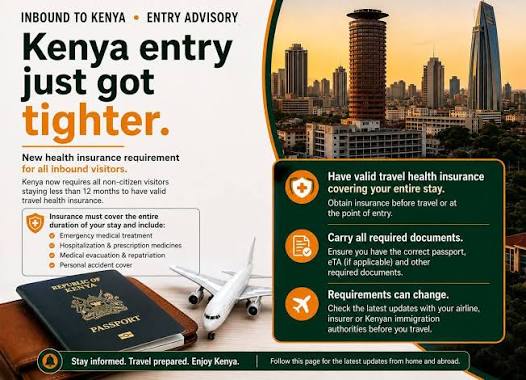
Foreign visitors travelling to Kenya must now prepare for an important new entry requirement: qualifying travel health insurance covering their entire stay in the country.
Understanding the Kenya travel insurance requirements is essential for a smooth entry into the country.
It is crucial to meet the Kenya travel insurance requirements to avoid any entry issues.
The Kenya travel insurance requirements include coverage for various medical situations during your visit.
Familiarize yourself with the Kenya travel insurance requirements to ensure you have adequate coverage.
The new rule applies to non-Kenyan visitors entering Kenya for a period of less than 12 months. This includes most tourists, kenya safari travellers, business visitors and other short-term international visitors.
Meeting the Kenya travel insurance requirements is crucial for non-residents.
Under the newly formalised requirements, visitors must have travel health insurance providing at least US$50,000 in total coverage, together with specific minimum benefits for emergency medical treatment, evacuation and repatriation.
To comply with the Kenya travel insurance requirements, purchase a suitable policy.
The Kenya travel insurance requirements are designed to protect visitors during their stay.
Ensure your policy meets the Kenya travel insurance requirements before your trip.
Understanding the Kenya travel insurance requirements helps in planning your visit.
It is recommended to review the Kenya travel insurance requirements before making any bookings.
This guide explains the new Kenya travel insurance requirements, what your policy should cover and what safari travellers should check before departure.
Important update: The requirements and online verification procedures may continue to evolve. Travellers should check the official Kenya eTA and Ministry of Health websites before purchasing insurance or travelling.
Is travel insurance mandatory for Kenya?
Yes. Kenya has introduced mandatory inbound travel health insurance for non-Kenyan citizens entering and remaining in the country for less than 12 months.
Compliance with the Kenya travel insurance requirements ensures a hassle-free entry experience.
Inquire about the Kenya travel insurance requirements with your insurer.
The requirement is provided for under Kenya’s Social Health Insurance Act and the Social Health Insurance Regulations. The government subsequently established minimum coverage levels for qualifying inbound travel insurance.
The purpose of the requirement is to ensure that international visitors can meet the costs of emergency medical care while they are in Kenya without placing those expenses on the country’s public healthcare system.
How much insurance coverage do visitors need?
A foreign visitor’s travel health insurance must provide at least US$50,000 in overall coverage.
The published framework also establishes minimum benefits for different types of medical care and assistance.
| Type of coverage | Published minimum benefit |
|---|---|
| Emergency medical transportation and evacuation | US$25,000 |
| Emergency medical expenses | US$20,000 |
| Repatriation of mortal remains | US$5,000 |
| Mental-healthcare services | US$1,000 |
| Prescribed medicines and drugs | US$300 |
| Required overall policy coverage | At least US$50,000 |
Travellers should not look only at the headline value of their policy. A policy advertising US$50,000 or more in general medical coverage may still be unsuitable if it excludes medical evacuation, repatriation or other required benefits.
Ask your insurer for written confirmation that the policy meets Kenya’s requirements and covers the entire duration of your visit.
Does the visitor have to pay US$50,000?
No. The US$50,000 figure is the required insurance coverage limit, not the price a visitor must pay for the policy.
The actual premium will depend on factors such as:
- The traveller’s age
- Country of residence
- Length of stay
- Existing medical conditions
- Total coverage selected
- Activities planned during the journey
- Whether cancellation and baggage protection are included
- Whether the journey includes safari, hiking or other outdoor activities
The Kenya travel insurance requirements apply to all visitors, regardless of their travel purpose.
Ensure that your insurance meets the Kenya travel insurance requirements to avoid complications.
Review the Kenya travel insurance requirements and confirm your coverage meets them.
Be aware of the Kenya travel insurance requirements when booking your travel arrangements.
Older travellers and people with pre-existing medical conditions may pay higher premiums or need additional medical screening.
Can visitors use insurance purchased in their home country?
International travel insurance purchased outside Kenya may be accepted, provided the policy meets or exceeds Kenya’s prescribed coverage requirements.
Travellers are therefore not necessarily required to purchase a separate Kenyan policy if they already have suitable international insurance.
However, existing annual policies, credit-card travel benefits and employer-provided plans should be checked carefully. Some policies provide high overall medical coverage but place lower limits on evacuation, repatriation, prescription medication or certain activities.
Before travelling, request an insurance certificate or confirmation letter showing:
- The traveller’s full name
- Policy number
- Validity dates
- Geographical area covered
- Overall medical coverage
- Emergency medical evacuation benefit
- Repatriation benefit
- Emergency-assistance contact details
- Any exclusions affecting safari or outdoor activities
The policy documents should preferably be available in English or accompanied by an English translation.
Will insurance be checked during the Kenya eTA application?
Kenya intends to connect travel insurance verification with its Electronic Travel Authorisation system.
Travellers who require an eTA may be asked to upload proof of qualifying insurance as part of their application before departure. Immigration officials may also verify compliance when the traveller enters Kenya.
At the time this guide was updated, the technical implementation was still developing, and the insurance-upload requirement might not yet appear in every application.
Check the latest updates on the Kenya travel insurance requirements before you travel.
Stay informed about the Kenya travel insurance requirements through official sources.
Travellers should use only the official Kenya eTA website and follow the requirements displayed during their application.
Understanding the Kenya travel insurance requirements can prevent entry issues at the airport.
Always verify the Kenya travel insurance requirements prior to your arrival in Kenya.
Avoid unofficial websites that imitate the government portal or charge unnecessary application fees.
Can insurance be purchased upon arrival in Kenya?
Kenya’s regulatory framework provides for visitors arriving without acceptable coverage to obtain a qualifying policy from an authorised insurer at a designated point of entry.
Nevertheless, relying on this option is not recommended.
Arriving without suitable insurance could cause delays at immigration, limit your choice of policy or create difficulties at airline check-in. Airlines may also request evidence that you meet the entry requirements before allowing you to board.
The safest approach is to arrange compliant travel health insurance before departure and carry both digital and printed copies of the policy certificate.
Does the rule apply to children?
The requirement is directed at non-Kenyan visitors rather than only adult travellers. Families should therefore make sure that every travelling child is properly named and covered by the policy.
A family policy may be acceptable if it clearly identifies all insured travellers and provides the required benefits to each person.
Parents should not assume that a child is automatically covered simply because the parents have purchased insurance.
What insurance is recommended for a Kenya safari?
The legal minimum is only the starting point. Safari travellers should consider more comprehensive protection because many wildlife destinations are located far from major hospitals.
A suitable Kenya safari insurance policy should ideally include:
- Emergency medical treatment
- Medical evacuation by road or air
- Repatriation to the traveller’s home country
- Safari and wildlife-viewing activities
- Domestic flights in light aircraft
- Trip cancellation and interruption
- Delayed or missed connections
- Lost, stolen or delayed baggage
- Personal liability
- 24-hour emergency assistance
- Coverage for pre-existing conditions where applicable
Visitors travelling to the Masai Mara, Samburu, Amboseli, Tsavo or remote conservancies should pay particular attention to emergency evacuation coverage.
Basic urban travel insurance may not provide sufficient assistance if a traveller becomes seriously ill or injured in a remote safari area.
Are safari activities automatically covered?
Not necessarily.
Standard policies may exclude certain activities or impose special conditions. Before purchasing a policy, tell the insurer if your itinerary includes:
- Game drives
- Walking safaris
- Hot-air balloon safaris
- Mountain climbing or high-altitude trekking
- Horse riding
- Cycling
- Boat excursions
- Diving or snorkelling
- Light-aircraft transfers
- Travel to remote conservation areas
A normal vehicle-based game drive is often treated as a standard tourism activity, but policy wording differs between insurers. Written confirmation is safer than relying on assumptions.
Does travel insurance replace emergency evacuation membership?
No. These are related but different services.
Some safari operators provide temporary emergency evacuation membership during the safari. This may help coordinate transport from a remote location to an appropriate medical facility.
However, evacuation membership is generally not the same as comprehensive travel insurance. It may not pay for hospital treatment, international repatriation, trip cancellation, baggage loss or other expenses.
Even when temporary evacuation support is included in a safari package, travellers should still purchase their own comprehensive insurance meeting Kenya’s entry requirements.
Does insurance guarantee free medical treatment?
No. Having insurance does not always mean that a hospital will provide treatment without requesting payment.
Depending on the insurer and medical provider, the traveller may need to pay certain expenses and submit a reimbursement claim later. Other insurers may arrange direct payment with the hospital.
Travellers should keep:
- Medical reports
- Hospital invoices
- Pharmacy receipts
- Police reports where applicable
- Transport receipts
- Communication records with the insurer
Contact the insurer’s emergency-assistance service as soon as reasonably possible when medical attention or evacuation is required.
What documents should visitors carry?
Visitors should travel with:
- A valid passport
- An approved Kenya eTA, unless exempt
- A travel health insurance certificate
- The complete policy wording
- Emergency-assistance telephone numbers
- Return or onward flight details
- Accommodation confirmations
- A copy of the safari itinerary
- Any required vaccination certificates
- Copies of essential prescriptions
Keep electronic copies in your email or secure online storage and carry printed copies in your hand luggage.
Do not place the only copy of your insurance certificate inside checked baggage.
When should visitors purchase their insurance?
Purchase the policy after confirming the principal travel arrangements but before submitting the eTA application if proof of coverage is requested.
Buying insurance early may also provide cancellation protection, depending on the policy. Insurance purchased immediately before departure may cover medical emergencies during the journey but not losses connected with earlier cancellations.
Check that the policy starts no later than your departure date and remains valid until you have completed the entire journey.
If your safari combines Kenya with Tanzania, Uganda, Rwanda or another country, make sure every destination and travel date is covered.
Frequently asked questions
Is travel insurance now required to enter Kenya?
Kenya has formalised a mandatory travel health insurance requirement for non-Kenyan visitors staying for less than 12 months. Travellers should verify the latest implementation details through the official government portals before departure.
What is the minimum insurance coverage for Kenya?
The required overall coverage is at least US$50,000, with specified benefits for emergency medical expenses, medical transportation, evacuation, repatriation, mental-healthcare services and prescribed medication.
Must I buy the insurance from a Kenyan company?
Not necessarily. A policy purchased in your home country may qualify if it meets Kenya’s required coverage levels and remains valid throughout your stay.
Can I use the travel insurance provided by my credit card?
Possibly, but you must confirm that it covers every required benefit. Credit-card policies sometimes have eligibility conditions, limited evacuation benefits or trip-payment requirements.
Do I need insurance before applying for the Kenya eTA?
Proof of insurance is expected to be connected to the eTA verification process. Because the system is still developing, check the official eTA application requirements when applying.
Is medical evacuation included in ordinary travel insurance?
It depends on the policy. Kenya’s requirements include emergency medical transportation and evacuation, but travellers must check the actual benefit limit and exclusions.
Does Nature Bound Africa sell travel insurance?
Nature Bound Africa arranges safari services but does not replace a licensed insurance adviser. We can provide your confirmed itinerary, accommodation information and other supporting travel documents for your insurance or eTA application.
Plan your Kenya safari with Nature Bound Africa
Understanding entry requirements is an important part of preparing for a safe and enjoyable safari.
Nature Bound Africa creates private, tailor-made journeys across Kenya, including the Masai Mara, Amboseli, Samburu, Tsavo, Lake Nakuru, Lake Naivasha and Ol Pejeta Conservancy.
When you book with us, we provide a detailed itinerary and confirmed travel arrangements that can support your insurance and Kenya eTA applications.
Contact our team to start planning a personalised Kenya safari based on your preferred dates, interests and accommodation level.
Plan your Kenya safari with Nature Bound Africa or combine Kenya and Tanzania safari.
Carry proof of your compliance with the Kenya travel insurance requirements during your trip.
Official sources
Entry rules may change. Before travelling, consult:
- Kenya Ministry of Health
- Official Kenya eTA portal
- Kenya Ministry of Health information for incoming travellers
- Kenya Directorate of Immigration Services
For clarity, review the Kenya travel insurance requirements on official government websites.
Adhering to the Kenya travel insurance requirements facilitates a smooth travel experience.