Table of Contents
ToggleKaren Blixen – Out of Africa!
She lost her farm, her health, and the man she loved—all in the same year—then went home and wrote one of the greatest books of the 20th century.
Her name was Karen Blixen. And her life proves that sometimes the most beautiful art comes from the most devastating loss.
The Escape
Copenhagen, 1914.
Karen Dinesen was 29 years old, Danish aristocracy, and suffocating.
She’d been in love with a man named Hans Blixen-Finecke—her second cousin—but he’d rejected her. So she did what desperate people sometimes do: she married his twin brother instead.
Baron Bror von Blixen-Finecke was charming, reckless, and planning to start a coffee farm in British East Africa. Marriage to him wasn’t about love. It was about escape—from Copenhagen’s suffocating social expectations, from the man she couldn’t have, from a life that felt like a cage.
The bargain would cost her almost everything.
And give her the only life she’d ever truly want to live.
The Farm
Kenya, 1914. Still called British East Africa then—a colonial territory where European settlers claimed vast tracts of land that belonged to the Kikuyu, Maasai, and other Indigenous peoples who’d lived there for centuries.
Karen and Bror bought 4,500 acres at the foot of the Ngong Hills, just outside Nairobi. A coffee plantation carved from someone else’s ancestral land—the original sin of colonialism wrapped in the romance of adventure.
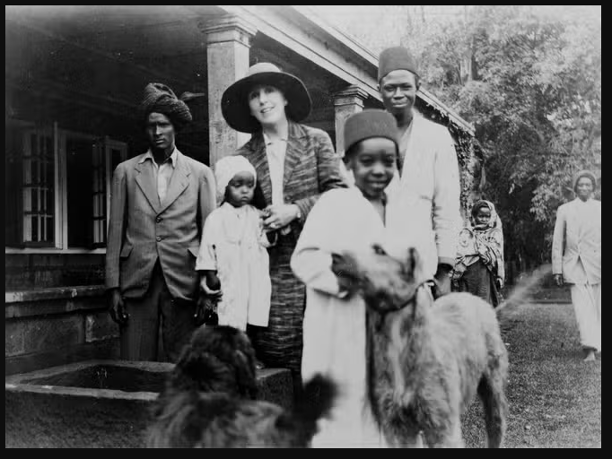
Karen threw herself into the work. She learned Swahili. She managed the farm’s operations while Bror disappeared for weeks on safari expeditions, hunting and philandering his way across East Africa.
She developed relationships with the Kikuyu workers—learning their stories, treating illnesses, navigating the impossible position of being a white woman trying to be fair in a system designed to be unjust.
And then Bror gave her syphilis.
He’d been unfaithful constantly—she’d known that. But the disease, incurable in 1914, was a betrayal that couldn’t be ignored.
Karen returned to Denmark for agonizing treatments with arsenic and mercury that would damage her health for the rest of her life. When she came back to Kenya, the marriage was finished—though they wouldn’t officially divorce until 1921.
Karen was alone on a struggling coffee farm, sick, heartbroken, and thousands of miles from home.
And then she met Denys Finch Hatton.
The Love
Denys was everything Bror wasn’t.
He was Oxford-educated, thoughtful, deeply attuned to Africa in ways that went beyond hunting trophies. He’d rejected conventional English aristocratic life to become a safari guide. He read poetry. He flew airplanes. He loved Mozart and philosophy and the vast silence of the African wilderness.
He and Karen fell into a relationship that defied every convention.
They never married. Denys refused—he valued his freedom too much to be bound, even to someone he loved. He’d disappear for months on safari, then show up unannounced at her farm. He kept his own house in Nairobi but would stay with Karen for weeks, where they’d read Keats aloud, play Mozart on her gramophone, and talk until dawn about everything and nothing.
It was a profoundly modern relationship in 1920s colonial Africa—two people choosing each other without legal or social structures. Karen wanted more. More commitment. More certainty. More of him.
But she loved Denys too much to demand what he couldn’t give.
So she accepted a love that was perfect when he was present and agonizing when he was gone.
Meanwhile, the coffee farm was dying.
The altitude was wrong—the Ngong Hills were too high, the beans couldn’t develop properly. Karen poured money, time, and desperate hope into the farm, borrowing from family, mortgaging her future on land that couldn’t produce.
She was losing everything slowly, watching the place she’d come to love slip through her fingers.
The Collapse
Everything fell apart at once.
The farm went bankrupt. Karen lost it all—the house, the land, the community she’d built over seventeen years. She had to auction off her possessions, say goodbye to Kikuyu workers who’d become family, pack up a life.
And then, on May 14, 1931, Denys died.
He was flying his small plane—he’d learned specifically so he could see Africa from above, understand its vastness from the air—when it crashed near Voi.
He was 44 years old.
Karen buried him in the Ngong Hills with a view of the plains stretching endlessly toward the horizon. The landscape they’d both loved. The only permanence she could give him.
Then she left Africa forever.
She returned to Denmark at 46: broke, sick, heartbroken. She moved into Rungstedlund—her family’s estate where she’d grown up. The place she’d fled seventeen years earlier.
She had no money. No prospects. No clear future.
And she started writing.
The Book
For six years, Karen wrote about Africa.
Not as a memoir exactly—more like an act of reclamation. She couldn’t live there anymore. Couldn’t return to the farm or bring back Denys or recover the version of herself who’d existed in those seventeen years.
But she could write it. Make it permanent in language. Preserve it in prose. Transform loss into literature.
She wrote under the pen name Isak Dinesen—a masculine pseudonym that let her work be judged without bias against female writers.
In 1937, she published Out of Africa.
The book is unlike most memoirs. It’s lyrical, almost dreamlike, structured more like poetry than journalism. Karen didn’t write a comprehensive account—she wrote about moments, textures, the specific quality of light on the savanna, conversations with people she’d loved, the exact way Denys would arrive unannounced after months of silence.
She wrote about the Kikuyu with respect and affection—though modern readers recognize the limitations of her colonial perspective. She genuinely cared for her workers, but she was still a white landowner who’d bought their ancestral land. Her love for Africa was real and complicated—the love of a colonizer who recognized beauty but not the full extent of injustice.
The book opens with seven words that became one of the most famous opening lines in literature:
“I had a farm in Africa, at the foot of the Ngong Hills.”
Past tense. Had, not have. Ownership claimed but lost. A specific place she could name but never return to.
Those seven words contain everything: possession, loss, longing, and the impossible dream of belonging to a place that was never really hers to claim.
The Legacy
Out of Africa became an international bestseller.
Critics recognized it as extraordinary—not just a travel memoir but a meditation on belonging, loss, and the impossibility of truly possessing a place.
Karen Blixen—as Isak Dinesen—became famous. She wrote more books: gothic tales, short stories that blurred reality and myth. She was nominated for the Nobel Prize multiple times. Ernest Hemingway said she deserved it more than he did.
But Out of Africa remained her masterpiece. The book that transformed seventeen years of struggle into something timeless.
The 1985 film with Meryl Streep and Robert Redford brought the story to millions, cementing Karen’s legend. Though the film romanticized what the book held in more complicated tension—the beauty and the colonialism, the love and the loss, the freedom and the devastating cost.
Karen never returned to Africa. She lived at Rungstedlund until her death in 1962—running a bird sanctuary on the grounds, giving occasional interviews where she’d talk about Kenya as if it existed in another dimension. A place she’d lived fully but could only revisit in memory and prose.
What She Taught Us
Here’s what makes Karen Blixen’s story so powerful:
She went to Africa to escape. She stayed seventeen years, built a life, and lost everything—farm, health, love—in a single catastrophic year.
She could have let that destroy her. Could have spent her remaining years bitter about what she’d lost.
Instead, she wrote.
She turned loss into literature. Heartbreak into art. The life she couldn’t keep into the book that made her immortal.
Out of Africa endures because it captures something universal: the experience of loving a place so completely that leaving breaks something fundamental inside you. The ache of building a life somewhere, losing it, and spending the rest of your existence trying to reclaim it through words.
Every person who’s ever left a place they loved—who carries that landscape inside them like a wound that won’t heal—recognizes themselves in Karen’s prose.
Every person who’s transformed pain into creation—who’s written, painted, composed their way through loss—walks a path she cleared.
She proved that the most beautiful art often comes from the most devastating loss. That you can survive losing everything if you can transform it into something that lasts.
1931 to 1962
Karen left Africa in 1931.
She spent the next 31 years trying to write her way back.
She never returned to Kenya. Never saw the Ngong Hills again. Never stood at Denys’s grave overlooking the plains.
But she didn’t need to.
Because in Out of Africa, she built something more permanent than any farm, more lasting than any love affair, more real than memory itself.
She built a place in language. A farm that would never fail. A love that would never crash. A version of Africa that would exist as long as people read her words.
“I had a farm in Africa.”
Past tense. Gone. Irretrievable.
Except in the pages where it lives forever—where the coffee grows, where Denys arrives unannounced, where the light falls just so across the savanna, where loss becomes literature and heartbreak becomes art.
Karen Blixen lost everything in 1931.
And from that loss, she created something that will never die.
Contact us today and our team safari specialists will design your perfect tour to Karen Blixen museum or an African adventure of a lifetime, tailored entirely to your travel style, interests, and schedule.
Speak with our safari experts: +255 784 737 413
Chat with us instantly on WhatsApp: +255 784 737 413
Go where you want. Travel when you want. Experience Africa your way.
The legacy of karen blixen out of africa lives on, affecting literature and art.
Her profound connection with Africa is encapsulated in karen blixen out of africa, a testament to her life.
Each chapter of karen blixen out of africa reveals the beauty and complexity of her story.
The pivotal moments in karen blixen out of africa shaped her identity and legacy.
Readers continue to seek the insights of karen blixen out of africa in their own journeys.
The narrative of karen blixen out of africa is one of transformation and empowerment.
In studying karen blixen out of africa, we find reflections of our own struggles and triumphs.
The richness of karen blixen out of africa unfolds with every reading.
Ultimately, karen blixen out of africa invites us to understand her unique perspective.
The world of karen blixen out of africa reflects a deep connection with the land and its people.
Karen Blixen’s voice in karen blixen out of africa resonates across cultures and time.
Through the stories in karen blixen out of africa, we gain insight into her life’s journey.
Exploring themes in karen blixen out of africa enriches our understanding of human experience.
The impact of karen blixen out of africa transcends literature, influencing art and culture.
In every corner of karen blixen out of africa, there lies a story waiting to be rediscovered.
The journey depicted in karen blixen out of africa serves as a beacon of hope and inspiration.
Understanding the context of karen blixen out of africa reveals the broader narrative of colonialism.
Karen Blixen’s legacy through karen blixen out of africa inspires countless writers and artists.
Each word in karen blixen out of africa carries the weight of her experiences and insights.
The profound lessons in karen blixen out of africa remain relevant in today’s world.
Through karen blixen out of africa, we explore the relationship between humanity and nature.
The emotional depth of karen blixen out of africa captivates readers from all walks of life.
Ultimately, the reflections in karen blixen out of africa remind us of our shared humanity.
Each encounter in karen blixen out of africa opens a window to a different world.
As readers, we are invited into the intimate world of karen blixen out of africa.
The literary journey of karen blixen out of africa continues to captivate new audiences.
As we turn the pages of karen blixen out of africa, we find pieces of ourselves within her story.
The essence of karen blixen out of africa is not just in the story but in the journey of its telling.
Through her prose in karen blixen out of africa, we learn about resilience and identity.
In the echoes of karen blixen out of africa, we hear the voices of those who came before her.
Every element of karen blixen out of africa contributes to its timeless impact on literature.
Ultimately, karen blixen out of africa invites us to reflect on our own life stories.
The legacy of karen blixen out of africa teaches us about courage and the human spirit.
In the end, karen blixen out of africa remains a tribute to the power of storytelling.
As we explore karen blixen out of africa, we discover a world rich with meaning and experience.
Karen Blixen’s journey in “Out of Africa” is a tale of resilience and artistry. The story of karen blixen out of africa continues to inspire generations.
Karen Blixen's Out of Africa Experience
The essence of karen blixen out of africa lies in the intricate details of her experiences and emotions.
Understanding Karen Blixen's Journey in Out of Africa: The Influence of her Life on Literature and the Focus on karen blixen out of africa
Through the lens of karen blixen out of africa, we explore themes of love, loss, and identity.