Menu

Tanzania’s Spice Islands Destination Overview

Tanzania’s Spice Islands Destination Overview

Tanzania’s Spice Islands Destination Overview

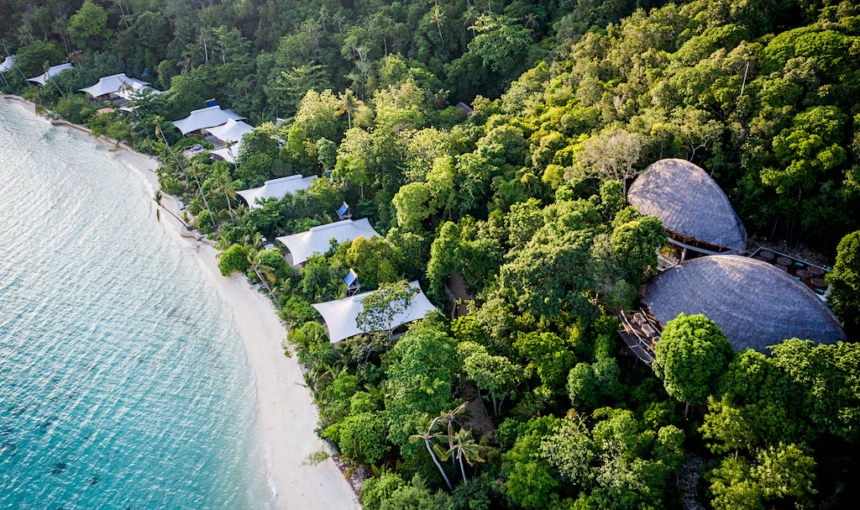
Whether it’s your first or hundredth journey to Africa, few sights rival the elegance of Tanzania’s Spice Islands revealed from above, where sapphire waters embrace soft ivory sands and lush palms. At their heart lies Zanzibar, an island steeped in history and charm. 

Wander Stone Town’s storied lanes, encounter rare red colobus monkeys in Jozani Forest, or sail serene seas rich in marine life. Blending heritage, natural beauty, and spice-laced cuisine, the Tanzanian Spice Isles embody barefoot luxury and timeless allure.

Zanzibar, a stunning Tanzanian archipelago, is a premier Indian Ocean destination known as the “Spice Islands” for producing cloves, nutmeg, and cinnamon. Offering a blend of African, Arab, and Indian cultures, it features historic Stone Town (a UNESCO site), turquoise waters, white-sand beaches, and top-tier snorkeling/diving in Unguja and Pemba.
 
Key Highlights
  • Location: An archipelago off the coast of Tanzania comprising main islands Unguja (Zanzibar) and Pemba, plus smaller islands.
  • Culture: Stone Town offers a rich mix of Arab, Persian, Indian, and European influences, with narrow streets, old forts, and the “House of Wonders”.
  • Spice Tours: Guided tours allow visitors to explore live plantations, smelling and tasting nutmeg, cloves, vanilla, and ginger in their natural environment.
  • Beaches & Marine Life: World-class beaches in northern areas like Nungwi and Kendwa, with vibrant coral reefs suitable for diving, snorkeling, and dolphin spotting.
  • Nature: Jozani Chwaka Bay National Park is home to the rare endemic Red Colobus monkey.
Practical Information
  • When to Visit: The dry season runs from June to August (cooler) and December to February.
  • Activities: Spice farm tours, snorkeling, diving, visiting Forodhani Market for seafood, and sailing on traditional dhow boats.
  • Best Time for Diving: October to February for calm, clear waters and whale sharks near Mafia Island.

Contact us today and our safari specialists will design your perfect African adventure of a lifetime, tailored entirely to your travel style, interests, and schedule.

Speak with our safari experts: +255 784 737 413

Chat with us instantly on WhatsApp: +255 784 737 413

Go where you want. Travel when you want. Experience Africa your way.

Kenya eVisa Everything you Need to Know

Kenya eVisa Everything you Need to Know

Kenya eVisa: Everything you Need to Know

Kenya is a unique African country, famous for its safaris and epic coastline. You can expect to find fantastic wildlife like lions, elephants and giraffes – and many more!

If you’re looking to travel to Kenya, you might be eligible for a Kenya eVisa. The Republic of Kenya has launched a Kenya eVisa system which allows visitors to get a Kenya visa online without visiting the Kenyan authorities.

Read on if you want to find out exactly how to get Kenya eVisa for your next trip to this great country in East Africa.

Can I get a tourist visa on arrival in Kenya?

Since 2021, the visa on arrival in Kenya was discontinued, meaning that all foreign visitors who require a visa to visit Kenya need to apply for it online. Travelers who were previously eligible for a visa on arrival must now get an eVisa.

All visitors must get an eVisa whether they are traveling to Kenya by air, sea, or land.

Who is eligible for a Kenya eVisa?

Residents of any country listed as a Category 2 can apply for a Kenya eVisa online.

Visitors under Category 1 do not require a visa to visit Kenya. This is mainly reserved for some nearby African countries, select South American regions, some Caribbean islands and islands in Australasia, not including Australia or New Zealand.

Category 2 is reserved for visitors that can get a Kenya visa online. This includes African countries not listed under Category 1 and most other countries in North and South America, Europe and Asia. Most countries are eligible to apply for a Kenya eVisa under this Kenyan visa system.

The countries under Category 3 require a referred visa, meaning they’ll need to apply in advance. This includes Afghanistan, Armenia, Iraq, North Korea, Lebanon, Libya and other Middle Eastern countries.

How long does the Kenya eVisa take to process?

They are typically processed 48 hours after application and can be valid for up to 3 months from the date of issue. Therefore, it’s advised not to apply too far ahead for your trip.

If you are worried about processing time, remember to apply at least 1 week before your intended departure date.

What documents do you need for a visa for Kenya?

To submit a successful online application for a Kenya eVisa, you must prepare some documents beforehand.

Travelers wanting to apply for a Kenya eVisa must have:

A scanned coloured copy of their biographical page within their current, valid passport

Passport-style photographs for Kenya, to be attached to the eVisa.

You may be required to show evidence of your accommodation reservations, a Kenya itinerary and a return air ticket for a tourist visa.

For a business visa, you must establish a business invitation or valid company registration letter and return an air ticket.

For a family visa, you may be required to show a letter of invitation from your relative, a passport or other identity documents from your host in Kenya, and a return air ticket. 

Suppose you are traveling from a country where Yellow Fever is a health risk. In that case, you must show your Yellow Fever certificate to border officials upon arrival in Kenya to prove your vaccination status.

You might be required to complete a Kenyan Travelers Health Surveillance form as a result of COVID-19 regulations for air travelers.

Nairobi, the capital city of Kenya

Nairobi, the capital city of Kenya – depositphotos.com

How much does a Kenya eVisa cost?

The average Kenya eVisa cost for a single entry visa is around $51, which includes a $1 service charge and card handling fee. This will allow the visa holder to visit Kenya once.

If you decide to opt for a multiple entry visa, it costs $101 and can be valid for up to 12 months from the date of issue. A 5-year multiple entry visa costs $161.

For a transit visa, the Kenya eVisa cost is $21, which includes a $1 service charge and card handling fee. This is valid for anyone needing to connect to another destination through Kenya for up to 72 hours and does not apply to anyone with a connecting flight who won’t leave the airport.

Kenya also has a joint East African tourist visa, explicitly dedicated to tourists traveling to or from Kenya, Rwanda and Uganda solely for tourism purposes. This unique Kenya eVisa cost is $101, including service charges.

Are you ready to visit Kenya?

If you’re looking for an East African adventure, Kenya better be on your bucket list. With so many incredible attractions in Kenya, including Nairobi, Wasini Island, the many beautiful beaches and, of course the main highlight, the Masai Mara National Reserve, you have many reasons to visit.

Remember to send in your Kenya eVisa application in advance to make the most of your next vacation to Kenya!

Contact us today and our safari specialists will design your perfect African adventure of a lifetime, tailored entirely to your travel style, interests, and schedule.

Speak with our safari experts: +255 784 737 413

Chat with us instantly on WhatsApp: +255 784 737 413

Go where you want. Travel when you want. Experience Africa your way.

Mount Kenya is a fantastic climb any time of the year

Mount Kenya is a fantastic climb any time of the year

Mount Kenya is a fantastic climb any time of the year!

In April and May, you might encounter a longer rainy season, while November brings a shorter one.

If you’re looking for optimal conditions, plan your trip from January to March or June to October. This way, you can avoid the rainy season and enjoy the finest weather and views.

Keep in mind that mountain weather can be unpredictable, so all seasons might make an appearance at any time. But sticking to those prime seasons will give you the most bang for your buck.

Being near the equator, it can get pretty chilly at night and the summit, so make sure to pack warm clothes or a cozy sleeping bag. On the lower and middle slopes, get ready for tropical heat and high humidity.

Dressing for big temperature swings is key for a successful trek!

Weather when climbing Mount Kenya.

Weather when climbing Mount Kenya.

Travel Preparations for Mount Kenya

For your adventure, make sure you have comfy shoes, cozy rain-resistant gear, a cool hat, and gloves.

If you’re tackling those peaks, don’t forget your climbing gear! Bring maps, water, snacks, camping gear, and a trusty compass.

And, of course, pack a first aid kit just in case.

Don’t miss out on capturing the views with a camera and binoculars, and protect yourself from the sun with a sun hat, sunscreen, and stylish sunglasses!

Related read: Trekking Essentials to Carry While Hiking

The view from the top looking out over the endless deserts, savannas, and rainforests totally makes all that hard work worth it in the end.

Plus, come on, how many people can say they’ve seen snow at the equator?

Contact us today and our safari specialists will design your perfect African adventure of a lifetime, tailored entirely to your travel style, interests, and schedule.

Speak with our safari experts: +255 784 737 413

Chat with us instantly on WhatsApp: +255 784 737 413

Go where you want. Travel when you want. Experience Africa your way.

Our Recommendation Sirimon Route

Our Recommendation: Sirimon Route

Our Recommendation: Sirimon Route

Fit adventure trekkers will find the Sirimon Route on Mount Kenya to be a fun and easily accessible trekking route. There is greater scenery than Naromoru, and some of the best walking is available on the dry side of the mountain.

Ascend through the woodland and onto a broad slope to reach the summit location. The route begins close to Nanyuki on the northwest face of the mountain.

The bunkhouse amenities are the greatest on this side of the mountain, and access is sufficient.

Starting from the bottom and hiking your way up, you’ll be treated to a truly diverse landscape. The trail takes you through a mix of deciduous forest, gallery forests, and the lush Afroalpine rainforest at the base of the massif. As you continue, you’ll pass through mountain cloud forests, bamboo groves and unique plant life like giant heaths and coso trees, bogs, and grasslands.

As you ascend, you’ll encounter impressive senzenzias and lobelias before reaching the top with its stunning rock and ice formations. There are 800 plant species in this area, with 81 found nowhere else – a colorful display of rare and tropical nature that’s truly a sight to behold.

If you hang out on the lower slopes among the lush forests and bamboo thickets, you might catch a glimpse of elephants, bushbucks, giant forest hogs, and even buffalo. On the other hand, the Afroalpine heights are home to massive tree heaths, quirky giant senecias and giant lobelias, with rock hyraxes keeping hikers and climbers company.

4 Days Up and Down Sirimon Route

Here’s a breakdown of the four days of trekking to Point Lenana on Mount Kenya.

Day 1: Nairobi / Nanyuki / Old Moses

Departure from Nairobi at 0700 hrs from your hotel and transfer to Nanyuki, arriving after 3 hours. Later transfer to Sirimon gate and hike to Old Moses camp for overnight (3300m), 3 to 4 hour hike (9kms).
Old Moses camp is where you acclimatize as you also come across different vegetation.

Old Moses Camp is not just a resting spot; it’s where the magic of acclimatization begins.

As you traverse through various vegetation zones, from lush forests to open moorlands, keep an eye out for unique flora and fauna. This initial leg of the journey acquaints trekkers with the diverse ecosystems that characterize Mount Kenya.

Time hiking: 3-4 hours

Day 2: Old Moses – Shiptons

After a hearty breakfast, you’ll embark on a scenic hike to Shipton’s Camp, situated at an elevation of 4200 meters. The trail meanders through Liki and Makinders valleys, treating trekkers to breathtaking vistas of rugged landscapes and towering peaks. This portion of the journey typically spans 6 to 8 hours, covering a distance that varies based on the pace and stops along the way.

Shipton’s Camp serves as a high-altitude base for trekkers, offering essential amenities amidst the raw beauty of Mount Kenya.

Keep your camera handy to capture glimpses of wildlife, such as rock hyraxes, duikers, and various bird species that inhabit these high-altitude regions.

Time hiking: 6-8 hours

Day 3: Shipton Camp / Point Lenana / Judmaier Camp (Old Moses Camp)

This is the pinnacle of your Mount Kenya adventure as you set out for the summit bid in the early morning hours. Departing from Shipton’s Camp at 3 am, the ascent begins with a challenging climb up a steep stony quarry, which eventually leads to Lower Hall Tarns.

The trail offers awe-inspiring views as you ascend towards Point Lenana, Mount Kenya’s third-highest peak, standing at approximately 4985 meters above sea level.

Reaching Point Lenana around sunrise rewards trekkers with a spectacular panorama of the surrounding peaks and the vast expanse below. After soaking in the majestic sunrise, the descent back to Shipton’s Camp takes around 2 hours, where a well-deserved breakfast awaits.

The journey continues as you descend further to Old Moses Camp, retracing your steps through familiar terrain for approximately 4 hours.

Hiking time: 4 hours

Day 4: Judamaier Camp (Old Moses) / Sirimon / Nairobi

On the final day of your trek, after a satisfying breakfast, you’ll bid farewell to the mountain and begin the descent through the lush rainforest. The trail winds its way down for about 2 hours, offering trekkers a chance to reflect on their journey amidst the tranquility of the forest.

As you emerge from the dense vegetation, you’ll reunite with your transport vehicle, marking the end of your Mount Kenya adventure.

The return journey to Nairobi is filled with memories of exhilarating challenges, breathtaking landscapes, and the camaraderie forged during the trek.

Hiking time: 2-3 hours

Contact us today and our safari specialists will design your perfect African adventure of a lifetime, tailored entirely to your travel style, interests, and schedule.

Speak with our safari experts: +255 784 737 413

Chat with us instantly on WhatsApp: +255 784 737 413

Go where you want. Travel when you want. Experience Africa your way.

Mount Kenya Trekking Routes

Mount Kenya Naro-Moru Route

Mount Kenya Naro-Moru Route

This route is the quickest way to reach Point Lenana. It starts from Naro-Moru Gate, passes through Meteorological Station, Mackinder’s Camp, and finally reaches Point Lenana.

This route was one of the most popular choices because it’s short and has convenient huts at Met Station (3050m) and MacKinders (4200m). The forest along this route is still lush, with a dense bamboo zone. Many climbers typically start at the park gate, but driving up to the Met Station (3050 meters) is possible.

The trek along Naro Moru offers a unique experience, leading you through a vertical bog into the expansive Teleki Valley below the Lewis Glacier. In the Teleki Valley, you’ll encounter iconic Tree and Cabbage Groundsels and Lobelia Telekii and Deckenii.

Sirimon Route

The route is usually considered one of the easier ones, as it climbs gradually with just a few steeper sections to reach the top camp. It’s currently the most popular route but not overly crowded.

Begin your adventure from Nanyuki and head to Sirimon Gate, then make your way through Old Moses Camp, Shipton’s Camp, and finally reach Point Lenana.

The forest is sparse along this route, and the bamboo zone isn’t very prominent. Most of the second day is spent in the alpine heath and moorland. When you cross the ridge into the MacKinder Valley, you’ll have a great viewpoint if the weather is clear. The approach to the peaks along the classic U-shaped MacKinder Valley can be stunning in good weather. The MacKinder Valley is home to many giant Lobelia and Groundsel, the classic flora of Mt. Kenya. You will also likely spot Rock Hyrax at Shipton’s cave or hut.

This is also the route that we recommend in more detail below.

Chogoria Route

For a scenic journey, start at Chogoria and pass through Chogoria Gate, Minto’s Hut, and make your way to Point Lenana.

The Chogoria route on Mount Kenya is often hailed as the most beautiful route to take. While there isn’t a high camp hut along the way, the journey can be made shorter by using 4×4 vehicles to skip the lower section. It’s common practice to drive 4x4s through the forest until you reach the Meru Bandas at 3000m.

Just past the junction near “The Temple” at 4300m, you’ll find an old, somewhat shaky hut where porters usually spend the night, while clients have to set up camp.

What sets this route apart is its stunning physical landscape. Unlike other routes that follow a U-shaped glacial valley, the Chogoria winds around the impressive ‘Temple’ with Hall Tarns above it and Lake Michaelson at the base of the amphitheater. Additional highlights like Lake Ellis, the Giant’s Billiard Table, and the Nithi Falls make this route even more captivating.

Many climbers choose to descend via the Chogoria after ascending other routes.

Burguret Route

Don’t forget about the Burguret Route (known for its ruggedness and less-traveled paths).

The Burguret route may not be as popular due to its challenging navigation and lack of amenities. However, the rugged, undeveloped nature of the trail and the possibility of having it all to yourself can be a draw for some adventurers.

Unlike other routes, Burguret doesn’t have a clearly marked path or any facilities like huts. You’ll need to arrange with the rangers in advance and make payments at a different gate since there’s no Park Gate on this route.

Navigating through the bamboo forest in the lower section might require some guidance from the guides, especially if there haven’t been recent hikers. The route can vary until you reach the first camping spot at Kampi Ya Machengeni (3000m) in the moorlands.

The next stretch is more open and easier to navigate, but you’ll still need to carve out your own path rather than follow a set trail.

Timau Route

The Timau Route, located on the north side, is also rarely traveled.

It used to be a popular route for driving up in a 4×4, as it winds its way through the milder northern slopes before getting steeper at around 4200m.

From there, it descends sharply into and across the Hinde Valley and the Nithi North River before ascending to meet the Chogoria Route at Hall Tarns.

The route’s conditions vary, but vehicles typically don’t exceed around 3400m.

While it’s still technically possible to climb via this route, it’s recommended to consult with the Rangers for current conditions.

Contact us today and our safari specialists will design your perfect African adventure of a lifetime, tailored entirely to your travel style, interests, and schedule.

Speak with our safari experts: +255 784 737 413

Chat with us instantly on WhatsApp: +255 784 737 413

Go where you want. Travel when you want. Experience Africa your way.
💬